
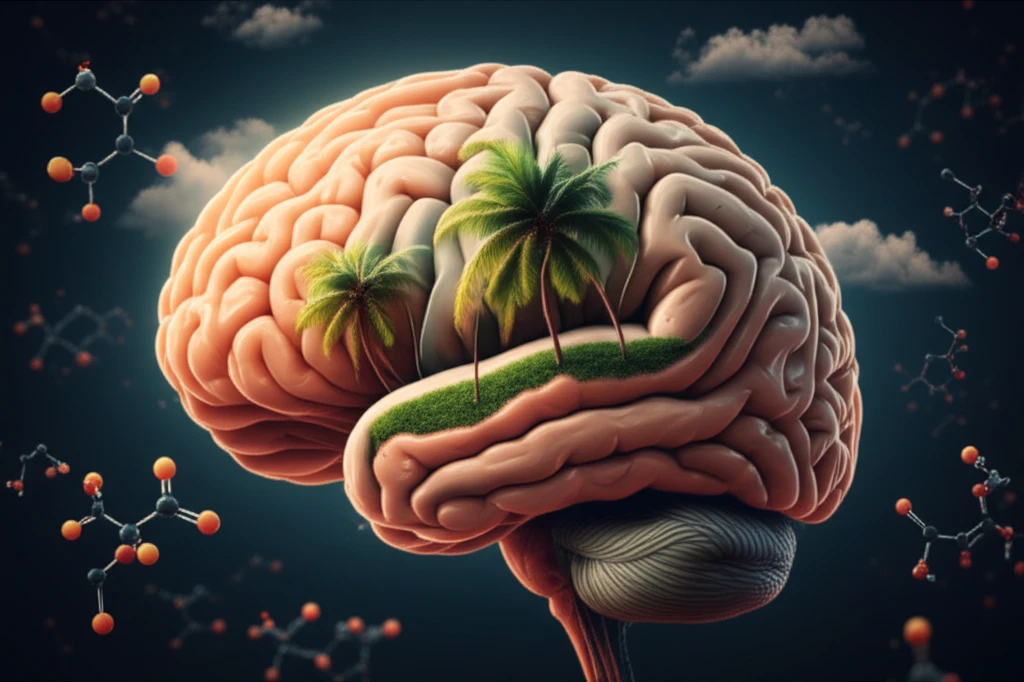
Illustration of a brain landscape with palm trees, symbolizing brain health and the protective effects of palm fruit bioactives.

Palm Fruit Power: Can Bioactives From Nature's Bounty Protect Your Brain?

"Discover how compounds found in palm fruit are making waves in neuroscience, potentially offering a natural defense against neurodegenerative diseases."


In a world grappling with an aging population, the specter of neurodegenerative diseases like Alzheimer's and Parkinson's looms large. These conditions, often marked by inflammation in the brain, pose a significant challenge to our health and well-being. But what if nature held a key to unlocking new ways to protect our brains? Recent studies are turning to an unexpected source: palm fruit bioactives. These naturally occurring compounds are showing promise in modulating brain inflammation, potentially offering a new avenue for prevention and treatment.

This research delves into the fascinating world of palm fruit bioactives (PFB) and their effects on human astrocytes—the star-shaped cells in the brain that play a critical role in inflammation. By examining how PFB influences the behavior of these cells, scientists are gaining valuable insights into the potential of these compounds to combat neurodegenerative diseases.

This article will explore the compelling evidence supporting the use of PFB, exploring the scientific findings and the implications for brain health. By understanding the power of nature, we may be one step closer to protecting our most precious asset: our minds.

Unveiling the Science: How Palm Fruit Bioactives Work

Illustration of a brain landscape with palm trees, symbolizing brain health and the protective effects of palm fruit bioactives.

The core of this research lies in understanding how PFB interacts with human astrocytes. When the brain faces injury or disease, astrocytes become 'activated,' a process that triggers inflammation. This activation leads to the release of cytokines and chemokines—signaling molecules that fuel the inflammatory response. The study focused on what happens when IL-1β, a key player in inflammation, activates these cells, and then exposes them to PFB. The results are revealing:

The researchers found that PFB significantly reduces the production of several key inflammatory molecules, including TNFα, RANTES, and IP-10. TNFα, or Tumor Necrosis Factor alpha, is a well-known inflammatory molecule. RANTES (regulated on activation, normal T cell expressed and secreted), and IP-10 (interferon gamma-induced protein 10) also play roles in the inflammatory cascade. PFB's ability to reduce these molecules suggests a powerful anti-inflammatory effect. Additionally, PFB was found to diminish the production of reactive oxygen species (ROS), which can cause cellular damage, and to reduce the expression of ICAM and VCAM, molecules involved in cell adhesion, further dampening the inflammatory response.

  • Reduced Inflammation: PFB significantly decreases the levels of key inflammatory molecules like TNFα, RANTES, and IP-10.
  • Antioxidant Effects: PFB reduces the production of reactive oxygen species (ROS), protecting cells from damage.
  • Cellular Modulation: PFB reduces the expression of cell adhesion molecules (ICAM and VCAM), potentially preventing the spread of inflammation.
These findings suggest that PFB could be a valuable tool in reducing neuroinflammation, which is a key factor in neurodegenerative diseases. The study's focus on astrocytes is particularly relevant, as these cells play a central role in the brain's inflammatory response. By modulating astrocyte activity, PFB could potentially offer a way to protect against the damage associated with these devastating conditions.

Looking Ahead: The Future of Palm Fruit Bioactives

The research into palm fruit bioactives opens up exciting possibilities for the future of brain health. With its potential to reduce inflammation and protect brain cells, PFB could be a valuable tool in the fight against neurodegenerative diseases. Further studies are needed to explore the optimal dosages, long-term effects, and potential benefits for specific conditions. As scientists continue to unravel the mysteries of the brain, the promise of natural compounds like PFB offers a beacon of hope for a healthier future.

About this Article -

This article was crafted using a human-AI hybrid and collaborative approach. AI assisted our team with initial drafting, research insights, identifying key questions, and image generation. Our human editors guided topic selection, defined the angle, structured the content, ensured factual accuracy and relevance, refined the tone, and conducted thorough editing to deliver helpful, high-quality information.See our About page for more information.

Everything You Need To Know

1

How do palm fruit bioactives (PFB) potentially protect the brain from neurodegenerative diseases?

Palm fruit bioactives (PFB) show promise by modulating brain inflammation, a key factor in neurodegenerative diseases like Alzheimer's and Parkinson's. Research indicates that PFB can reduce the production of inflammatory molecules and reactive oxygen species (ROS), and diminish the expression of cell adhesion molecules (ICAM and VCAM). By influencing the behavior of human astrocytes, PFB offers a potential avenue for both preventing and treating these conditions. While promising, further research is needed to fully understand the optimal dosages, long-term effects, and specific benefits of PFB for various neurodegenerative diseases.

2

What role do human astrocytes play in brain inflammation, and how do palm fruit bioactives (PFB) affect them?

Human astrocytes, star-shaped cells in the brain, play a critical role in inflammation. When the brain faces injury or disease, these astrocytes become activated, triggering inflammation and releasing cytokines and chemokines. Palm fruit bioactives (PFB) have been shown to modulate this astrocyte activity. Specifically, PFB reduces the production of key inflammatory molecules like TNFα, RANTES, and IP-10, effectively dampening the inflammatory response initiated by astrocytes. By modulating astrocyte activity, PFB could potentially protect against the damage associated with neurodegenerative diseases.

3

What are TNFα, RANTES, and IP-10, and how does the reduction of these molecules by palm fruit bioactives (PFB) impact brain health?

TNFα (Tumor Necrosis Factor alpha), RANTES (regulated on activation, normal T cell expressed and secreted), and IP-10 (interferon gamma-induced protein 10) are key inflammatory molecules involved in the inflammatory cascade within the brain. TNFα is a well-known inflammatory molecule, while RANTES and IP-10 also contribute to the inflammatory response. Palm fruit bioactives (PFB) have demonstrated the ability to significantly reduce the production of these molecules. By reducing these inflammatory signals, PFB can help to diminish neuroinflammation, a key factor in neurodegenerative diseases, potentially protecting brain cells from damage.

4

Besides reducing inflammation, what other mechanisms do palm fruit bioactives (PFB) employ to protect brain cells?

In addition to reducing inflammation by decreasing levels of TNFα, RANTES, and IP-10, palm fruit bioactives (PFB) offer further protection to brain cells through multiple mechanisms. PFB reduces the production of reactive oxygen species (ROS), which can cause cellular damage. Furthermore, PFB diminishes the expression of cell adhesion molecules (ICAM and VCAM), which are involved in cell adhesion, potentially preventing the spread of inflammation within the brain. This multifaceted approach suggests PFB could be a valuable tool in combating neurodegenerative diseases.

5

What are the potential future implications of research on palm fruit bioactives (PFB) for treating neurodegenerative diseases?

Research into palm fruit bioactives (PFB) opens up promising possibilities for future treatments of neurodegenerative diseases. Its ability to reduce inflammation, diminish the production of ROS and modulate astrocyte activity positions PFB as a valuable candidate in the fight against these conditions. Future studies could explore optimal dosages, long-term effects, and potential benefits for specific diseases like Alzheimer's and Parkinson's. While it holds great promise, it's important to note that further investigation is needed before PFB can be implemented as a widespread treatment.

Newsletter Subscribe

Subscribe to get the latest articles and insights directly in your inbox.