
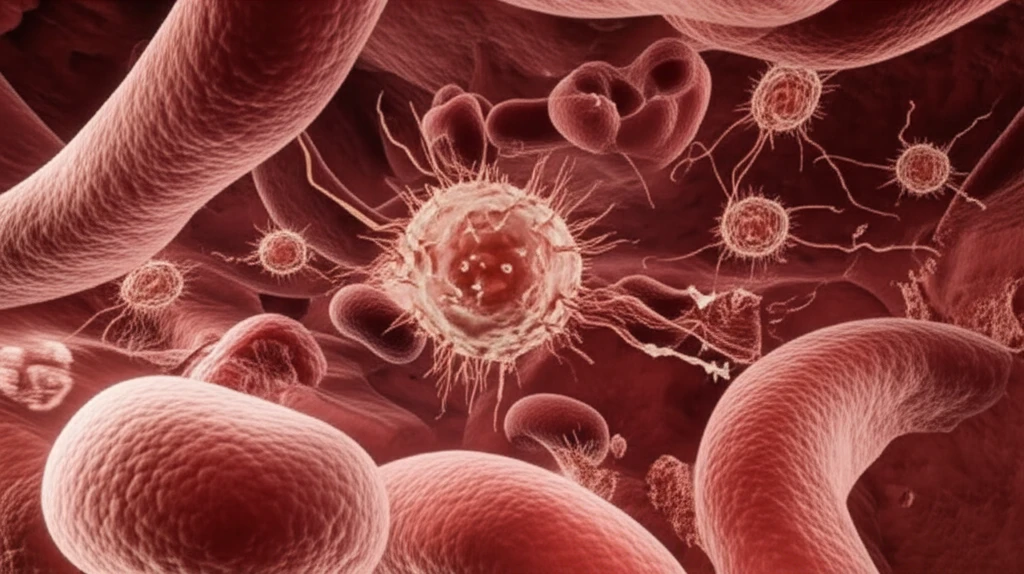
Surreal illustration of macrophage cells attacking lung cells, representing osteosarcoma metastasis.

Osteosarcoma's Silent Enabler: How Macrophages Fuel Lung Metastasis

"New research unveils the critical role of tumor-associated macrophages (TAMs) in promoting osteosarcoma's spread to the lungs, offering potential new targets for treatment."


Osteosarcoma (OS), a malignant bone tumor primarily affecting young individuals, poses a significant challenge due to its tendency to metastasize, particularly to the lungs. While advancements in chemotherapy have improved survival rates, metastasis remains a major obstacle, underscoring the urgent need for novel therapeutic strategies.

A growing body of evidence highlights the crucial role of the tumor microenvironment in cancer progression. Tumor-associated macrophages (TAMs), key players in this environment, are now recognized for their complex involvement in various aspects of tumor biology, including the promotion of metastasis.

Recent research sheds light on how TAMs contribute to osteosarcoma metastasis. The study uncovers the mechanism through which TAMs promote lung metastasis and epithelial-mesenchymal transition (EMT) in osteosarcoma cells, identifying potential targets for future anti-metastatic therapies.

Unmasking the Macrophage-Metastasis Connection in Osteosarcoma

Surreal illustration of macrophage cells attacking lung cells, representing osteosarcoma metastasis.

The research team's investigation into osteosarcoma metastasis revealed a significant correlation between TAM infiltration and COX-2 expression in osteosarcoma tissues. Analysis of primary tumors and corresponding lung metastases demonstrated that TAMs were more abundant in lung metastases, where COX-2 expression was also markedly elevated. This finding suggests a link between TAMs, COX-2, and the spread of osteosarcoma cells to the lungs.

To further elucidate the mechanisms involved, the researchers conducted in vitro experiments co-culturing osteosarcoma cells with macrophages. They observed that TAMs promoted the migration and invasion of osteosarcoma cells. This effect was mediated by increased expression of COX-2 and downstream signaling molecules, leading to the induction of EMT, a process that enables cancer cells to become more mobile and invasive.

  • TAMs Increase Migration and Invasion: Both THP-1- and PBMC-derived macrophages significantly enhanced the migration of MG63 and KHOS osteosarcoma cells in vitro.
  • M0 and M2 Macrophages Have Stronger Effects: THP-1-derived M0 and M2 macrophages more effectively promoted cell migration compared to M1 macrophages.
  • EMT Induction: Macrophage-conditioned medium induced changes in EMT markers, downregulating E-cadherin and upregulating N-cadherin and vimentin.
  • Upregulation of EMT-TFs: Expression levels of EMT-activating transcription factors like ZEB-1 and SNAIL were significantly increased in the co-cultured groups.
The researchers also investigated the effects of inhibiting COX-2, using both a specific siRNA and the COX-2 inhibitor celecoxib. Blocking COX-2 reversed the TAM-induced migration and invasion of osteosarcoma cells. This inhibition also led to reduced phosphorylation of STAT3, a key signaling molecule involved in cell growth and survival, and downregulation of EMT-related transcription factors and MMP9, an enzyme involved in the breakdown of the extracellular matrix.

A Promising Path Forward: Targeting TAMs and COX-2 in Osteosarcoma

These findings underscore the critical role of TAMs and COX-2 in promoting osteosarcoma metastasis. By activating the COX-2/STAT3 axis, TAMs enhance the ability of osteosarcoma cells to invade and migrate to the lungs.

The study suggests that targeting TAMs and COX-2 could be a promising therapeutic strategy to prevent or reduce lung metastasis in osteosarcoma patients. Further research is warranted to explore the potential of COX-2 inhibitors, TAM-targeting agents, and combination therapies to improve outcomes for individuals with this aggressive cancer.

Ongoing investigation of precise TAM signaling pathways and interactions within the tumor microenvironment are essential for designing future anti-metastatic interventions. Clinical studies assessing efficacy of these new targets should be performed.

About this Article -

This article was crafted using a human-AI hybrid and collaborative approach. AI assisted our team with initial drafting, research insights, identifying key questions, and image generation. Our human editors guided topic selection, defined the angle, structured the content, ensured factual accuracy and relevance, refined the tone, and conducted thorough editing to deliver helpful, high-quality information.See our About page for more information.

This article is based on research published under:

DOI-LINK: 10.1016/j.canlet.2018.10.011, Alternate LINK

Title: Tumor-Associated Macrophages Promote Lung Metastasis And Induce Epithelial-Mesenchymal Transition In Osteosarcoma By Activating The Cox-2/Stat3 Axis

Subject: Cancer Research

Journal: Cancer Letters

Publisher: Elsevier BV

Authors: Yu Han, Wei Guo, Tingting Ren, Yi Huang, Shidong Wang, Kuisheng Liu, Bingxin Zheng, Kang Yang, Hongliang Zhang, Xin Liang

Published: 2019-01-01

Everything You Need To Know

1

What is osteosarcoma and why is it a significant concern?

Osteosarcoma is a malignant bone tumor that predominantly affects young people. It is a significant clinical challenge because of its propensity to metastasize, especially to the lungs. Metastasis, the spread of cancer cells from the primary tumor to other parts of the body, is a major factor in treatment failure and reduced survival rates. This makes understanding and targeting the mechanisms of metastasis critical for improving outcomes.

2

What role do tumor-associated macrophages (TAMs) play in osteosarcoma?

Tumor-associated macrophages (TAMs) are immune cells present within the tumor microenvironment. These cells play a complex role in cancer progression. The current research highlights that TAMs promote the spread of osteosarcoma to the lungs. They do this by activating the COX-2/STAT3 axis, which in turn enhances the ability of osteosarcoma cells to invade and migrate. This process underscores the importance of the tumor microenvironment in cancer development and spread.

3

How does the COX-2/STAT3 axis relate to osteosarcoma metastasis?

The COX-2/STAT3 axis is a signaling pathway activated by TAMs. When TAMs are present, they trigger the expression of COX-2. Elevated COX-2 levels then lead to the activation of STAT3. This cascade of events promotes the epithelial-mesenchymal transition (EMT) in osteosarcoma cells. EMT makes cancer cells more mobile and invasive, enabling them to metastasize. Inhibiting COX-2 has been shown to reverse the effects of TAMs, reducing cell migration and invasion.

4

What are the potential implications of these findings for treating osteosarcoma?

The findings suggest that targeting TAMs and COX-2 could offer new ways to treat osteosarcoma. Researchers observed that inhibiting COX-2 using celecoxib and siRNA could reverse the effects of TAMs. This inhibition reduced cell migration and invasion, along with a decrease in STAT3 activation and downregulation of EMT-related transcription factors. This indicates that drugs that interfere with this pathway could potentially slow or stop the spread of the cancer to the lungs, thus improving patient outcomes.

5

What is epithelial-mesenchymal transition (EMT) and how is it related to the spread of this cancer?

Epithelial-mesenchymal transition (EMT) is a cellular process where cancer cells lose their epithelial characteristics and gain mesenchymal traits, making them more mobile and invasive. TAMs promote EMT in osteosarcoma cells by activating the COX-2/STAT3 axis, which increases the expression of EMT-related transcription factors and the ability of the cells to invade and migrate. Inhibiting the COX-2/STAT3 axis can reverse EMT, potentially reducing the metastatic potential of osteosarcoma cells.

Newsletter Subscribe

Subscribe to get the latest articles and insights directly in your inbox.