
Navigate with Confidence: How Augmented Reality is Revolutionizing Wheelchair Accessibility

"Discover the innovative technology using mobile augmented reality to enhance indoor navigation for wheelchair users, making everyday environments more accessible and independent."
For individuals with lower limb disabilities, simple tasks and navigating different environments can present significant hurdles. Wheelchairs often provide essential mobility and promote social inclusion, yet they don't eliminate the challenges of navigating complex indoor spaces. Imagine the frustration of trying to find the accessible restroom in a sprawling hospital or navigating a crowded shopping mall.
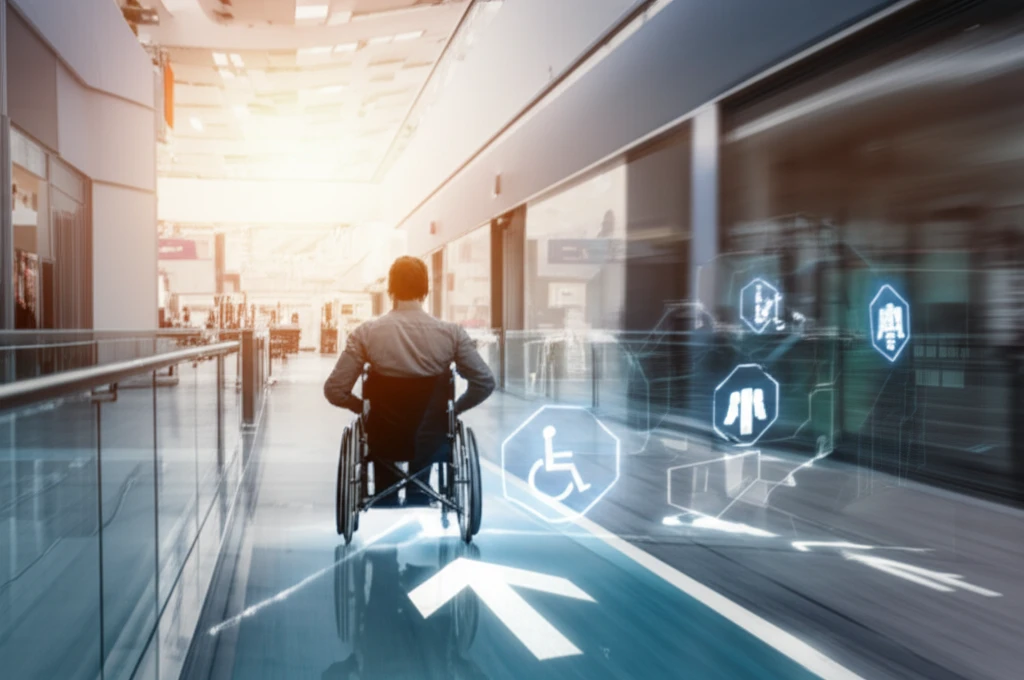
Assistive technology is key to unlocking greater independence and improving the quality of life for people with mobility impairments. One promising avenue of innovation involves mobile augmented reality (AR). AR overlays digital information onto the real world, offering the potential to create intuitive and accessible navigation systems. This technology can guide wheelchair users through indoor spaces, providing real-time assistance and customized routes.
This article delves into the use of mobile AR to develop indoor navigation systems tailored for wheelchair users. We'll explore the challenges, the proposed solutions, and the potential benefits of this technology, examining how it can record building layouts, address accessibility issues, and provide a more seamless and confident navigation experience.
Market Growth and Early Prototypes
The Global Wheelchair AR Navigation-Display market was valued at $325 million in 2024 and is projected to reach $1.24 billion by 2033, representing a reported CAGR of 16.2% from 2025 to 2033. Research has also documented a prototype wheelchair navigation system developed for the University of Lille campus, combining augmented reality with short-path guidance and smart glasses. Another 2022 study proposed a robotic-arm asynchronous control system using steady-state visual evoked potentials in an augmented-reality environment.
Mobile AR and Simulated Training
Published work identifies Mobile Augmented Reality as an approach for indoor wheelchair navigation and proposes five main functional requirements, including indoor guidance and system registration and configuration. A separate augmented-reality serious game supports people with motor disabilities while they control robotic wheelchairs, using a racing track containing restriction areas and static and dynamic elements. These sources indicate that current methods combine registered mobile overlays with simulated environments, while their effectiveness depends on accurate configuration and the system's ability to represent changing surroundings.
From Overlays to Spatial Computing
Accounts of augmented reality's history describe a progression from early display experiments and visual overlays to mobile AR, wearable devices, smart glasses, and enterprise spatial computing. Other historical reviews frame this development across roughly the last 50 years, from early head-mounted displays to mobile applications and spatial computing. This trajectory places wheelchair navigation within a broader evolution from experimental display systems toward portable and context-aware interfaces.
What Makes Indoor Navigation So Challenging for Wheelchair Users?
While outdoor navigation systems have become commonplace, indoor navigation presents unique difficulties. GPS signals, which are the foundation of most outdoor systems, often weaken or become unreliable inside buildings. This lack of precision makes it difficult to accurately pinpoint a user's location and provide effective guidance. Furthermore, indoor environments are filled with obstacles and variations that are not accounted for in standard GPS data.
- Lack of precise indoor positioning: GPS signals are often unreliable indoors.
- Complex environments: Indoor spaces have many obstacles that standard navigation systems don't account for.
- Accessibility barriers: Stairs, narrow doorways, and a lack of ramps can create significant challenges.
- Need for customized routes: Wheelchair users require routes that consider their specific needs and limitations.
Markers, Feedback, and Navigation Reviews
A 2023 navigation method for robotic wheelchairs uses both the patterns and configurations of augmented-reality markers, including their position and orientation, to support self-location and destination navigation. A 2024 review proposes Augmented Reality-enhanced Immediate Visual Feedback learning modules for wheelchair skills such as wheelies and curb negotiation among people with spinal cord injury and other disabilities. A 2025 systematic review examines developments in wheelchair navigation-assistance systems over the previous five years.
Wayfinding Benefits and Reliability Gaps
A systematic review of AR wayfinding research analyzed 88 salient studies and describes AR as a way to provide navigational assistance while preserving awareness of real-world surroundings. However, the existence of a large research literature does not by itself establish consistent performance across environments. A separate navigation system relies on smartphone motion estimation in 3D space, image processing, and artificial intelligence to support autonomous mobility, illustrating the technical dependence on accurate sensing and computer vision.
Different AR Navigation Approaches
Comparative research describes augmented reality as usable for navigation maps and visualizing both the current environment and the environment planned for a journey. It also emphasizes that AR technology relies on different methodological approaches rather than one uniform implementation. For wheelchair accessibility, this means systems may differ in how they represent routes, display environmental information, and connect digital guidance with the user's surroundings.
The Future of Accessible Navigation
Mobile AR technology holds immense promise for revolutionizing indoor navigation for wheelchair users. By addressing the limitations of existing systems and incorporating user-specific needs, AR-based navigation can empower individuals with mobility impairments to navigate indoor spaces with greater confidence and independence. As AR technology continues to evolve, we can anticipate even more sophisticated and user-friendly navigation solutions that promote accessibility and inclusion for all.
A Promising but Developing Tool
Augmented reality appears to offer a practical way to connect navigation information with a wheelchair user's immediate surroundings. Its strongest potential lies in making route guidance and environmental information easier to interpret during movement. Because implementations and environments vary, AR should be treated as a developing accessibility tool whose value depends on thoughtful design, testing, and user needs.
Wearables, Routes, and Gesture Control
Future wheelchair systems may use AR-enabled glasses or head-up displays to provide real-time navigation assistance, highlight accessible routes, identify obstacles, and show points of interest. One market report projects a 15.5% CAGR for the global AR navigation market from 2025 to 2035, although this is a market forecast rather than a guaranteed outcome. Research on gesture-based smart wheelchairs is also identifying technological developments, research gaps, and future directions, including work relevant to low-resource environments such as Bangladesh.
Accessibility Beyond the Interface
AR navigation is unlikely to solve wheelchair accessibility on its own. Its usefulness will depend on how reliably systems represent real environments and how well their guidance fits the varied needs of wheelchair users. Broader progress therefore requires attention to physical access, dependable information, inclusive design, and equitable availability alongside technological development.
Campus Navigation in Practice
A real-time wheelchair navigation system developed for the University of Lille campus used geological mapping to indicate an access path to a desired location, identify the shortest route, and identify obstacles to avoid. This design places the user's practical journey at the center of the system rather than treating navigation as a purely abstract mapping task. The prototype demonstrates how AR-supported guidance could help users interpret routes and hazards while moving through a real campus environment.