
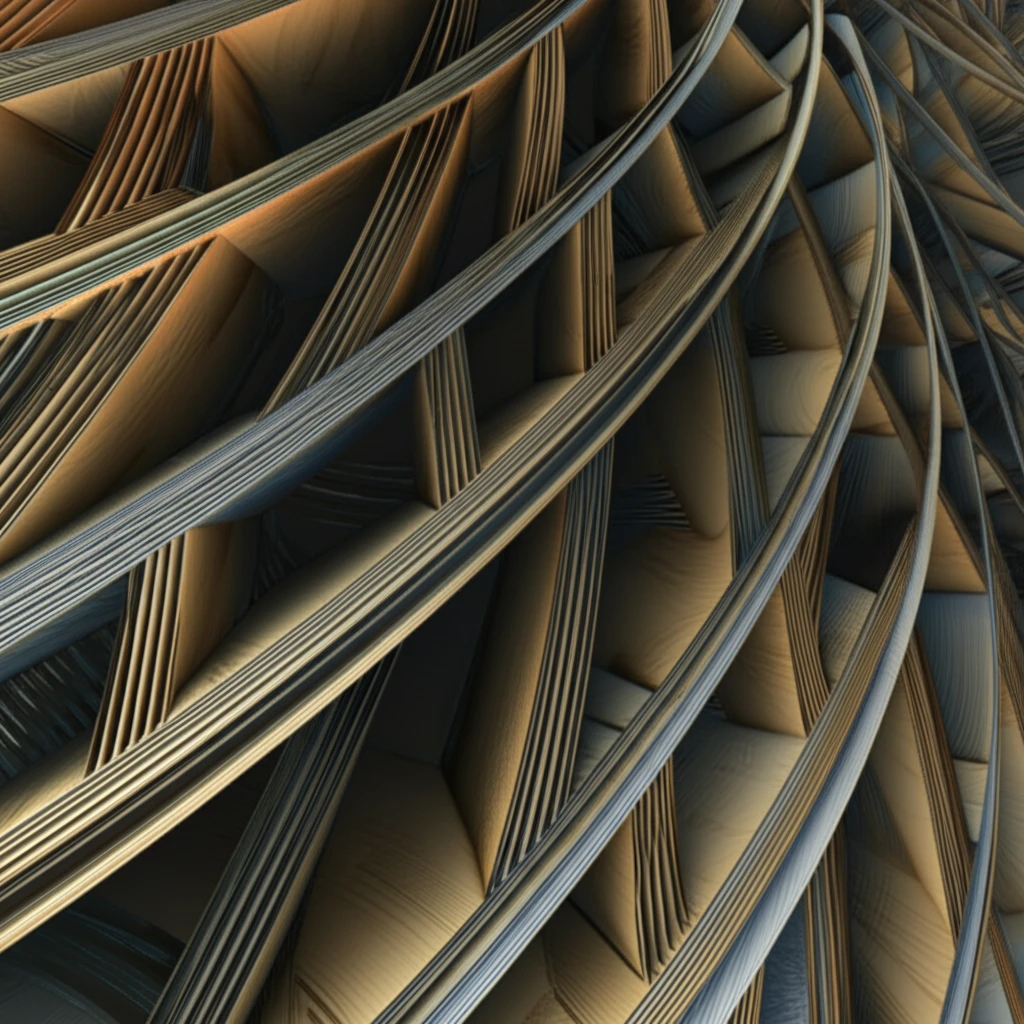
Bio-inspired metallic lattice, mimicking wood structure

Nature's Blueprint: Engineering Stronger Materials Inspired by Wood

"Unlocking the secrets of wood's micro-structure to create tougher, bio-inspired materials for advanced engineering applications."


In the quest for stronger, lighter, and more resilient materials, engineers are increasingly turning to nature for inspiration. Metallic foams and cellular materials have long been prized for their unique combination of properties, including low density, high stiffness, and energy absorption capabilities. These materials find applications across various sectors, from automotive and aerospace to biomedical engineering.

However, inherent variability in microstructure has limited the use of these materials for structural purposes. Recent advancements in additive manufacturing (AM) technologies are changing the landscape, enabling the creation of optimized lattice materials with precisely controlled architectures. This has led to the concept of 'architectured materials,' where design focuses on filling the gaps in material performance by manipulating micro-topology and morphology.

Nature has consistently utilized lattice materials to solve complex structural and functional problems, providing a wealth of inspiration for material scientists. This article explores how researchers are drawing inspiration from the micro-architecture of wood – specifically, its cellular structure and density variations – to engineer metallic lattices with enhanced fracture resistance and energy absorption.

Why Wood? Unpacking Nature's Design Secrets

Bio-inspired metallic lattice, mimicking wood structure

Wood, a quintessential natural material, has served humanity for millennia due to its exceptional properties. Its high stiffness-to-weight ratio, combined with remarkable toughness, makes it ideal for numerous applications. At the millimeter scale, wood exhibits a cellular structure composed of prismatic cells aligned along the trunk, enclosing pore spaces. The local relative density of this cellular structure strongly correlates with wood's mechanical properties.

The anisotropy of wood further contributes to its unique characteristics. Wood possesses three axes of material symmetry: longitudinal (L), radial (D), and tangential (T). Stiffness along the longitudinal direction is significantly greater than in the other two directions. Furthermore, wood's microstructure affects its fracture behavior. Cracks propagating through wood are identified by two letters, indicating the axis normal to the crack surface and the direction of growth. Fracture toughness varies depending on the system, with the LT and LD systems generally exhibiting higher toughness.

  • Growth Rings: Seasonal cycles induce variations in density between early-wood (less dense and softer) and late-wood (denser and stiffer), affecting crack propagation.
  • Sap Channels: These large tubular channels transport nutrients, and their interaction with cracks can lead to crack arrest or deflection, increasing toughness.
  • Radial Rays: Planes of weakness that allow for low-energy peeling fracture.
Inspired by these natural design principles, researchers are exploring topological modifications to metallic lattices, mimicking wood's density gradients and sap channels to enhance material performance. This involves computational simulations to understand how these bio-inspired features influence crack propagation and energy absorption.

The Future of Materials: Bio-Inspiration and Beyond

This research demonstrates the potential of bio-inspired design to create advanced materials with enhanced structural properties. By mimicking the intricate micro-architectures found in nature, engineers can develop innovative solutions for a wide range of applications. The combination of additive manufacturing and bio-inspired design opens new avenues for creating materials that are stronger, lighter, and more resilient, paving the way for a future where materials are designed with nature's wisdom in mind.

About this Article -

This article was crafted using a human-AI hybrid and collaborative approach. AI assisted our team with initial drafting, research insights, identifying key questions, and image generation. Our human editors guided topic selection, defined the angle, structured the content, ensured factual accuracy and relevance, refined the tone, and conducted thorough editing to deliver helpful, high-quality information.See our About page for more information.

This article is based on research published under:

DOI-LINK: 10.1016/j.eml.2018.11.002, Alternate LINK

Title: Engineering The Crack Path In Lattice Cellular Materials Through Bio-Inspired Micro-Structural Alterations

Subject: Mechanical Engineering

Journal: Extreme Mechanics Letters

Publisher: Elsevier BV

Authors: Riccardo Manno, Wei Gao, Ivano Benedetti

Published: 2019-01-01

Everything You Need To Know

1

What does studying the microstructure of wood involve, and why is it important?

The study of wood's microstructure focuses on understanding the arrangement of cells and density variations within the material. This is crucial because these microstructural features directly influence wood's mechanical properties, such as strength, stiffness, and fracture resistance. Understanding these aspects allows engineers to mimic them in synthetic materials, enhancing their performance in various applications.

2

What are metallic foams and cellular materials, and why are they important? What are the limits to their use and how is that changing?

Metallic foams and cellular materials are valued for their low density, high stiffness, and energy absorption capabilities. These properties make them suitable for applications in automotive, aerospace, and biomedical engineering. However, variability in their microstructure has limited their use in structural applications. Recent advances in additive manufacturing enable the creation of optimized lattice materials with precisely controlled architectures, thus allowing the manipulation of micro-topology and morphology, and improving material performance.

3

What are the axes of material symmetry in wood, and why is understanding anisotropy important?

Wood possesses three axes of material symmetry: longitudinal (L), radial (D), and tangential (T). The stiffness along the longitudinal direction is significantly greater than in the other two directions, affecting how it responds to stress and fractures. Understanding anisotropy is significant because it allows engineers to design materials that exploit these directional properties for specific applications. For example, aligning the longitudinal axis with the direction of primary stress can maximize strength.

4

What are growth rings, sap channels, and radial rays in wood, and how do they affect crack propagation?

Growth rings are seasonal variations in wood density, with early-wood being less dense and late-wood being denser. Sap channels are tubular channels that transport nutrients, and radial rays are planes of weakness. These features affect crack propagation by either arresting or deflecting cracks (sap channels), creating planes of weakness (radial rays), or influencing the path of cracks due to density differences (growth rings). Mimicking these features in synthetic materials can enhance fracture resistance and toughness.

5

What is bio-inspired design, and why is it significant for creating advanced materials?

Bio-inspired design involves mimicking natural structures and processes to create advanced materials. This is significant because nature has evolved highly efficient and optimized designs over millions of years. By replicating these designs, engineers can develop materials with enhanced properties, such as strength, lightness, and resilience. Additive manufacturing facilitates the creation of complex bio-inspired structures, enabling the realization of materials with tailored properties for specific applications.

Newsletter Subscribe

Subscribe to get the latest articles and insights directly in your inbox.