
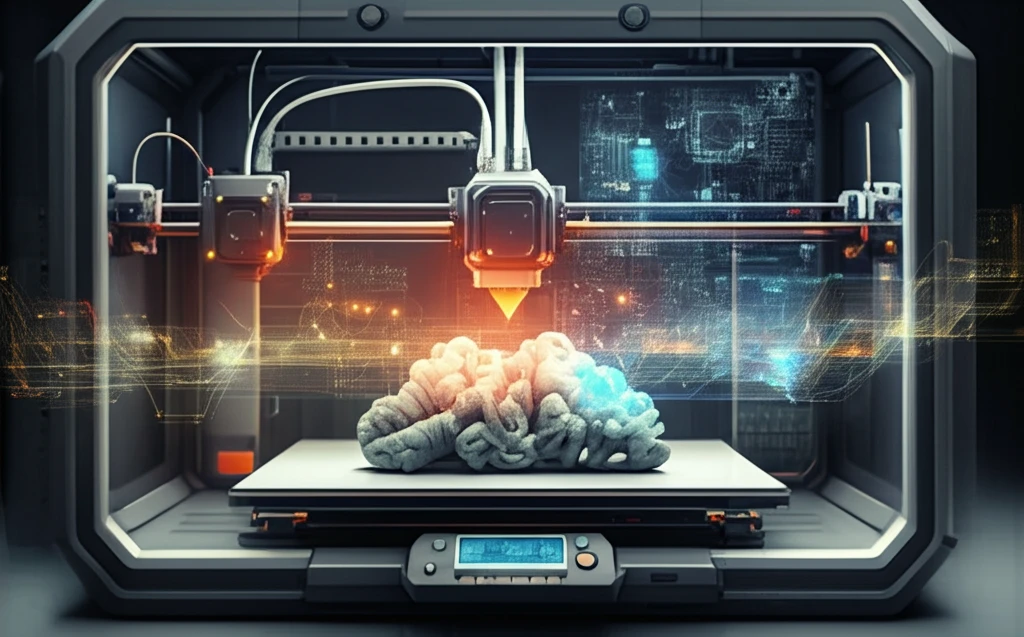
Cloud Control: Revolutionizing 3D Printing at Lightning Speed

"Unlocking Advanced Capabilities with Cloud-Based 3D Printer Control"
3D printing has rapidly evolved from a niche technology to a mainstream manufacturing process, impacting industries from healthcare to aerospace. Yet, despite its widespread adoption, limitations persist, especially in the realm of control systems. Traditional 3D printers rely on local controllers, often constrained by computational power, which limits the complexity of designs and the efficiency of printing processes.
Enter cloud-based control, a paradigm shift that moves the control of 3D printers to remote servers. This innovative approach, known as Control as a Service (CaaS), offers a wealth of benefits, including access to advanced algorithms, enhanced processing capabilities, and remote accessibility. Imagine controlling a 3D printer from anywhere in the world, optimizing performance in real-time with sophisticated software running on powerful cloud infrastructure. CaaS is poised to transform 3D printing, unlocking new levels of speed, accuracy, and scalability.
This article explores the groundbreaking research into cloud-based control for 3D printers, demonstrating how low-level motor commands streamed directly from the cloud can significantly enhance printing performance. We'll dive into the technical aspects of this approach, examine the benefits and challenges, and explore the future possibilities of 3D printer CaaS.
A Multi-Billion-Dollar Industry on the Rise
The 3D printing industry has grown into a $22 billion market driving innovation across aerospace, healthcare, and even space exploration. Over 68% of companies use 3D printing primarily for prototyping and pre-series production, as it shortens design cycles and reduces trial costs. Cloud platforms are emerging to manage and monitor printing resources, offering aggregated machine and material usage statistics with secure data transfer via asymmetric encryption.
Cloud Manufacturing Models for 3D Printing
Cloud manufacturing models for 3D printing range from primary models focused on resource sharing to advanced models that integrate intelligent scheduling and service composition. Cloud platforms improve utilization of 3D printing resources while serving as a means to create and maintain a 3D printing community, expanding the range of users and candidate services. Evaluating the quality of cloud 3D printing services remains an active area of research, with scholars developing systematic methodologies to rigorously assess service performance across the product life cycle.
The Evolution of Cloud-Integrated Additive Manufacturing
The convergence of cloud computing and additive manufacturing has evolved gradually over the past decade, building on the maturation of both internet infrastructure and 3D printing technologies. Early cloud printing solutions focused primarily on remote printer management, while more recent developments have expanded to encompass end-to-end production workflows. This evolution has been driven by increasing demand for distributed manufacturing and mass customization capabilities.
Why Move 3D Printer Control to the Cloud?
Traditional 3D printers rely on local controllers, microcontrollers that interpret G-codes (high-level control commands) and translate them into the precise movements required to build an object layer by layer. While effective, this approach has limitations. Local controllers often lack the processing power to execute advanced control algorithms, such as those that compensate for vibration or optimize print speed. Upgrading hardware can be costly and complex.
- Access to Advanced Algorithms: Implement sophisticated control strategies without local hardware limitations.
- Enhanced Processing Power: Leverage the computational resources of the cloud for real-time optimization.
- Remote Accessibility: Control and monitor 3D printers from anywhere with an internet connection.
- Simplified Upgrades: Software updates are seamless and don't require hardware changes.
- Data Sharing and Collaboration: Cloud-based platforms facilitate data sharing and collaborative design.
Emerging Directions in Cloud 3D Printing Research
Recent academic work has explored various aspects of cloud-based 3D printing, from resource allocation algorithms to quality assurance frameworks. Researchers are investigating how artificial intelligence and machine learning can optimize printing parameters and predict failures before they occur. The field continues to grow as both industry and academia recognize the potential of cloud-integrated additive manufacturing to reshape production paradigms.
Addressing Print Failures Through Cloud Intelligence
Print failures remain a significant challenge in additive manufacturing, often caused by design errors, process limitations, and inadequate monitoring, with much existing research on these issues remaining fragmented. Cloud-based platforms are addressing this through AI-powered failure detection systems that use computer vision and deep learning to identify issues like spaghetti failures in real time. Solutions such as Cloud 3D Print and 3DPrinterOS offer real-time monitoring, automated slicing, and smart analytics that help transform reliability and output quality, making failed prints increasingly rare.
Local vs. Cloud: Weighing the Trade-Offs
When comparing local and cloud-based 3D printing approaches, trade-offs exist in terms of cost, scalability, and direct control over the printing process. Local setups offer hands-on oversight but may lack efficient resource utilization across multiple machines, while cloud platforms provide centralized management, data analytics, and broader collaboration capabilities. The optimal solution often depends on the specific use case, the scale of operation, and the organization's workflow requirements.
The Future of 3D Printer Control
Cloud-based control represents a significant step forward in the evolution of 3D printing. By moving control functions to the cloud, manufacturers and hobbyists alike can unlock new levels of performance, accessibility, and scalability. As cloud infrastructure continues to improve and advanced algorithms become more readily available, CaaS is poised to revolutionize the 3D printing industry, enabling faster, more accurate, and more accessible additive manufacturing for everyone.
Convergence of Cloud and Additive Manufacturing
The convergence of cloud computing and 3D printing represents a significant paradigm shift in manufacturing, with researchers recognizing its transformative potential across the product life cycle. Studies emphasize the need for systematic evaluation methodologies to assess cloud 3D printing service quality, while IoT-assisted cloud platforms are opening new possibilities for resource optimization and distributed production networks. The integration of these technologies is reshaping how manufacturing services are accessed, configured, and delivered.
Trends Shaping the Next Era of 3D Printing
Looking toward 2026 and beyond, key trends include the growing role of AI in optimizing printing processes, a push toward greater sustainability, and increasing emphasis on repeatability for production-grade output. Industry experts predict significant advances in materials science, including new metal powders and high-entropy alloys with superior mechanical properties for high-stress applications such as aerospace. The market is expected to continue its rapid growth trajectory, with automation and AI-driven solutions becoming increasingly central to manufacturing workflows.
Sustainability, Cost, and Scalability Hurdles
While additive manufacturing offers design freedom and material efficiency, its environmental sustainability remains a critical concern due to energy-intensive processes and limited recyclability of materials. Cloud-based platforms are enabling mass customization by integrating distributed 3D printers, but this raises questions about cost-effective resource allocation across dynamic service networks. Novel approaches such as serverless computing architectures are being developed to address the computational demands of cloud-assisted 3D printing in a timely and cost-effective manner.
Real-World Applications Transforming Industries
Real-world case studies demonstrate 3D printing's transformative impact across diverse industries, from healthcare and aerospace to fashion and food production. Businesses are leveraging 3D printers, specialized software, and advanced materials to drive innovation and operational efficiency. For instance, companies like Chouette use 3D-printed custom housings to protect AI technology deployed in vineyard health monitoring, illustrating how additive manufacturing enables novel applications at the intersection of technology and agriculture.