
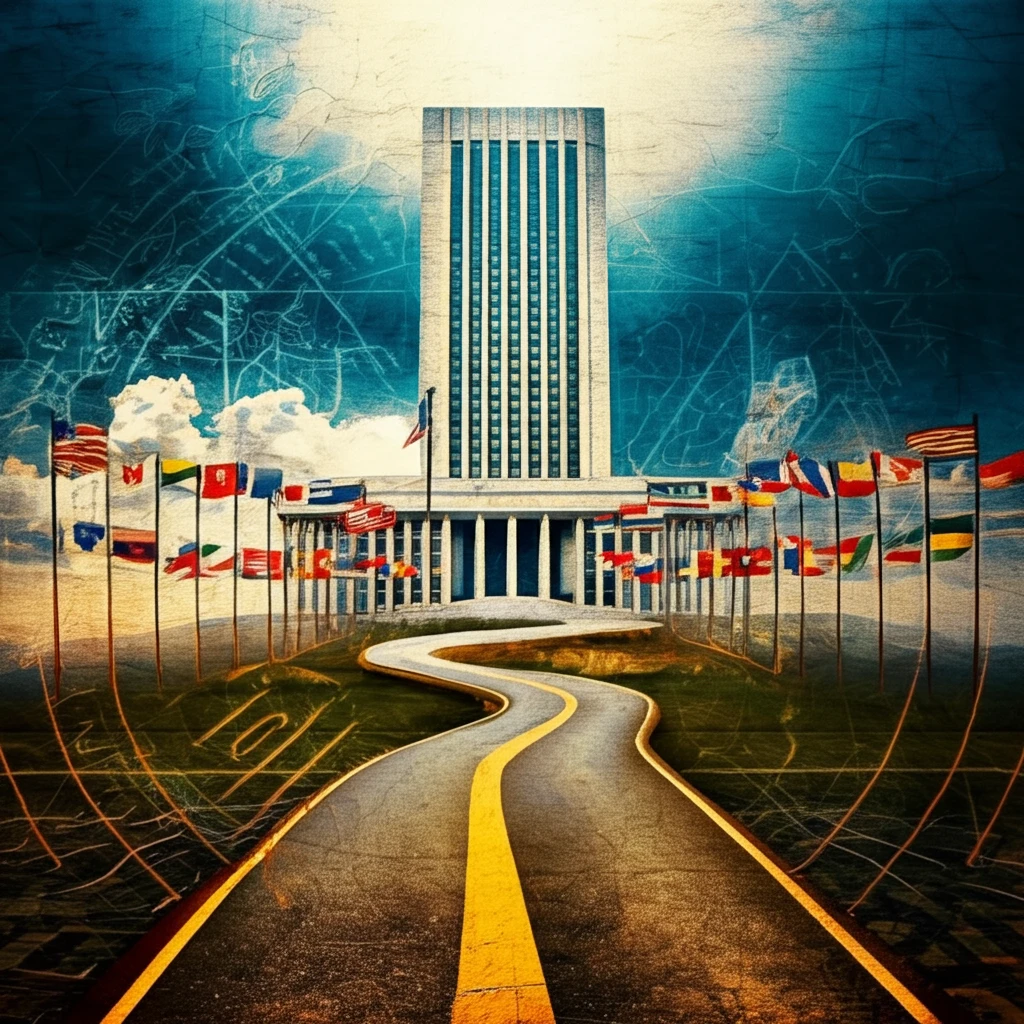
Nation Building 2.0: How Foreign Policy Expertise Shapes Our World

"Uncover the surprising evolution of US State Department strategies and how they impact international relations."
Have you ever wondered how a nation decides to rebuild another? The story of nation-building is one filled with complex expertise and evolving strategies, especially within the United States State Department. This article dives into the fascinating world of US foreign policy, revealing how knowledge practices have transformed over time. It's not just about history; it's about understanding how decisions made decades ago still influence global politics today.
Think of the US State Department as a central hub where ideas about rebuilding nations are formed and put into action. By looking at key moments in history, we can see how the department's approach to nation-building has changed. From the early 20th century to the modern era, the expertise valued has shifted dramatically, impacting the very substance of US foreign policy.
This journey through time will uncover the critical shifts in how the State Department defines expertise, collects data, and ultimately shapes its policies. It's a story of social scientists, geopolitical strategists, and human rights lawyers all vying to influence the course of nation-building. Join us as we explore this intriguing evolution and its lasting impact on the world.
The Rising Tide of Nation-Building Efforts
Nation building efforts have increased significantly in recent decades, with Europe and the United Nations frequently leading such initiatives. Despite the volume of activity, outcomes remain uncertain—according to The American Spectator, regardless of which data set one examines, the odds of successful nation building are not favorable. Academic literature, including Ashraf Ghani and Clare Lockhart's work, examines how national identification evolves over time as a key variable in whether nations come together or fall apart.
Methodological Hurdles in Measuring Success
Standardization remains a persistent challenge across complex policy domains. In fields like biomedical research, method heterogeneity and lack of standardized protocols confound direct comparisons and limit the ability to generalize findings. These same challenges apply to nation-building efforts, where diverse actors bring different frameworks, making it difficult to establish consistent benchmarks for progress or evaluate what actually works.
The United Nations and Early Nation-Building Frameworks
The modern international framework for nation building traces back to the founding of the United Nations in 1945, conceptualized partly through Franklin Roosevelt's sketch of the original three branches: the Four Policemen, an executive branch, and an international assembly of member states. In the early 20th century, the United States was already engaged in such efforts—the Philippines convened its first elected assembly in 1907, and the 1916 Jones Act promised eventual independence. These milestones established precedents for the international community's involvement in guiding states toward self-governance.
The Evolving Landscape of Nation-Building Expertise
In the early 20th century, during the Progressive Era, nation-building expertise was rooted in social science. Bright academics, numbering around 150, operated outside the State Department, armed with research and theories. Their focus was on collecting 'factual evidence' to guide policy, viewing nation-building through a lens of rational, scientific problem-solving. This approach, however, lacked a grounded understanding of geopolitical realities.
- Progressive Era (1910s): Social science driven, academic-led expertise.
- Mid-20th Century (1940s): Geopolitical empiricism, think tank influence, State Department focus.
- Late 20th Century (1990s): Liberal legalism, human rights emphasis, legal frameworks.
The Role of Inclusive Participation in Nation Building
Recent scholarship emphasizes that nation building requires broad societal participation. Research published in the Research Review International Journal of Multidisciplinary highlights that women are an inseparable part of family, society, and the nation, and that a complete society is formed only when the qualities of both genders are harmonized. Meanwhile, International Alert has called for greater youth leadership in nation-building, with stakeholders renewing their commitment to strengthen youth participation in building peaceful and inclusive societies.
Transitional Justice and National Reconciliation
Nation-building efforts often falter over deeply divisive issues that resist easy resolution. In Sri Lanka, disagreement over the proposed transitional justice mechanism in the Geneva Resolution became a public flashpoint, illustrating how accountability measures can fragment rather than unite a post-conflict society. As noted in the Geneva process, the division of opinion on transitional justice became a defining obstacle to reconciliation, revealing the tension between international expectations and domestic political realities.
Competitive Versus Comparative Advantage in Policy
Economic and policy analysis frameworks distinguish between competitive and comparative advantage—concepts that shape how nations approach development and trade. Neary's 2003 work in the Review of International Economics explores how these frameworks interact when nations pursue strategic economic positioning. Understanding these distinctions is relevant to nation building because it affects how states prioritize industries, engage in international trade, and design economic policies that support long-term stability.
The Future of Nation-Building: Expertise and Context
The evolution of nation-building expertise within the US State Department reveals a fascinating interplay between knowledge, power, and global events. As the world continues to evolve, understanding the historical shifts in policy approaches is crucial for navigating future challenges. A blend of contextual understanding, geopolitical awareness, and human rights principles may hold the key to more effective and sustainable nation-building strategies.
Lessons from the UN's Nation-Building Track Record
The Council on Foreign Relations has examined the pitfalls of UN nation building, noting that the international community frequently fails to show the stamina required to guide nations toward genuine stability. East Timor has been cited by the UN as a model nation-building project, yet subsequent unrest demonstrated that initial progress does not guarantee lasting peace. The UN's own record suggests that coherent strategy and long-term commitment remain its most persistent challenges in state-building contexts.
Global Economic Projections and Emerging Trends
The IMF's World Economic Outlook provides ongoing surveys of global economic prospects and policy directions, published twice yearly with interim updates. Meanwhile, emerging economic programs such as Africa's citizenship-by-investment initiatives signal new approaches to attracting capital and talent into developing nations. These trends suggest that nation building in the coming decade may increasingly leverage economic incentive structures alongside traditional diplomatic and humanitarian interventions.
Systemic Impact Through Institutional Frameworks
Efforts to drive systemic change increasingly integrate environmental, social, and governance (ESG) principles into core organizational strategy rather than treating them as peripheral projects. At the same time, targeted skills training and wage-based incentive programs have been studied for their impact on social mobility—such as research into rural early childhood education providers in Tennessee exploring the lived experiences of upskilling initiatives. These examples illustrate that effective nation building depends on embedding policy interventions within the broader institutional fabric of societies.
Beyond Infrastructure: Empathy as a Foundation
As the Adani Group has articulated, true nation building transcends steel and concrete—it is fundamentally about empathy, responsibility, and tackling real-world challenges to uplift communities. In India, platforms like MYBharat aim to connect citizens through leadership programs and national initiatives, building a vibrant and resilient future through collective contribution. These examples reflect a growing recognition that nation building succeeds only when it centers human dignity and community engagement alongside material development.