
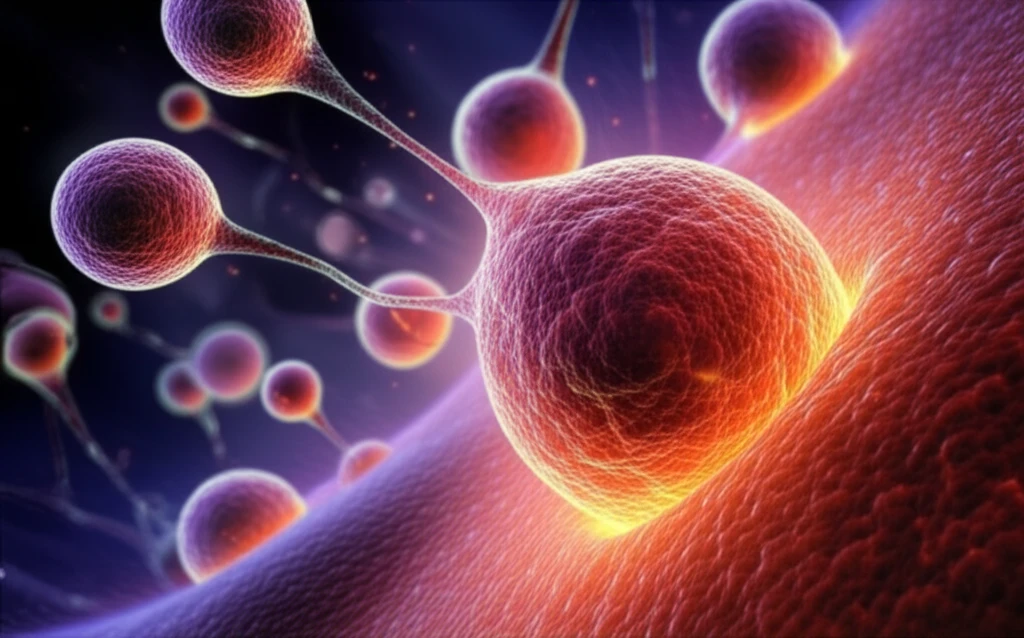
Nanoparticles targeting cancer cells

Nanoparticles: The Tiny Tech Revolutionizing Cancer Treatment and Beyond

"Exploring the innovative applications of nanoparticles in drug delivery, diagnostics, and regenerative medicine."


Nanotechnology is rapidly advancing, offering unprecedented opportunities to revolutionize medicine. At the forefront of this revolution are nanoparticles—tiny particles, measured in billionths of a meter, with unique properties that make them ideal for a variety of biomedical applications.

From targeted drug delivery to enhanced diagnostics and regenerative medicine, nanoparticles are showing promise in addressing some of the most challenging healthcare problems. Their ability to interact with biological systems at the cellular and molecular level opens up new avenues for treating diseases and improving patient outcomes.

This article explores recent research highlighting the diverse applications of nanoparticles, focusing on their potential to transform cancer treatment, neural regeneration, and glucose monitoring for diabetes management. We’ll delve into the science behind these innovations and examine the potential impact on healthcare.

Targeted Cancer Therapy: Nanoparticles Deliver the Punch

Nanoparticles targeting cancer cells

One of the most promising applications of nanoparticles is in targeted drug delivery for cancer therapy. Traditional chemotherapy often affects healthy cells along with cancerous ones, leading to significant side effects. Nanoparticles can be engineered to selectively target cancer cells, delivering therapeutic drugs directly to the tumor site while sparing healthy tissue.

Researchers are exploring various strategies for nanoparticle-based drug delivery, including:

  • Superparamagnetic Iron Oxide Nanoparticles (SPIONs): These nanoparticles can be guided to the tumor site using external magnetic fields. When combined with drugs like chlorin e6 (Ce6), SPIONs can enhance photodynamic therapy (PDT), a treatment that uses light to activate drugs and destroy cancer cells.
  • Hyaluronic Acid Nanoparticles: These nanoparticles can target CD44 receptors, which are often overexpressed on cancer cells. By loading these nanoparticles with drugs like doxorubicin, researchers can selectively kill cancer cells while minimizing damage to healthy cells.
  • Polypeptide Complex Micelles: These micelles are designed to respond to specific conditions within the tumor environment, such as high glucose levels. By complexing phenylboronic acid (PBA)-functionalized polypeptides with dopamine-modified polypeptides, researchers can create micelles that release drugs in response to changes in glucose concentration.
These approaches hold immense potential for improving the efficacy and reducing the toxicity of cancer treatments. By precisely targeting cancer cells, nanoparticles can deliver higher doses of drugs directly to the tumor, leading to better outcomes and fewer side effects for patients.

The Future is Nano

Nanoparticle technology represents a paradigm shift in medicine, offering the potential to diagnose, treat, and prevent diseases in ways never before imagined. As research continues to advance, we can expect to see even more innovative applications of nanoparticles emerge, transforming healthcare and improving the lives of patients worldwide.

About this Article -

This article was crafted using a human-AI hybrid and collaborative approach. AI assisted our team with initial drafting, research insights, identifying key questions, and image generation. Our human editors guided topic selection, defined the angle, structured the content, ensured factual accuracy and relevance, refined the tone, and conducted thorough editing to deliver helpful, high-quality information.See our About page for more information.

Everything You Need To Know

1

What are nanoparticles and how are they used in medicine?

Nanoparticles are incredibly small particles, measured in billionths of a meter, that are being used in various biomedical applications. They possess unique properties that allow them to interact with biological systems at a cellular and molecular level. This characteristic is why they are suitable for drug delivery, diagnostics, and regenerative medicine. Their size and properties make them ideal for targeting specific cells and tissues.

2

Why is targeted drug delivery using nanoparticles important for cancer treatment?

Targeted drug delivery using nanoparticles is significant because it can improve the efficacy of cancer treatments while reducing side effects. Traditional chemotherapy affects both healthy and cancerous cells. Nanoparticles are designed to target cancer cells selectively, delivering drugs directly to the tumor site. This allows for higher drug concentrations at the tumor site and minimizes exposure of healthy tissues, leading to better patient outcomes. The use of Superparamagnetic Iron Oxide Nanoparticles (SPIONs), Hyaluronic Acid Nanoparticles, and Polypeptide Complex Micelles are some examples of how this is achieved.

3

How do Superparamagnetic Iron Oxide Nanoparticles (SPIONs) work in cancer therapy?

Superparamagnetic Iron Oxide Nanoparticles (SPIONs) are a type of nanoparticle that can be guided to a tumor site using external magnetic fields. When combined with drugs like chlorin e6 (Ce6), SPIONs can enhance photodynamic therapy (PDT). This therapy uses light to activate the drug and destroy cancer cells. The external magnetic field helps to concentrate the SPIONs, and thus the drug, at the tumor site, improving the therapy's effectiveness.

4

How do Hyaluronic Acid Nanoparticles target cancer cells?

Hyaluronic Acid Nanoparticles target cancer cells by interacting with CD44 receptors, which are frequently overexpressed on cancer cells. By loading these nanoparticles with drugs like doxorubicin, they can selectively kill cancer cells while minimizing damage to healthy cells. This approach improves treatment efficacy and reduces the adverse effects associated with traditional cancer therapies.

5

How do Polypeptide Complex Micelles work for drug delivery?

Polypeptide Complex Micelles are designed to respond to conditions within the tumor environment, such as high glucose levels. Researchers can create micelles that release drugs in response to changes in glucose concentration by complexing phenylboronic acid (PBA)-functionalized polypeptides with dopamine-modified polypeptides. This method allows for precise drug release at the tumor site, taking advantage of the unique characteristics of the tumor environment for targeted therapy.

Newsletter Subscribe

Subscribe to get the latest articles and insights directly in your inbox.