
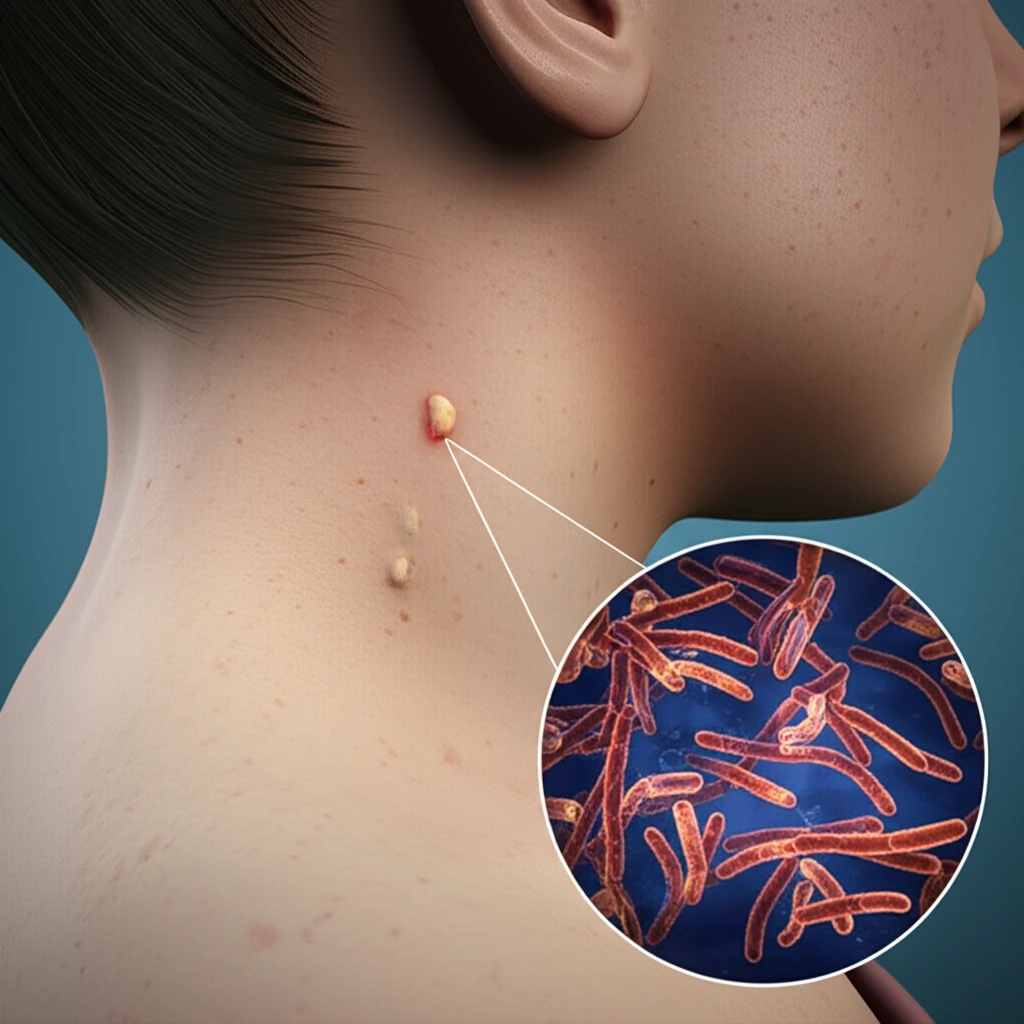
Swollen lymph nodes and chickenpox spots with bacteria.

Mysterious Link: How Chickenpox Might Complicate Bacterial Infections

"Unraveling the connection between varicella-zoster virus and severe lymph node infections, and what it means for your health."


Non-tuberculous mycobacteria (NTM) are common microorganisms found in the environment. While generally harmless, they can sometimes cause infections, especially in individuals with compromised immune systems. These infections often manifest as skin, soft tissue, or lung diseases, but can also affect the lymph nodes.

Lymphadenitis, or inflammation of the lymph nodes, due to NTM is rare in people with healthy immune systems. Typically, the body's defenses are well-equipped to handle these bacteria, preventing them from causing serious harm. However, when the immune system is weakened, NTM can take hold, leading to more severe infections.

A recent case study sheds light on a peculiar situation: a young girl with a common chickenpox infection developed a severe lymph node infection caused by Mycobacterium fortuitum. This raises questions about how viral infections like chickenpox can disrupt the immune system and increase susceptibility to bacterial complications.

The Case: Chickenpox Opens the Door to Bacterial Infection

Swollen lymph nodes and chickenpox spots with bacteria.

A previously healthy nine-year-old girl developed palpable lymphadenomegaly in her left cervical region, accompanied by fever, but without any other systemic manifestations. The patient also showed typical varicella symptoms, and was prescribed to rest for 15 days. During her chickenpox infection, the node continued to grow, and eventually developed into a vesicle. After this period, a vesicle with purulent content was observed on her lower left gum, it was associated with a dental fracture that had occurred prior to the emergence of the node. Concerns arose when a vesicle with purulent content appeared near a previously fractured tooth. Initial treatments with amoxicillin and cephalexin, common antibiotics, proved ineffective.

Further investigation revealed a concerning progression. The lymphadenitis worsened, evolving into a fistula (an abnormal connection between two body parts) followed by a suppurative ulceration. Biopsies indicated reactive lymphoid hyperplasia, epithelioid granuloma, and necrotic areas. Additionally, the tests came back negative for alcohol acid resistant bacilli (AARB). Despite these findings, standard cultures didn't reveal any fungal or bacterial growth, and chest radiography showed no abnormalities. Subsequent tests for purified protein derivative (PPD) and HIV also came back negative, and the symptoms persisted.

  • Persistent Lesion: A circular lesion was discovered during a physical examination, measuring 4.5cm in diameter with well limited, prominent, hardened, and erythematosus edges; a granular base covered with purulent content; and a surrounding purple area.
  • Biopsy Results: Another biopsy was performed, revealing areas of necrotizing granulomatosis without evidence of infectious agents. Two palpable lymph nodes were identified at the mandible that were static, of hardened consistency, and painful to touch. The largest node measured 1.5cm in diameter. No other lymph node chain was observed.
  • Culture Analysis: The cervical nodule was cultured for common germs, AARB, fungi, Actinomyces, and Nocardia. Part of the material was sown in culture media (lamb blood agar, MacConkey agar, Sabouraud agar, Mycosel agar, Lowenstein-Jensen medium, and Ogawa-Kudoh agar).
Finally, after more specialized testing, the culprit was identified as Mycobacterium fortuitum, confirmed by a polymerase chain reaction (PCR) with DNA sequencing. Sensitivity testing revealed the bacteria were susceptible to imipenem and sulfametoxazol/trimetoprima. A treatment plan of imipenem + cilastatin sodium, which is associated with sulfametoxazol + trimetoprima was initiated, resulting in a retraction of the lesion.

Why Chickenpox Can Lead to Bacterial Complications

The case raises a critical question: how did chickenpox, a common childhood illness, pave the way for a severe bacterial infection? The answer lies in the virus's impact on the immune system. Varicella-zoster virus (VZV) interferes with the activation of phagocytes, the immune cells responsible for engulfing and destroying bacteria.

VZV disrupts a key signaling pathway involving STAT3 and STAT1, transcription activators crucial for producing immune-boosting substances like interleukin (IL)-12) and reactive oxygen species (ERO). By dampening these responses, VZV weakens the macrophages' ability to eliminate bacteria effectively.

This case underscores the importance of considering NTM infections in patients presenting with lymphadenitis, especially when a recent viral infection like chickenpox has occurred. While NTM rarely causes disease in healthy individuals, viral infections can temporarily weaken the immune system, creating an opportunity for these bacteria to take hold and cause serious complications. Further research is needed to fully understand the interplay between viral infections and bacterial susceptibility.

About this Article -

This article was crafted using a human-AI hybrid and collaborative approach. AI assisted our team with initial drafting, research insights, identifying key questions, and image generation. Our human editors guided topic selection, defined the angle, structured the content, ensured factual accuracy and relevance, refined the tone, and conducted thorough editing to deliver helpful, high-quality information.See our About page for more information.

This article is based on research published under:

DOI-LINK: 10.1590/0037-8682-0166-2013, Alternate LINK

Title: Mycobacterium Fortuitum-Related Lymphadenitis Associated With The Varicella-Zoster Virus

Subject: Infectious Diseases

Journal: Revista da Sociedade Brasileira de Medicina Tropical

Publisher: FapUNIFESP (SciELO)

Authors: Kleber Giovanni Luz, Maria Helena Marques Fonseca De Britto, Domitila Costa De Farias, Mayara Varaschim Almeida, Nastassja Morgana De Sousa Figueirêdo, Paula De Medeiros Nacácio E Silva

Published: 2014-01-01

Everything You Need To Know

1

How does chickenpox increase the risk of developing other infections?

The varicella-zoster virus (VZV), which causes chickenpox, can interfere with the activation of phagocytes. Phagocytes are crucial immune cells responsible for engulfing and destroying bacteria. When VZV impairs their function, the body becomes more vulnerable to bacterial infections, such as those caused by non-tuberculous mycobacteria (NTM). This creates an opportunity for bacteria like Mycobacterium fortuitum to establish an infection, especially in cases where the immune system is already under stress.

2

What is Lymphadenitis and what role does it play in post-chickenpox complications?

Lymphadenitis is the inflammation of the lymph nodes. In the context of this case, it refers to the infection and inflammation of the lymph nodes caused by non-tuberculous mycobacteria (NTM), specifically Mycobacterium fortuitum, following a chickenpox infection. Typically, the body's defenses are well-equipped to handle these bacteria, preventing them from causing serious harm, however, when the immune system is weakened the NTM can take hold, leading to more severe infections.

3

Can you describe what happened to the young girl in the case after she contracted chickenpox?

The young girl developed a severe lymph node infection caused by Mycobacterium fortuitum, an opportunistic non-tuberculous mycobacteria (NTM). This infection manifested as lymphadenomegaly, fever, and eventually a vesicle with purulent content near a fractured tooth. The progression involved worsening lymphadenitis, a fistula, and a suppurative ulceration. Initial antibiotic treatments were ineffective, but a specialized treatment plan of imipenem + cilastatin sodium, which is associated with sulfametoxazol + trimetoprima, was eventually successful.

4

What are non-tuberculous mycobacteria (NTM) and why are they significant in the context of viral infections?

Non-tuberculous mycobacteria (NTM), like Mycobacterium fortuitum, are microorganisms commonly found in the environment. While usually harmless, they can cause infections, particularly in individuals with weakened immune systems. These infections often appear as skin, soft tissue, or lung diseases, but can also affect the lymph nodes. What makes them significant is their ability to take advantage of compromised immune defenses, leading to complications following viral infections like chickenpox. More research is needed to confirm this connection.

5

What are the broader implications of the varicella-zoster virus (VZV) leading to a bacterial infection from a Mycobacterium fortuitum?

The case suggests that a weakened immune system due to the varicella-zoster virus (VZV) can make individuals more susceptible to bacterial infections, specifically by non-tuberculous mycobacteria (NTM) like Mycobacterium fortuitum. It underscores the importance of considering bacterial complications in patients with viral infections, especially if they present with unusual symptoms or are not responding to standard treatments. It highlights the need for thorough diagnostic testing, including specialized cultures and PCR, to identify less common pathogens, as well as comprehensive treatment plans that consider both viral and bacterial aspects of the infection.

Newsletter Subscribe

Subscribe to get the latest articles and insights directly in your inbox.