
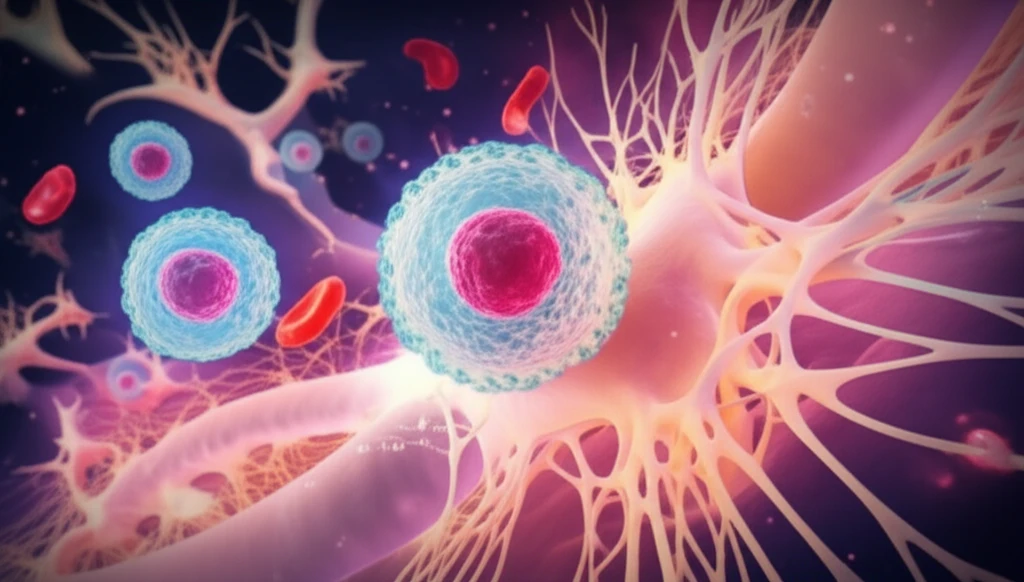
Myeloma cells interacting with bone marrow environment.

Myeloma's Hidden Allies: How Bone Marrow Stroma and Vessels Fuel Cancer's Spread

"Uncover the crucial role of the bone marrow microenvironment in myeloma's progression and discover potential new targets for treatment."


Bone metastasis, the spread of cancer to the bones, is a complex process involving various cell populations and regulatory proteins. While cancers like breast, prostate, lung, and thyroid often spread to the bone, multiple myeloma (MM) has a unique connection to the bone marrow. This process involves circulating tumor cells (CTCs) finding specialized bone marrow "niches" to settle and grow.

After arriving in the bone marrow, these tumor cells interact with the local environment, influencing their survival, dormancy, or proliferation. The tumor cells adapt to evade the immune system, either remaining dormant or multiplying to form bone metastases, ultimately disrupting normal bone physiology.

The bone marrow's rich blood supply and adhesive molecules on tumor cells facilitate this process. Factors within the bone marrow, such as acidity and low oxygen levels, can also promote tumor growth and drug resistance. Additionally, chemokines like osteopontin act as chemoattractants for cancer cells.

The Bone Marrow Niche: A Supportive Environment for Myeloma

Myeloma cells interacting with bone marrow environment.

The bone marrow (BM) niche plays a crucial role in supporting myeloma cell survival and proliferation. The BM comprises hematopoietic cells (myeloid cells, T lymphocytes, B lymphocytes, natural killer (NK) cells, monocytes, macrophages, dendritic cells, osteoclasts, erythrocytes, megakaryocytes, and platelets) and non-hematopoietic cells (fibroblasts, adipocytes, osteoblasts, endothelial cells, and blood vessels). Each BM cellular compartment provides the structural and physiological support for hematopoietic cells and may also modulate MM cell homing and progression.

Myeloma cells can significantly alter the composition of the BM stroma by influencing the functional and differentiating status of BMSC progenitors. This creates a feedback loop where the BM milieu supports myeloma cell growth. Changes in the non-cellular compartment, including the extracellular matrix (ECM) and liquid milieu, further contribute to creating a supportive niche for MM cells.

  • Cell Adhesion: Myeloma cells strongly adhere to BMSCs, promoting myeloma cell growth, proliferation, and drug resistance. Molecules like CD44, VLA-4, VLA5, LFA1, NCAM, ICAM1, syndecan-1, CD40/CD40L, and beta-1 and beta-2 integrin mediate this adhesion.
  • Cytokine Support: Cytokines like IL-6, secreted by BMSCs, are key growth and survival factors. IL-6 activates signaling cascades and anti-apoptotic proteins, conferring drug resistance.
  • Angiogenic Molecules: BMSCs from MM patients express pro-angiogenic molecules like VEGF, Ang-1, bFGF, PDGF, HGF, TGF-x, and IL-1, which promote blood vessel formation.
  • GDF15 Influence: Growth differentiation factor 15 (GDF15), aberrantly expressed by MM-derived BMSCs, increases the survival of stroma-dependent myeloma cells and enhances their tumor-initiating potential.
  • SDF-1/CXCR4 Axis: The stromal cell-derived factor 1 (SDF-1)/CXCR4 axis is critical for BMSC-myeloma interaction, facilitating homing and engraftment of myeloma cells in the BM. Targeting SDF-1 can prevent disease progression and enhance sensitivity to anti-MM agents.
  • Exosome Communication: BMSC-derived exosomes, containing proteins and RNA, are transferred to myeloma cells, affecting their growth and drug resistance. These exosomes influence survival pathways and have differing microRNA content compared to normal BMSC-derived exosomes.
Myeloma cells can also alter the composition of the BM stroma by acting on BMSC progenitors and changing their functional and differentiating status. In fact, MM cells may shape the BM milieu, ultimately supporting MM cell growth, thus suggesting an interesting feedback loop between MM cells and BM niches.

Future Directions: Targeting the Bone Marrow Niche

Metastasis remains a critical, unresolved issue for cancer patients. Given the heterogeneity of tumors, especially in myeloma, and their supportive microenvironment, targeting both the tumor clone and the microenvironment is essential to improve outcomes.

Future research should focus on developing therapeutic strategies to target the stroma and vasculature in myeloma and other bone metastatic diseases. Understanding the mechanisms of anti-cancer therapies, such as the anti-angiogenic effects of bisphosphonates, is also crucial.

Ongoing clinical trials are evaluating CXCR4-targeting agents, reflecting the importance of this pathway in myeloma dissemination. Targeting the BM microenvironment and its niches represents a promising area for future drug development.

About this Article -

This article was crafted using a human-AI hybrid and collaborative approach. AI assisted our team with initial drafting, research insights, identifying key questions, and image generation. Our human editors guided topic selection, defined the angle, structured the content, ensured factual accuracy and relevance, refined the tone, and conducted thorough editing to deliver helpful, high-quality information.See our About page for more information.

This article is based on research published under:

DOI-LINK: 10.1007/s11914-017-0399-3, Alternate LINK

Title: Bone Marrow Stroma And Vascular Contributions To Myeloma Bone Homing

Subject: Endocrinology, Diabetes and Metabolism

Journal: Current Osteoporosis Reports

Publisher: Springer Science and Business Media LLC

Authors: Michele Moschetta, Yawara Kawano, Antonio Sacco, Angelo Belotti, Rossella Ribolla, Marco Chiarini, Viviana Giustini, Diego Bertoli, Alessandra Sottini, Monica Valotti, Claudia Ghidini, Federico Serana, Michele Malagola, Luisa Imberti, Domenico Russo, Alessandro Montanelli, Giuseppe Rossi, Michaela R. Reagan, Patricia Maiso, Bruno Paiva, Irene M. Ghobrial, Aldo M. Roccaro

Published: 2017-09-09

Everything You Need To Know

1

How do myeloma cells exploit the bone marrow environment to establish themselves and thrive?

In multiple myeloma, tumor cells establish themselves within the bone marrow, a process facilitated by interactions with the bone marrow stroma and blood vessels. This environment influences whether these cells remain dormant, proliferate, or evade the immune system. Factors such as the bone marrow's rich blood supply and the presence of adhesive molecules on tumor cells further support this process. Additionally, the microenvironment, characterized by acidity and low oxygen levels, can promote tumor growth and drug resistance. Chemokines, such as osteopontin, also act as chemoattractants for cancer cells, guiding them to these supportive niches.

2

What are the primary ways the bone marrow niche supports the survival and proliferation of myeloma cells?

The bone marrow niche supports myeloma cell survival through various mechanisms. Cell adhesion molecules like CD44, VLA-4, and ICAM1 mediate the attachment of myeloma cells to bone marrow stromal cells (BMSCs), promoting growth and drug resistance. Cytokines such as IL-6, secreted by BMSCs, act as key growth factors. Pro-angiogenic molecules like VEGF and Ang-1 promote blood vessel formation, and GDF15 enhances the survival and tumor-initiating potential of myeloma cells. The SDF-1/CXCR4 axis also facilitates myeloma cell homing and engraftment. Additionally, BMSC-derived exosomes influence myeloma cell growth and drug resistance.

3

Can myeloma cells modify the bone marrow stroma, and if so, how does this impact their growth and survival?

Myeloma cells can alter the bone marrow stroma by acting on BMSC progenitors, changing their function. This creates a feedback loop where the bone marrow milieu supports myeloma cell growth. For instance, MM cells can shape the bone marrow microenvironment to their advantage, further fueling their proliferation and survival. This interaction suggests that targeting both the myeloma cells and their supportive bone marrow niches is crucial for improving treatment outcomes.

4

What strategies are being considered to target the bone marrow niche in order to treat myeloma?

Targeting the bone marrow niche is a promising therapeutic strategy, especially considering the heterogeneity of myeloma tumors. Given the supportive microenvironment, therapies that disrupt the interactions between myeloma cells and the bone marrow stroma can improve outcomes. Strategies might involve inhibiting cell adhesion molecules, blocking cytokine signaling pathways, targeting pro-angiogenic factors, or disrupting exosome communication. Disrupting the SDF-1/CXCR4 axis can prevent disease progression and enhance sensitivity to anti-MM agents.

5

In what specific ways do myeloma cells and the bone marrow microenvironment communicate and influence each other?

The interplay between multiple myeloma cells and the bone marrow microenvironment involves complex signaling and communication mechanisms. For example, myeloma cells can induce BMSCs to secrete cytokines like IL-6, which in turn promotes myeloma cell growth and drug resistance. Additionally, exosomes released by BMSCs can carry proteins and RNA that affect myeloma cell survival pathways. Understanding these interactions at a molecular level is essential for developing targeted therapies that disrupt the supportive bone marrow niche and improve outcomes for myeloma patients.

Newsletter Subscribe

Subscribe to get the latest articles and insights directly in your inbox.