
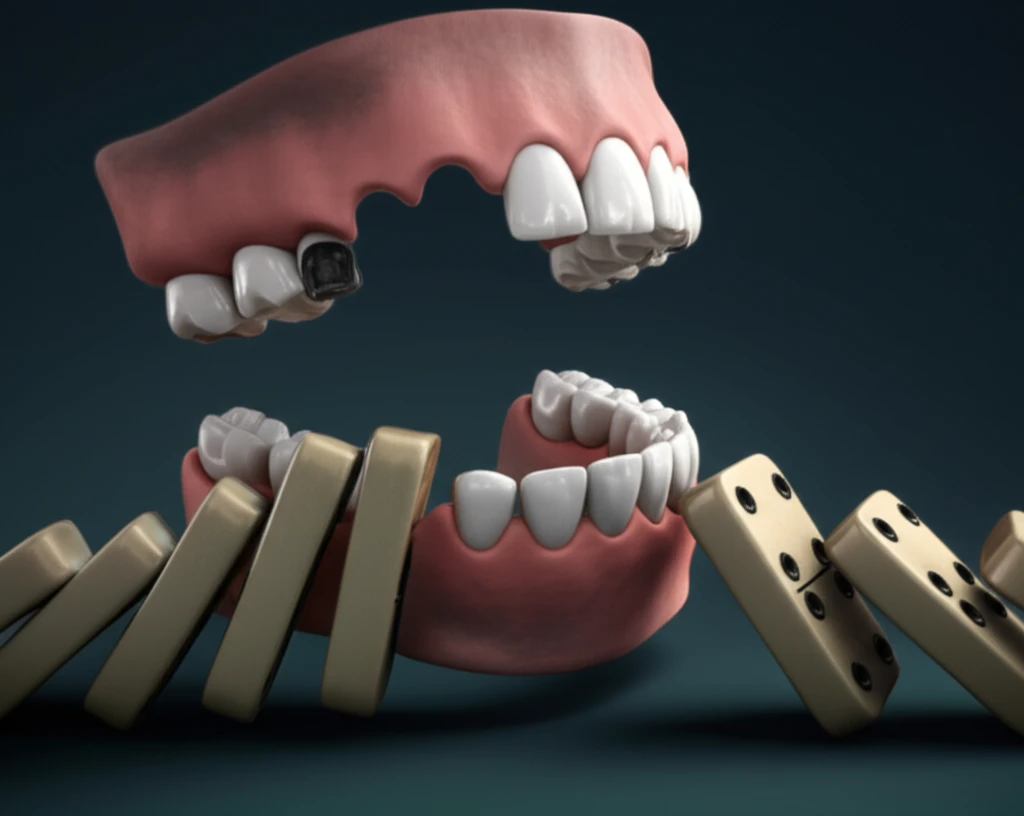
Illustration of domino effect in jaw due to missing molars

Missing Molars? How It Impacts Your Jaw and What to Do About It

"Uncover the surprising connection between missing molars and temporomandibular joint (TMJ) dysfunction, and learn practical steps to protect your jaw health."


Your temporomandibular joint (TMJ) is a critical hinge that connects your jaw to your skull, enabling you to speak, chew, and yawn. Its health is closely linked to the alignment and condition of your teeth. When key teeth, especially molars, are lost and not replaced, it can disrupt the harmony of this intricate system, potentially leading to TMJ dysfunction.

Molars, particularly the first molars, play a pivotal role in maintaining proper occlusion—the way your teeth fit together. When these teeth are missing, it’s like removing a keystone from an arch; the stability of the entire dental structure is compromised. This can result in a cascade of problems, from shifting teeth to changes in your bite, ultimately impacting the TMJ.

This article explores the often-overlooked connection between missing molars and TMJ dysfunction. You’ll discover how seemingly minor changes in your dental alignment can lead to significant jaw problems and, more importantly, what you can do to prevent and address these issues. Understanding this relationship is the first step toward protecting your jaw health and ensuring long-term dental well-being.

The Domino Effect: How Missing Molars Lead to TMJ Issues

Illustration of domino effect in jaw due to missing molars

Losing a molar isn't just about having a gap in your smile. It sets off a chain reaction that can destabilize your entire dental structure. Adjacent teeth may begin to drift into the empty space, and the opposing tooth in the upper jaw can over-erupt, extending further down than it should. This misalignment throws off your bite, placing uneven stress on the TMJ.

Think of your bite as a balanced scale. When a molar is missing, the weight distribution changes, forcing the TMJ to compensate. Over time, this can lead to a range of issues, including:

  • Clicking or Popping: You might hear or feel clicking or popping sounds in your jaw joint when you open or close your mouth.
  • Pain and Tenderness: The muscles around your jaw can become sore and tender, leading to headaches, earaches, and facial pain.
  • Limited Range of Motion: It may become difficult to open your mouth fully or move your jaw from side to side.
  • Condylar Flattening: In severe cases, the cartilage in the TMJ can wear down, leading to flattening of the condyle (the bony knob at the end of your jaw).
A study of 174 patients with missing mandibular first molars revealed significant associations between these issues and TMJ dysfunction. The researchers found that supra-eruption of opposing molars and drifting of adjacent teeth were significantly associated with asymptomatic clicking of the TMJ. Furthermore, patients with deep bites (where the upper front teeth significantly overlap the lower front teeth) showed radiographic evidence of condylar flattening. The longer the molars were missing, the more frequent the clicking.

Taking Action: Protecting Your Jaw Health

The good news is that you don't have to live with the consequences of missing molars. Several effective strategies can help restore balance to your bite and alleviate TMJ symptoms. The key is to be proactive and seek professional help.

About this Article -

This article was crafted using a human-AI hybrid and collaborative approach. AI assisted our team with initial drafting, research insights, identifying key questions, and image generation. Our human editors guided topic selection, defined the angle, structured the content, ensured factual accuracy and relevance, refined the tone, and conducted thorough editing to deliver helpful, high-quality information.See our About page for more information.

Everything You Need To Know

1

What is the direct impact of missing molars on the Temporomandibular Joint (TMJ)?

Missing molars directly impact the Temporomandibular Joint (TMJ) by disrupting the natural alignment and occlusion of your teeth. The absence of molars, especially the first molars, compromises the stability of your dental structure. This can lead to a cascade of problems. Adjacent teeth may drift, and opposing teeth can over-erupt, leading to uneven stress distribution on the TMJ. Over time, this imbalance can result in TMJ dysfunction, causing symptoms like clicking or popping, pain, limited range of motion, and even condylar flattening.

2

How do missing molars affect the overall dental structure and bite?

The absence of molars initiates a 'domino effect' within the mouth. When a molar is missing, the adjacent teeth tend to drift into the vacant space, while the opposing tooth in the upper jaw might over-erupt. This misalignment disrupts your bite, leading to uneven pressure on the TMJ. This imbalance can result in a variety of issues, including changes in the way your teeth fit together and increased stress on the jaw joint.

3

What specific TMJ symptoms are linked to missing molars, and why do they occur?

Missing molars are associated with several TMJ symptoms. The most common are clicking or popping sounds in the jaw joint, pain and tenderness in the jaw muscles leading to headaches, earaches, and facial pain, and limited range of motion, making it difficult to fully open or move the jaw. These symptoms arise due to the altered bite and uneven stress on the TMJ. The TMJ must compensate for the missing teeth, leading to strain and inflammation within the joint and surrounding muscles. Prolonged imbalance can also lead to condylar flattening, the wearing down of the cartilage in the TMJ.

4

What is the role of the first molars in maintaining proper dental health and preventing TMJ dysfunction?

The first molars are pivotal in maintaining proper occlusion, which is how your teeth fit together. They act as key support structures. When first molars are missing, the stability of the entire dental structure is compromised. This destabilization can lead to shifting teeth, changes in your bite, and ultimately, TMJ dysfunction. Maintaining these molars helps distribute the forces of chewing evenly, preventing excessive stress on the TMJ.

5

What proactive steps can be taken to address the issues caused by missing molars and protect jaw health?

The good news is that the consequences of missing molars can be addressed. Several effective strategies can restore balance to your bite and alleviate TMJ symptoms. It is important to be proactive and seek professional help. Replacement options like dental implants, bridges, or partial dentures can fill the gaps. These solutions prevent teeth from shifting and help maintain proper occlusion. Additionally, treatments for TMJ dysfunction, such as physical therapy, mouthguards, or, in some cases, more involved procedures, may be necessary to alleviate symptoms and protect your jaw health. Regular dental check-ups are important to monitor your dental health.

Newsletter Subscribe

Subscribe to get the latest articles and insights directly in your inbox.