
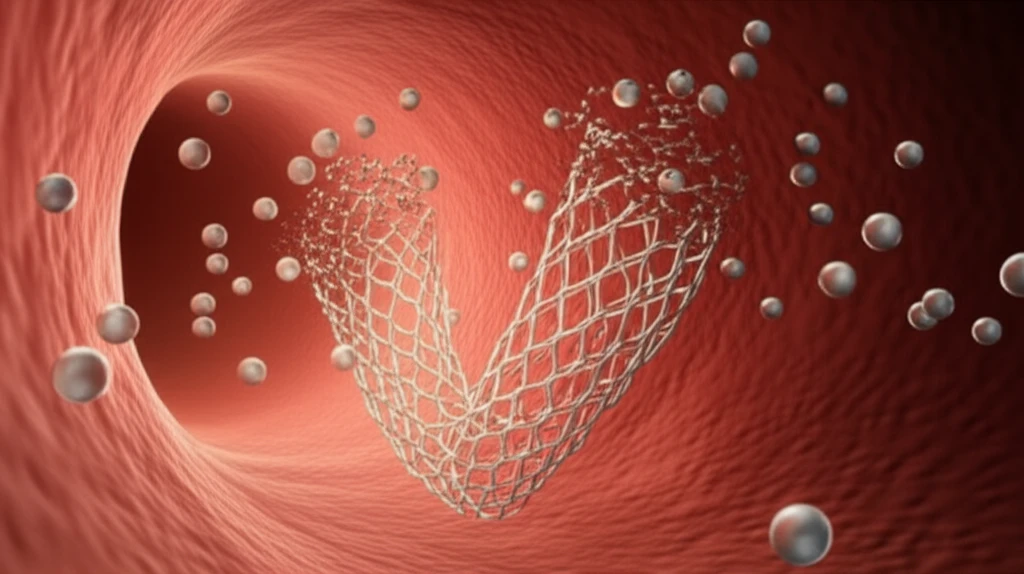
Magnesium Scaffolds: A New Hope for Acute Coronary Syndrome?

"Early research suggests these bioresorbable implants offer a safe, promising alternative to traditional stents."
For years, metallic drug-eluting stents (DES) have been a cornerstone in treating coronary artery disease. But what if there was a better option? Bioresorbable vascular scaffolds (BRS) represent a cutting-edge advancement, designed to overcome the limitations of traditional metallic stents. Among these, magnesium-based scaffolds are generating considerable excitement.
A recent study, the Magmaris-ACS Registry, marks a significant step forward. It's the first assessment of the Magmaris scaffold, a sirolimus-eluting bioresorbable magnesium scaffold, in patients experiencing acute coronary syndrome (ACS). While previous research has focused on stable angina patients, this study explores the potential of this second-generation BRS in the more challenging setting of ACS.
This article breaks down the study's findings, exploring what they might mean for the future of cardiac care. We'll dive into the details of how these scaffolds work, what the study revealed about their safety and effectiveness, and what questions remain before they can become a widespread treatment option.
Magnesium Scaffolds in ACS: Emerging Data
Magnesium-based bioresorbable scaffolds (MgBRS) offer theoretical advantages over permanent metallic stents in percutaneous coronary intervention, particularly for younger patients or those with vulnerable plaques in acute coronary syndrome (ACS). Early clinical outcomes with MgBRS have been inconsistent, and long-term data remain scarce. The Magmaris bioresorbable magnesium scaffold is an alternative to drug-eluting stents, but its role in acute coronary syndrome remains insufficiently studied. Prospective registries suggest Magmaris represents a feasible and safe interventional option for treating de novo coronary lesions in this high-risk cohort.
Magmaris as an Alternative to DES
Bioresorbable scaffolds provide transient vessel support without the long-term limitations of permanent metallic drug-eluting stents. The sirolimus-eluting resorbable magnesium scaffold Magmaris is the only CE-marked metallic bioresorbable scaffold and provides short-term lumen support before being completely bioresorbed. This technology was developed to overcome the limitations of metallic drug-eluting stents, which remain permanently encapsulated in the vessel wall. Understanding the safety and efficacy of Magmaris in ACS is clinically relevant to guide further development of magnesium-based scaffold technologies.
First Assessments in ACS Populations
The Magmaris-ACS Registry represents the first assessment of Magmaris implantation in the acute coronary syndrome population. Bioresorbable vascular scaffolds represent the newest coronary stent technology, developed to overcome the limitations of metallic drug-eluting stents. Early outcome data from magnesium bioresorbable scaffold implantation in acute coronary syndrome showed inconsistent results, with long-term data remaining scarce. This foundational work established the initial evidence base for magnesium-based scaffold use in high-risk ACS patients.
What Makes Magnesium Scaffolds Different?
Traditional metallic stents provide a permanent support structure to keep arteries open after procedures like angioplasty. However, their permanent nature can sometimes lead to long-term complications. Bioresorbable scaffolds, on the other hand, offer a temporary solution. They provide support while the artery heals, then gradually dissolve over time, leaving the artery in a more natural state.
- Bioresorption: Made from a proprietary absorbable magnesium alloy, these scaffolds completely dissolve, reducing the risk of long-term complications associated with permanent implants.
- Reduced Inflammation: In ACS, where inflammation plays a key role, a temporary scaffold might be more beneficial than a permanent foreign body.
- Improved Artery Function: By fully dissolving, the scaffold allows the artery to regain its natural ability to expand and contract, potentially improving long-term outcomes.
Comparative Outcomes at 12 Months
Recent research indicates that implantation of a magnesium-based bioresorbable stent in patients with acute coronary syndrome is associated with a greater extent of late lumen loss at the 12-month follow-up compared with implantation of a permanent, everolimus-eluting metallic stent. This finding suggests potential limitations in the efficacy of magnesium scaffolds compared to established drug-eluting stent technologies. The role of bioresorbable magnesium scaffolds in acute coronary syndrome remains insufficiently studied despite their theoretical advantages. Further investigation is needed to determine the clinical significance of these findings.
Potential Limitations and Challenges
Despite the theoretical advantages of bioresorbable scaffolds, early clinical outcomes with magnesium-based devices have shown inconsistency. Long-term data remain scarce, making it difficult to fully evaluate their safety and efficacy profile. The technology faces challenges in demonstrating clear superiority over established metallic drug-eluting stents in clinical practice. These uncertainties highlight the need for more comprehensive studies to establish the role of magnesium scaffolds in coronary intervention.
Bioresorbable vs Metallic Stents
Bioresorbable scaffolds were introduced into clinical practice to overcome the limitations of metallic drug-eluting stents, particularly regarding permanent vessel encapsulation. The Magmaris magnesium scaffold represents a bioresorbable alternative that provides temporary mechanical support before being fully resorbed by the body. This approach contrasts with permanent metallic stents that remain indefinitely in the coronary artery. The comparison focuses on balancing temporary support with long-term vessel healing and patency outcomes.
The Future of Magnesium Scaffolds
The Magmaris-ACS Registry offers a promising glimpse into the potential of magnesium bioresorbable scaffolds for treating acute coronary syndrome. The study demonstrated that the use of these scaffolds was associated with a high degree of procedural safety and encouraging early clinical outcomes in non-ST elevation ACS patients.
Current Understanding and Perspectives
The development of magnesium-based bioresorbable scaffolds represents an important innovation in coronary intervention technology. These devices aim to address the fundamental limitation of permanent metallic stents by providing temporary vessel support during the critical healing period. While early data shows promise, the technology requires further validation through larger clinical studies. The field continues to evolve as researchers work to optimize scaffold design and improve clinical outcomes for patients with coronary artery disease.
Advancing BRS Technology
Bioresorbable scaffolds were developed as an innovative solution to overcome the limitations of metallic stents. While polymeric BRS initially demonstrated comparable clinical outcomes to drug-eluting stents in clinical trials, subsequent large-scale studies revealed higher rates of scaffold thrombosis. This has driven the development of magnesium-based alternatives that may offer improved biocompatibility and resorption profiles. The future of BRS technology lies in optimizing material properties and scaffold design to achieve better long-term clinical outcomes.
Long-term Outcomes in Clinical Practice
Evaluating the long-term clinical and intravascular outcomes in acute coronary syndrome patients treated with magnesium-based bioresorbable scaffolds remains a priority. Clinical studies focus on assessing both safety and efficacy parameters to establish the role of these devices in routine practice. The broader context involves balancing the theoretical advantages of bioresorbability with the need for proven clinical benefits. Healthcare systems must consider cost-effectiveness and training requirements when adopting new scaffold technologies.
Patient Outcomes and Clinical Application
Clinical studies of magnesium bioresorbable scaffolds have enrolled patients with non-ST-elevation acute coronary syndrome, excluding STEMI cases, who underwent percutaneous coronary intervention. These studies typically involve around 193 patients receiving at least one Magmaris scaffold, providing real-world data on device performance. The research focuses on mid-term safety and efficacy outcomes to inform clinical decision-making. Such studies are essential for translating technological innovations into improved patient care in routine clinical practice.
It's important to remember that this is just the beginning. While the initial results are positive, longer-term follow-up is crucial to fully understand the benefits and risks of this technology. Furthermore, larger, randomized controlled trials are needed to compare magnesium scaffolds directly to traditional metallic stents and to determine which patients are most likely to benefit.
For individuals at risk of or experiencing coronary artery issues, these findings suggest a promising avenue for future treatments. As research progresses, magnesium scaffolds could become an increasingly important tool in the fight against heart disease.