
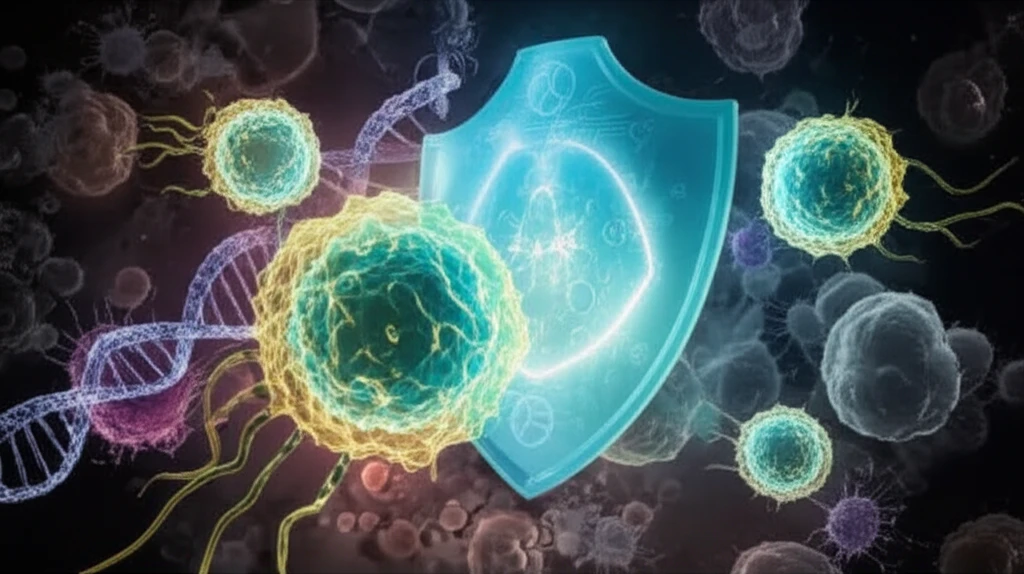
Macrophages interacting with cancer cells in a tumor microenvironment.

Macrophages and Cancer: Unlocking the Secrets of POTEE

"New research reveals how POTEE expression in macrophages influences tumor development, offering potential new targets for cancer immunotherapy."


The battle against cancer is a complex one, with the tumor microenvironment playing a crucial role in determining the disease's progression. Among the key players in this environment are macrophages, immune cells that can either promote or suppress tumor growth. Understanding how macrophages interact with cancer cells is essential for developing effective therapies.

Recent research has focused on a specific protein called POTEE, which is expressed in macrophages. While POTEE's role in cancer has been previously linked to various tumor types, its function within immune cells, particularly macrophages, has remained largely unexplored. This lack of understanding prompted scientists to investigate POTEE's expression and function in macrophages and its potential impact on tumor development.

This article delves into the findings of a new study that sheds light on POTEE's role in macrophages and how it influences the tumor microenvironment. We will explore how POTEE expression is regulated in different macrophage subtypes, its interaction with other proteins involved in cancer progression, and its potential as a therapeutic target for cancer immunotherapy.

POTEE: A Key Regulator in Macrophages

Macrophages interacting with cancer cells in a tumor microenvironment.

The study's findings reveal that POTEE is specifically expressed in macrophages, but not in other immune cells like monocytes or T-cells. This selective expression suggests a unique role for POTEE in macrophage function. Further investigation showed that POTEE expression remains relatively stable in different macrophage subtypes (M1 and M2), regardless of various stressors, except under hypoxic conditions mimicking the tumor environment.

Under these hypoxic conditions, specifically when exposed to factors secreted by breast cancer cells (MDA-MB-231), macrophages exhibited increased POTEE expression. This upregulation was associated with the acquisition of tumor-associated macrophage (TAM) characteristics, which are known to promote tumor growth and metastasis.

  • Increased POTEE Expression: Hypoxia and tumor-secreted factors upregulate POTEE in macrophages.
  • TAM Characteristics: Increased POTEE expression correlates with macrophages adopting a tumor-promoting phenotype.
  • mTORC2 Activation: POTEE interacts with mTORC2, a key signaling pathway involved in cell growth and survival.
Researchers further discovered that POTEE interacts with mTORC2, a crucial signaling pathway involved in cell growth, survival, and metabolism. This interaction appears to be critical for macrophages to acquire their tumor-promoting characteristics. Blocking POTEE expression through siRNA resulted in decreased mTORC2 signaling and reduced macrophage survival, highlighting POTEE's importance in macrophage function within the tumor microenvironment.

Implications and Future Directions

This research provides valuable insights into the role of POTEE in macrophage function and its contribution to the tumor microenvironment. The finding that POTEE expression is upregulated under hypoxic conditions and promotes TAM characteristics suggests that targeting POTEE could be a promising strategy for cancer immunotherapy.

By inhibiting POTEE expression or disrupting its interaction with mTORC2, it may be possible to reprogram macrophages from tumor-promoting to tumor-suppressing cells. This approach could potentially disrupt tumor growth, prevent metastasis, and enhance the efficacy of existing cancer therapies.

Further research is needed to fully elucidate the mechanisms by which POTEE regulates macrophage function and its interaction with the tumor microenvironment. Clinical trials are also necessary to evaluate the safety and efficacy of POTEE-targeted therapies in cancer patients. Nevertheless, this study provides a solid foundation for future investigations and highlights the potential of POTEE as a novel target for cancer immunotherapy.

About this Article -

This article was crafted using a human-AI hybrid and collaborative approach. AI assisted our team with initial drafting, research insights, identifying key questions, and image generation. Our human editors guided topic selection, defined the angle, structured the content, ensured factual accuracy and relevance, refined the tone, and conducted thorough editing to deliver helpful, high-quality information.See our About page for more information.

This article is based on research published under:

DOI-LINK: 10.1016/j.cellimm.2018.10.010, Alternate LINK

Title: Identification Of Mφ Specific Potee Expression: Its Role In Mtorc2 Activation Via Protein-Protein Interaction In Tams

Subject: Immunology

Journal: Cellular Immunology

Publisher: Elsevier BV

Authors: Umeshkumar Vekariya, Kavita Rawat, Reshu Saxena, Raj Kamal Tripathi

Published: 2019-01-01

Everything You Need To Know

1

What is POTEE, and where is it found?

POTEE is a protein specifically expressed in macrophages, a type of immune cell. The research shows that POTEE expression is linked to the tumor microenvironment and its regulation within macrophages. This specific expression sets POTEE apart, suggesting a distinct role in macrophage function compared to other immune cells like monocytes or T-cells.

2

Why is the upregulation of POTEE important?

The upregulation of POTEE is significant because it is associated with macrophages acquiring tumor-associated macrophage (TAM) characteristics. TAMs promote tumor growth and metastasis. When macrophages are exposed to hypoxic conditions and factors secreted by breast cancer cells (MDA-MB-231), POTEE expression increases, leading to the macrophages taking on a tumor-promoting role within the tumor microenvironment.

3

What is the role of mTORC2 in this context, and how does it relate to POTEE?

mTORC2 is a key signaling pathway involved in cell growth, survival, and metabolism. The research revealed that POTEE interacts with mTORC2. This interaction is critical for macrophages to acquire their tumor-promoting characteristics. Blocking POTEE expression decreases mTORC2 signaling and reduces macrophage survival, highlighting POTEE's role within the tumor microenvironment.

4

How could targeting POTEE potentially help in cancer treatment?

The research suggests that targeting POTEE could be a viable cancer immunotherapy strategy. Since POTEE expression is upregulated under hypoxic conditions and promotes TAM characteristics, blocking POTEE could potentially reduce the tumor-promoting effects of macrophages within the tumor microenvironment. This could lead to inhibiting tumor growth and metastasis.

5

What were the main findings of this research?

The research focused on POTEE expression in macrophages and its impact on the tumor microenvironment. Key findings include the selective expression of POTEE in macrophages, upregulation of POTEE under hypoxic conditions, the association of POTEE expression with TAM characteristics, and the interaction of POTEE with mTORC2. These findings collectively provide new insights into how POTEE influences tumor progression and open potential new avenues for cancer treatment.

Newsletter Subscribe

Subscribe to get the latest articles and insights directly in your inbox.