
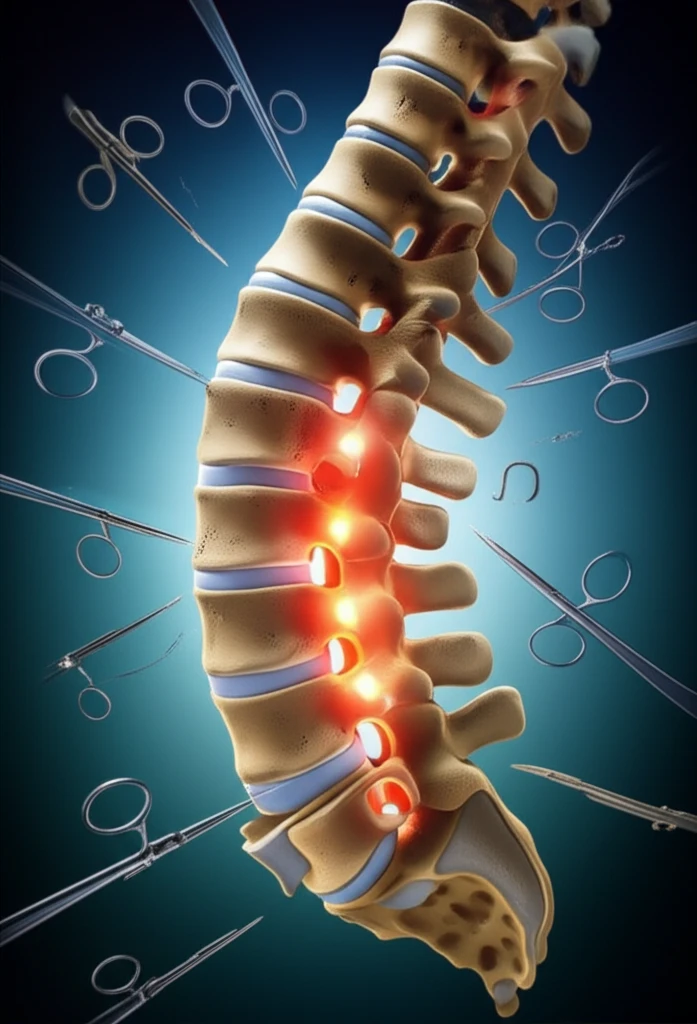
Illustration of lumbar fusion surgery, depicting fused vertebrae, surgical tools, and a patient finding relief.

Lumbar Fusion: What You Need to Know About This Back Pain Treatment

"Explore the realities of lumbar fusion, a surgical procedure for back pain, from understanding its purpose to evaluating its effectiveness and risks."


Back pain can be a debilitating condition, severely impacting daily life. When conservative treatments fail, lumbar fusion surgery emerges as a potential solution. This procedure, which involves the permanent joining of vertebrae in the lower back, aims to alleviate pain and restore function. But what exactly does it entail, and is it the right choice for you?

This comprehensive guide dives into the world of lumbar fusion, offering an in-depth look at its purpose, the conditions it treats, and the steps involved. We'll explore the procedure itself, the recovery process, and the potential benefits and risks. Whether you're a patient considering this option, a caregiver, or simply curious, this article provides a clear, easy-to-understand overview.

By breaking down complex medical information into accessible terms, we hope to empower you with the knowledge to make informed decisions about your back health. Let's explore the details of lumbar fusion, ensuring you're well-equipped to navigate your journey to a pain-free life.

What is Lumbar Fusion Surgery, and Why Is It Performed?

Illustration of lumbar fusion surgery, depicting fused vertebrae, surgical tools, and a patient finding relief.

Lumbar fusion is a surgical procedure designed to stabilize the spine by permanently connecting two or more vertebrae in the lower back. The goal is to reduce pain and improve function for individuals suffering from severe back problems that haven't responded to other treatments. This surgery involves using bone grafts and, sometimes, hardware like screws and rods to create a solid, immobile segment of the spine.

The primary aim of lumbar fusion is to alleviate pain and enhance the patient's quality of life. This is achieved by eliminating motion between the affected vertebrae, thereby reducing the strain on nerves and muscles that cause pain. It's often considered when there's spinal instability or excessive movement that leads to chronic discomfort. The procedure can also help correct spinal deformities, such as scoliosis.

  • Severe back pain not relieved by other treatments.
  • Spinal instability or excessive movement.
  • Spinal deformities like scoliosis.
  • Degenerative disc disease.
  • Spondylolisthesis (a condition where one vertebra slips over another).
The decision to undergo lumbar fusion is a serious one, typically considered after other, less invasive treatments have been exhausted. These may include physical therapy, pain medication, injections, and lifestyle adjustments. The surgery is usually recommended when these methods fail to provide adequate relief or when there's a significant structural problem in the spine.

Conclusion: Making Informed Decisions About Your Back Health

Understanding lumbar fusion surgery is crucial for anyone facing chronic back pain. By understanding the procedure, its benefits, and potential risks, patients can make informed decisions in consultation with their healthcare providers. Lumbar fusion offers a pathway to pain relief and improved quality of life for those who have exhausted other options. As with any surgical intervention, a thorough understanding of the process and a realistic expectation of outcomes are essential for a successful recovery and a return to a more active life.

About this Article -

This article was crafted using a human-AI hybrid and collaborative approach. AI assisted our team with initial drafting, research insights, identifying key questions, and image generation. Our human editors guided topic selection, defined the angle, structured the content, ensured factual accuracy and relevance, refined the tone, and conducted thorough editing to deliver helpful, high-quality information.See our About page for more information.

This article is based on research published under:

DOI-LINK: 10.3233/bme-181004, Alternate LINK

Title: Biomechanical Evaluation Of Four Surgical Scenarios Of Lumbar Fusion With Hyperlordotic Interbody Cage: A Finite Element Study

Subject: Biomedical Engineering

Journal: Bio-Medical Materials and Engineering

Publisher: IOS Press

Authors: Zhenjun Zhang, Guy R. Fogel, Zhenhua Liao, Yitao Sun, Xuejun Sun, Weiqiang Liu

Published: 2018-09-17

Everything You Need To Know

1

What is lumbar fusion and what is its main purpose?

Lumbar fusion is a surgical procedure that permanently connects two or more vertebrae in the lower back. Its primary purpose is to stabilize the spine, reduce pain, and improve function for individuals suffering from severe back problems that haven't responded to other treatments. The process involves using bone grafts, and sometimes hardware like screws and rods, to create a solid, immobile segment of the spine, eliminating motion between the affected vertebrae and reducing strain on nerves and muscles that cause pain.

2

Under what conditions is lumbar fusion typically considered as a treatment option?

Lumbar fusion is considered when individuals experience severe back pain unrelieved by other treatments, spinal instability or excessive movement, spinal deformities like scoliosis, degenerative disc disease, or spondylolisthesis (a condition where one vertebra slips over another). It is usually recommended after less invasive treatments, such as physical therapy, pain medication, injections, and lifestyle adjustments, have failed to provide adequate relief.

3

What happens during the lumbar fusion procedure?

During lumbar fusion, the surgeon aims to stabilize the spine by permanently joining two or more vertebrae in the lower back. This involves using bone grafts, and sometimes hardware like screws and rods, to create a solid, immobile segment. By eliminating motion between the affected vertebrae, lumbar fusion reduces strain on nerves and muscles, alleviating pain. This can also help correct spinal deformities, such as scoliosis.

4

What non-surgical treatments are usually tried before considering lumbar fusion, and why is surgery reserved as a later option?

Before considering lumbar fusion, doctors typically recommend non-surgical treatments such as physical therapy, pain medication, injections, and lifestyle adjustments. Lumbar fusion is usually reserved as a later option because it is a major surgical procedure with potential risks and a longer recovery period compared to non-invasive methods. The goal is to exhaust all less invasive treatments before resorting to surgery to address the back pain.

5

If lumbar fusion eliminates motion between vertebrae, what are the potential long-term implications for the spine's overall function and mobility?

While lumbar fusion aims to alleviate pain by eliminating motion between specific vertebrae, it's important to acknowledge that this immobility can have long-term implications. Adjacent segments of the spine may experience increased stress and wear, potentially leading to adjacent segment disease, where problems develop in the vertebrae above or below the fused segment. The extent of these effects can vary based on individual factors such as age, activity level, and the number of fused segments. Physical therapy and lifestyle modifications may be needed to maintain overall spinal health and mobility. The original text focuses on benefits but doesn't address the long-term impacts on other spine segments, which is a crucial aspect for patient education.

Newsletter Subscribe

Subscribe to get the latest articles and insights directly in your inbox.