
Back Pain Breakthrough: How New Fusion Techniques Offer Hope

"A Deep Dive into Hyperlordotic Interbody Cages and Finite Element Analysis"
Chronic back pain affects millions, significantly impacting their quality of life. Lumbar spinal fusion, a common surgical procedure, aims to alleviate this pain by stabilizing the spine. The procedure involves fusing vertebrae together, often using interbody fusion cages to provide structural support while the bones heal and fuse.
However, lumbar fusion isn't without its challenges. Subsidence, where the fusion cage sinks into the vertebral body, is a serious complication. Understanding the biomechanical factors that contribute to subsidence is crucial for improving surgical outcomes and minimizing risks. Researchers are continuously exploring new techniques and technologies to enhance the effectiveness and longevity of lumbar fusion.
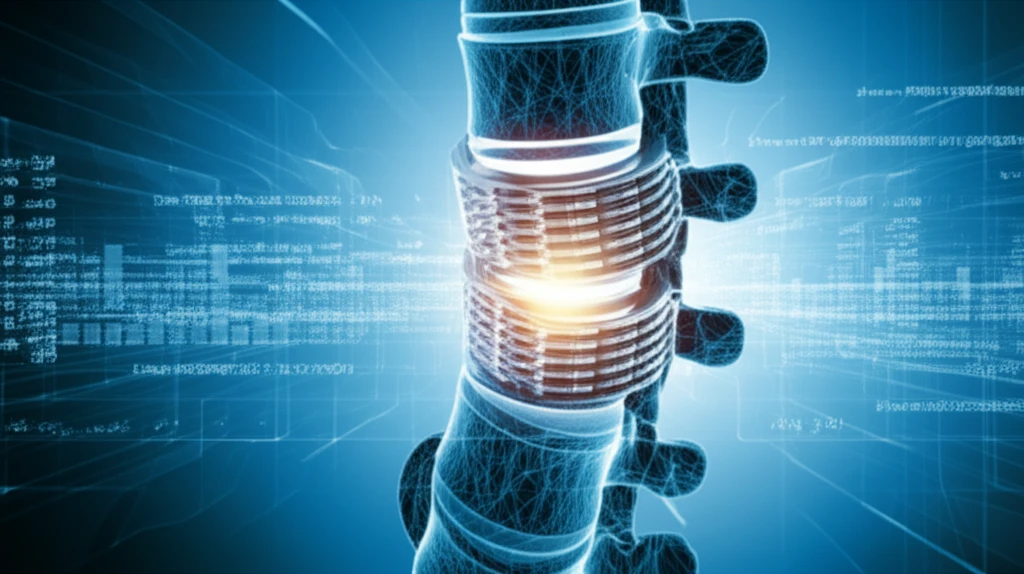
One promising area of advancement involves the use of hyperlordotic interbody cages, designed with an increased angle to better restore the spine's natural curvature. These cages, combined with sophisticated analysis techniques like finite element analysis (FEA), offer surgeons a more precise way to plan and execute lumbar fusions, potentially reducing complications and improving patient outcomes.
Back Pain by the Numbers
Chronic back pain remains one of the most prevalent causes of disability worldwide, affecting millions of adults and contributing substantially to healthcare costs and lost productivity. While exact figures vary by region and study methodology, the burden is widely acknowledged to be growing as populations age. Spinal fusion is among the most commonly performed surgical interventions for persistent spinal conditions, yet outcomes vary and ongoing research aims to improve patient selection and surgical technique.
How Spinal Fusion Is Currently Performed
Spinal fusion surgery typically involves joining two or more vertebrae using bone graft material, often augmented with instrumentation such as rods, screws, or interbody cages to stabilize the segment. Standard approaches include posterior lumbar interbody fusion, anterior lumbar interbody fusion, and lateral techniques, each with distinct advantages depending on the pathology. However, limitations persist, including adjacent segment disease, pseudarthrosis (failure to fuse), and prolonged recovery times, prompting ongoing innovation.
From Ancient Roots to Modern Techniques
Spinal fusion surgery has a longer history than many realize, with early efforts dating back centuries before the modern era. According to published historical reviews, the vast majority of technological advances have occurred within the past 50 years, building on a rich foundation of innovation and resourcefulness among earlier surgeons. The most conservative and crude techniques of the past laid the groundwork for contemporary lumbar spinal fusion approaches. As outcomes continue to improve for patients with cervical and thoracolumbar pathology, understanding this historical trajectory remains important.
What is Finite Element Analysis (FEA) and Why Does It Matter?
Finite Element Analysis (FEA) is a powerful computer simulation technique used to predict how an object will behave under specific conditions. In the context of lumbar fusion, FEA allows researchers and surgeons to model the spine and fusion cage, simulating various stresses and movements. This helps them understand how different surgical scenarios affect the spine's biomechanics.
- Optimizing Cage Design: FEA helps engineers design interbody cages that distribute stress evenly, minimizing the risk of subsidence.
- Evaluating Surgical Techniques: By simulating different surgical approaches, FEA can identify the most stable and effective methods for lumbar fusion.
- Personalized Treatment Planning: FEA can be used to create patient-specific models, allowing surgeons to tailor the fusion procedure to the individual's unique anatomy and condition.
Emerging Techniques and Innovations in Lumbar Fusion
Recent peer-reviewed literature from the last five years highlights a trend toward minimally invasive surgical techniques, alongside innovations in robotics, augmented reality, computer-assisted navigation, and artificial intelligence. A systematic review published in the Journal of Clinical Medicine evaluated 32 eligible studies from 2020 to 2025, documenting advancements in day-case lumbar fusion surgery. Additionally, a 2025 study from the Texas Back Institute reported positive clinical outcomes for patients undergoing hybrid spine surgery—combining disc replacement at one level with fusion at an adjacent level—in a series of 305 patients. These developments suggest a trajectory toward more precise, less invasive, and increasingly personalized spinal care.
Where Fusion Falls Short
Despite its widespread use, spinal fusion is not without significant criticism and documented failures. Concerns persist about the risk of adjacent segment disease, where unfused segments accelerate degeneration after surgery. Pseudarthrosis—failure to achieve solid bony fusion—remains a complication that can necessitate revision surgery. Some researchers also question whether fusion is overutilized for conditions that might respond equally well to conservative management, raising debates about surgical appropriateness and healthcare resource allocation.
Fusion vs. Nonoperative Treatment
A systematic review and meta-analysis published in 2025 examined the effectiveness and safety of spinal fusion compared with conservative management for lumbar degenerative pathology, noting that the relative benefits remain controversial. A separate comparative study of 93 patients with chronic radicular lumbar spondylopathy evaluated long-term outcomes of spinal fusion versus non-surgical treatment. Both analyses underscore the complexity of treatment decision-making, with the evidence suggesting that fusion may benefit certain patient populations while outcomes for others remain inconclusive. The controversy highlights the need for personalized treatment strategies rather than a one-size-fits-all approach.
The Future of Lumbar Fusion: A Personalized Approach
The study highlights the potential of FEA and hyperlordotic interbody cages to improve lumbar fusion outcomes. While the ALL had little effect on biomechanics after lumbar fusion with a hyperlordotic interbody cage, bilateral pedicle screws significantly decreased stress in the cage and endplate. As technology advances, we can expect even more sophisticated tools and techniques to emerge, leading to more personalized and effective back pain treatments.
Expert Perspectives on Current Techniques
A comprehensive review of lumbar spinal fusion techniques highlighted meaningful differences among interbody fusion approaches regarding surgical technique, clinical outcomes, and complication profiles. Expert consensus from the Chinese Study Group for Lateral Lumbar Spine Surgery, established using a modified Delphi method, provides guidance on the clinical application of lateral lumbar interbody fusion (LLIF), including grade A recommendations for specific indications. Together, these sources suggest that technique selection should be individualized based on pathology, patient anatomy, and institutional expertise, rather than a single dominant approach.
What Comes Next for Spinal Fusion
The future of spinal fusion is likely to be shaped by continued integration of artificial intelligence, robotics, and navigation technologies aimed at improving precision and reducing complications. Ongoing research into biologics—such as stem cell therapies and growth factors—may enhance fusion rates and reduce the need for autograft harvesting. Personalized medicine approaches, including genetic profiling to predict fusion success, could further refine patient selection. As techniques continue to evolve, the goal remains to achieve better outcomes with less invasive interventions.
Beyond the Operating Room
Widespread adoption of advanced fusion techniques faces systemic challenges, including disparities in access to specialized spine centers, high costs of instrumentation and technology, and variable insurance coverage. Training requirements for new minimally invasive and robotic-assisted procedures demand substantial investment from healthcare systems. Additionally, the growing volume of spinal surgery raises questions about appropriate utilization and the need for evidence-based guidelines to ensure resources are directed toward patients most likely to benefit.
What Fusion Means for Patients
For patients living with chronic back pain, fusion surgery represents a potential pathway to improved function and quality of life, though outcomes depend on careful candidacy selection and realistic expectations. Recovery timelines vary widely, and many patients require dedicated rehabilitation to achieve optimal results. The human impact extends beyond pain relief—successful surgery can restore independence, return individuals to work, and improve mental health. As techniques advance, the central promise of spinal fusion remains the alleviation of suffering for those who have exhausted conservative options.