
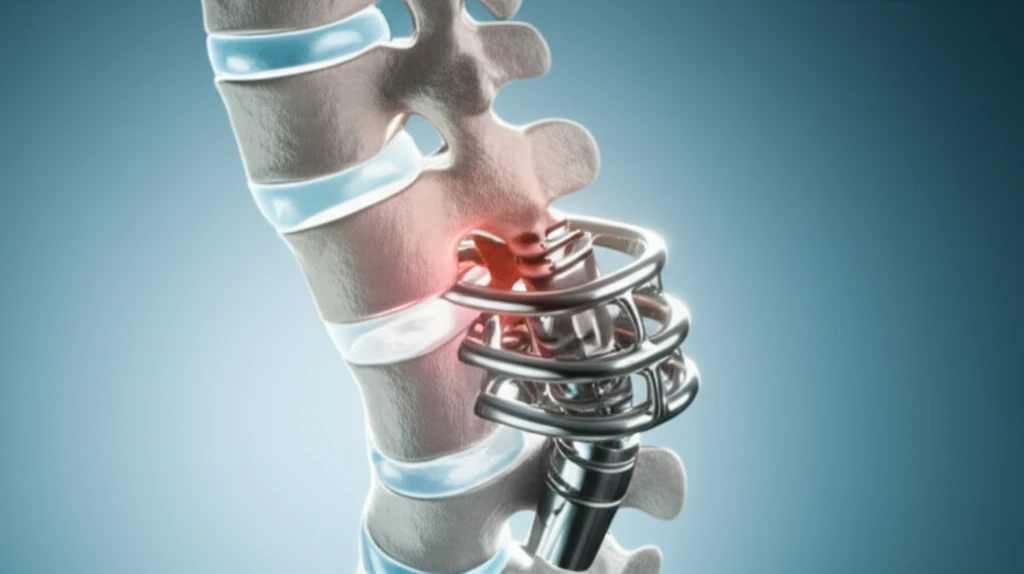
Illustration of a spine with an interbody cage being implanted, representing innovation in back pain treatment.

Lumbar Fusion Breakthrough: New Insights Could Revolutionize Back Pain Treatment

"Groundbreaking research explores innovative surgical techniques for spinal fusion, potentially improving outcomes for millions."


Back pain is a widespread and often debilitating condition affecting millions worldwide. For many, lumbar spinal fusion surgery offers a path to relief. This procedure involves fusing vertebrae in the lower back, aiming to stabilize the spine and alleviate pain. However, the effectiveness and long-term outcomes of this surgery have been the subject of ongoing research and debate.

Recent studies have turned their focus to innovative techniques and technologies, with the goal of enhancing the fusion process and improving patient outcomes. A key area of interest is the use of hyperlordotic interbody cages – devices designed to provide structural support and promote bone fusion. These cages are implanted between the vertebrae to facilitate the healing process.

This article explores a groundbreaking finite element study that has delved deep into the biomechanics of lumbar fusion. The research examines the effects of different surgical scenarios involving hyperlordotic cages, providing new insights into the factors that influence the success of spinal fusion. This information could lead to more effective surgical approaches and improved patient outcomes, offering renewed hope for those battling back pain.

Unveiling the Study: Surgical Scenarios and Biomechanical Analysis

Illustration of a spine with an interbody cage being implanted, representing innovation in back pain treatment.

The research, published in the journal Bio-Medical and Materials Engineering, meticulously analyzed four different surgical scenarios. These scenarios were simulated using finite element analysis (FEA), a sophisticated computer modeling technique that allows researchers to study the biomechanical behavior of the spine under various conditions. The focus was on how different surgical techniques, particularly those involving hyperlordotic interbody cages, impact the spine.

The surgical scenarios examined included variations in the anterior longitudinal ligament (ALL) – a key structure that provides stability to the spine – and the use of pedicle screws, which are often used to provide additional support. The FEA models allowed the researchers to assess various factors, including the range of motion, facet joint forces, and the stress on the cage and surrounding structures.

  • ALL Intact: The anterior longitudinal ligament was left intact.
  • ALL Resected: The anterior longitudinal ligament was surgically removed.
  • ALL Intact with Bilateral Pedicle Screws: The anterior longitudinal ligament was intact, and pedicle screws were used.
  • ALL Resected with Bilateral Pedicle Screws: The anterior longitudinal ligament was removed, and pedicle screws were used.
The study's findings revealed that the use of bilateral pedicle screws significantly reduced stress on the cage and endplates, as well as lowering facet contact force. This suggests that the inclusion of pedicle screws could be beneficial in improving the stability of the fusion and potentially reducing the risk of complications. Furthermore, the research indicated that the ALL had a minimal impact on the overall biomechanics after lumbar fusion, suggesting that its preservation or resection may not significantly alter the outcomes of the surgery.

Implications and Future Directions

This study provides valuable insights into the biomechanics of lumbar fusion and offers potential improvements in surgical techniques. The findings support the use of bilateral pedicle screws to enhance stability and potentially reduce the risk of complications. Although more research is needed, these advancements offer hope for improved outcomes and a better quality of life for individuals suffering from back pain. Future studies should focus on refining surgical techniques, optimizing cage designs, and further investigating the long-term effects of lumbar fusion.

About this Article -

This article was crafted using a human-AI hybrid and collaborative approach. AI assisted our team with initial drafting, research insights, identifying key questions, and image generation. Our human editors guided topic selection, defined the angle, structured the content, ensured factual accuracy and relevance, refined the tone, and conducted thorough editing to deliver helpful, high-quality information.See our About page for more information.

Everything You Need To Know

1

What is Lumbar Spinal Fusion, and how is it used to treat back pain?

Lumbar spinal fusion is a surgical procedure designed to alleviate back pain by fusing vertebrae in the lower back. This involves joining two or more vertebrae together, which stabilizes the spine and reduces movement at the affected levels. The primary goal of Lumbar Spinal Fusion is to eliminate pain caused by instability or other issues within the spine. The procedure can provide significant relief for individuals suffering from chronic back pain.

2

How do hyperlordotic interbody cages contribute to the success of Lumbar Spinal Fusion?

Hyperlordotic interbody cages play a crucial role in Lumbar Spinal Fusion by providing structural support and promoting bone fusion between the vertebrae. These devices are implanted between the vertebrae to facilitate the healing process. The design of the hyperlordotic cage helps to maintain the correct spinal alignment and create an environment that encourages the bone to grow and fuse together, which is critical for the long-term success of the surgery. This fusion stabilizes the spine and reduces pain.

3

What are the key findings regarding the Anterior Longitudinal Ligament (ALL) in Lumbar Spinal Fusion, according to the study?

The study revealed that the Anterior Longitudinal Ligament (ALL) had a minimal impact on the overall biomechanics after Lumbar Spinal Fusion. This suggests that preserving or resecting the ALL may not significantly alter the outcomes of the surgery. The study's findings indicate that the presence or absence of the ALL does not substantially change the long-term success of spinal fusion, offering surgeons flexibility in their approach without compromising patient outcomes. The use of Pedicle Screws has higher impact.

4

What is the significance of using bilateral pedicle screws in Lumbar Spinal Fusion, and how was this determined?

The use of bilateral pedicle screws in Lumbar Spinal Fusion was found to significantly reduce stress on the cage and endplates, as well as lowering facet contact force, as determined by finite element analysis (FEA). This indicates that pedicle screws enhance the stability of the fusion and potentially lower the risk of complications. FEA, a sophisticated computer modeling technique, was used to simulate different surgical scenarios. This allowed researchers to study the biomechanical behavior of the spine under various conditions, providing evidence of the screws' benefits.

5

What are the future directions for research in Lumbar Spinal Fusion based on the study's conclusions?

Future studies should focus on refining surgical techniques, optimizing cage designs, and further investigating the long-term effects of Lumbar Spinal Fusion. The research highlights the importance of continued advancements in surgical approaches, potentially leading to improved patient outcomes and quality of life for those suffering from back pain. Further investigation into these areas could lead to even more effective and less invasive procedures in the future, providing new hope for individuals with chronic back issues.

Newsletter Subscribe

Subscribe to get the latest articles and insights directly in your inbox.