
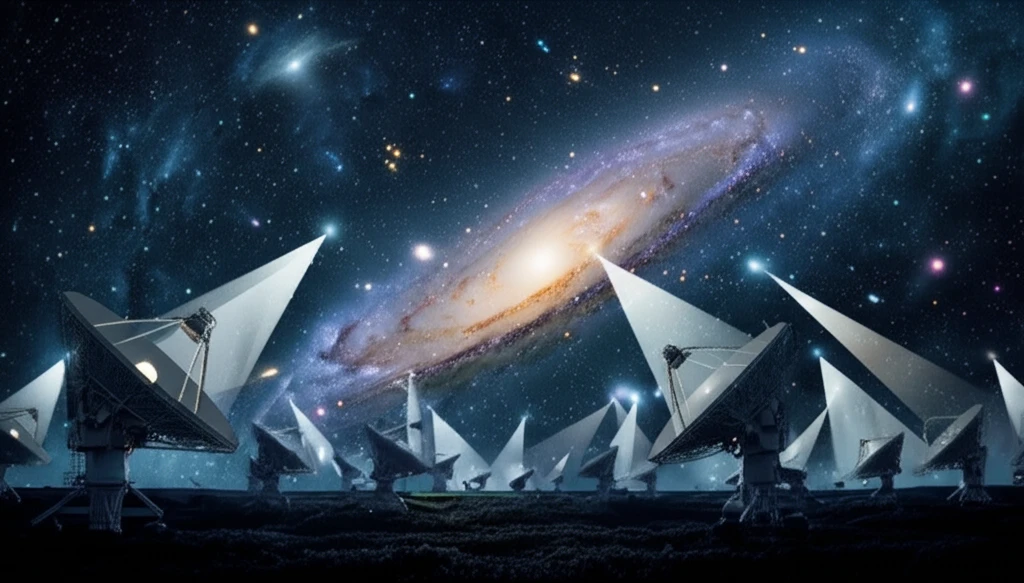
Lost in Space? How Astronomers Correct Blurry Cosmic Images

"Discover how phase-referencing VLBI observation corrections are revolutionizing our understanding of the universe and keeping our cosmic maps sharp."
Imagine trying to take a picture of something incredibly far away. Now, imagine doing it through a thick, swirling atmosphere that distorts everything. That's the challenge astronomers face when observing the universe using Very Long Baseline Interferometry (VLBI). This technique combines data from telescopes across vast distances to create images of incredibly high resolution. However, Earth's atmosphere and other factors can blur these images, leading to a loss of coherence. It's like trying to listen to a symphony with someone constantly changing the volume – the clarity is lost.
In a world of technological marvels, the details matter. In astronomy, those details come from observing the sky with the most precise instruments we have. VLBI is one such method, allowing scientists to resolve astronomical objects with unprecedented clarity. But the devil is in the details, and in this case, the 'devil' is the atmospheric and instrumental errors that can corrupt observations. Correcting these errors is vital to getting an accurate picture of the cosmos.
The original research paper, "Coherence loss in phase-referenced VLBI observations (Corrigendum)" by Martí-Vidal et al., addresses a critical error in a previously published equation. This equation is used to model the relationship between the limiting dynamic range (the ability to see faint objects near bright ones) and the angular distance between a target and a calibrator (a reference point). The correction ensures that the images we create from VLBI data are as accurate as possible.
A Global Network at Scale
Very long baseline interferometry works because many radio telescopes are operated together as a single array, with networks spanning entire continents. The International VLBI Service for Geodesy and Astrometry maintains an archive of astrometric and geodetic VLBI observations spanning 1979 to 2023, which serves as the basis for statistics on the technique's reach and usage. Facilities such as HartRAO participate in regional networks like the European VLBI Network, while Australian telescopes form arrays capable of VLBI observations. Wide-field VLBI surveys have also been applied to science cases such as measuring the AGN fraction in the COSMOS field at 1.4 GHz, including the faint radio population.
Sharp Eyes, Narrow Field
VLBI delivers extremely high angular resolution because it requires very high brightness temperatures for a detection, which makes it a reliable way to identify active galactic nuclei. The trade-off is that conventional VLBI has tiny fields of view, which makes it impractical to observe many sources at once. Coherence is also a limiting factor: experiments at 89 GHz using hydrogen maser frequency standards show that, under good atmospheric conditions, coherence can be maintained for only up to about 700 seconds. Because distance, propagation effects, and wavelength limitations do not disappear, they instead have to be modeled, calibrated, and accounted for through long-duration observations and precise synchronization.
From Michelson to a Black Hole
On the morning of 17 April 1967, radio astronomers made the first successful very long baseline interferometry observations using telescopes at DRAO and the Algonquin Radio Observatory, located 3074 km apart. The technique has deeper roots: the history of using interferometry to improve angular resolution goes back to Michelson's stellar interferometer in the early 1920s. Modern VLBI links telescopes whose signals are combined over baselines of up to 10,000 km, yielding detail about 50 times greater than the Hubble Space Telescope. In recent years the technique has been extended further, for example when ALMA joined VLBI observations of Sagittarius A*, the Galactic Center supermassive black hole, at 86 GHz.
The Quest for Sharp Cosmic Images: Understanding VLBI Corrections
To truly grasp the significance of this correction, it's important to understand how VLBI works. Think of it as a giant, Earth-sized telescope. By combining signals from multiple telescopes, astronomers can achieve the resolving power of a telescope as large as the distance between the antennas. This allows them to see incredibly fine details in distant objects like quasars, black holes, and even the surfaces of stars. VLBI is essential for studying the universe at the highest possible resolution.
- Improved image clarity and resolution
- More accurate measurements of astronomical object positions
- Enhanced ability to study faint objects near bright sources
- Greater confidence in scientific results based on VLBI data
From Dying Stars to the Early Universe
Recent peer-reviewed work shows VLBI probing an extraordinary range of cosmic objects. Studies have used VLBI to observe OH maser stars such as S Persei, reported in New Astronomy Reviews. Elsewhere, e-VLBI observations of the GRB 080409 afterglow with an Australasian network demonstrated the capability to form a large regional array, with data transported and processed in real time over high-capacity networks. Multi-frequency VLBI observations have also been applied to the gravitational lens system B0218+357, and VLBI measurements of the quasar VIK J2318-3113 push the technique out to a redshift of z = 6.44.
The Case for the Defense
Far from being a story of failure, VLBI's record includes its most celebrated triumph: the first horizon-scale images of the two most accessible supermassive black holes. A review in Astrophysics and Space Science characterizes these achievements as a VLBI success story. Advances in the technique are credited with enabling imaging at horizon scales that was previously out of reach. The source material presents this as a positive narrative rather than one of setbacks.
Measuring the Measurement
Comparisons between VLBI analyses reveal how analysis choices affect the results. One study of standard analysis runs shows baseline length repeatability plotted against baseline length for different cutoff elevation angles, varied in steps of 5 degrees from 5 to 25 degrees in the SOLVE software, using the first four epochs of VLBI observations from 1998. Continuous (CONT) VLBI campaigns have been carried out about every three years since 2002 to capture state-of-the-art data, and simultaneous CONT17 networks have been compared in terms of Earth orientation parameters (EOP) and scale. The same style of comparison exposes where theory and practice diverge: VLBI-derived nutation time series leave residuals of roughly 200 microarcseconds in rms against the MHB model, revealing imperfections in both the theory and the VLBI observing and analysis strategies.
The Ever-Sharpening View of the Universe
The correction of this equation is a testament to the ongoing refinement of astronomical techniques. Science is a process of continuous improvement, and even seemingly small corrections can have a significant impact on the accuracy and reliability of our understanding of the universe. By ensuring the precision of VLBI observations, astronomers can continue to push the boundaries of our knowledge, revealing the hidden wonders of the cosmos with ever-increasing clarity. These corrected calculations reinforce the importance of refining our tools and techniques to ensure that the pictures we create of the universe are as accurate as possible. As technology evolves and new methods emerge, it's likely that even more details will come into focus, painting an increasingly vivid picture of our universe.
Filtering the Cosmos
Expert commentary frames VLBI as a filter: it allows only the most compact non-thermal emission to be isolated from radio survey data. This selectivity is what makes the technique so valuable, but it carries a cost. The observational and computational demands of applying VLBI to large surveys have, until recently, been too high to make it practical. That constraint explains why wide-field VLBI survey work has been slow to arrive.
Automated and Continental in Scale
The next generation of geodetic VLBI, the VLBI Global Observing System (VGOS), targets continuous observations and delivery of initial geodetic products in less than 24 hours. Meeting that goal will require a fully automated VLBI analysis chain so results can be made available in near-real time. In parallel, new collaborations are extending coverage across the globe, such as the East Asia to Italy Nearly Global (EATING) VLBI project, which grew out of cooperation between Korean, Japanese, and Italian researchers studying compact sources.
Coordination as the Core Challenge
VLBI depends fundamentally on coordinated networks of radio telescopes working together to achieve super-high angular resolution, with arrays spanning whole continents or even including antennas in space. The systemic challenge is that every observation inherits environmental effects: atmospheric impacts and the effects of Earth's shape are always present in the data. VLBI is particularly well suited to coping with these because it can determine all five parameters of Earth's orientation without making hypotheses about them. That capability makes the technique foundational to how astronomers and geodesists separate astrophysical signals from Earth-bound contamination.
More Than Cosmic Pictures
Beyond imaging, VLBI has a concrete role in everyday life: it is a fundamental geodetic observation method that observes and records measurements of Earth's position, tilt, and speed of rotation, and it is the only method that does so, underlining its importance to the toolkit of geodetic techniques. On the scientific side, researchers are motivated to push VLBI to higher frequencies as a desirable way to increase angular resolution and open up new fields of science investigation. These threads come together in practice, such as in a partnership described in Australia aimed at improving position, navigation, and timing services. The technique thus spans the arc from pure science to navigation and timing infrastructure.