
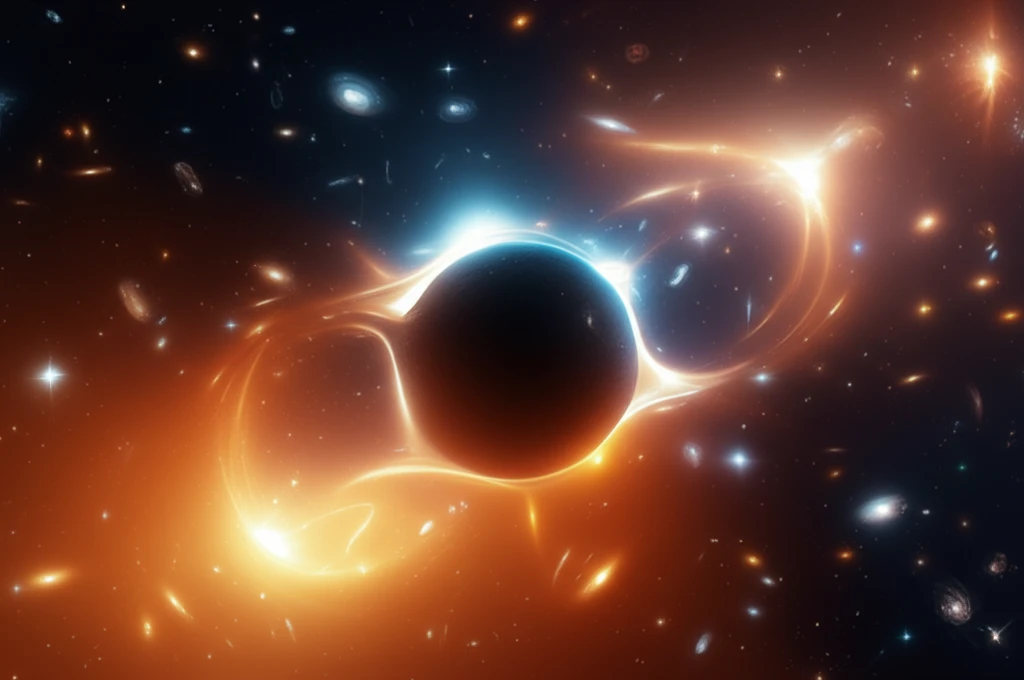
Unlocking the Universe's Secrets: How Cosmic Infrared Background Helps Map Dark Matter

"Delving into the innovative use of cosmic infrared background (CIB) to illuminate the universe's hidden structures."
Imagine the universe as a vast, intricate tapestry woven with stars, galaxies, and unseen structures. For decades, scientists have been developing methods to map the distribution of matter, including the elusive dark matter that makes up a significant portion of the cosmos. Gravitational lensing, the bending of light by massive objects, has emerged as a powerful tool in this endeavor. By observing how light from distant sources is distorted, researchers can infer the presence and distribution of intervening mass, offering insights into the universe's underlying framework.
Traditionally, gravitational lensing studies have focused on two primary sources: the cosmic microwave background (CMB) and individual galaxies. The CMB, the afterglow of the Big Bang, provides a pristine canvas for mapping the large-scale structure of the universe. Galaxy surveys, on the other hand, allow scientists to probe the distribution of matter on smaller scales by analyzing the shapes and orientations of distant galaxies. Now, a new player has entered the field: the cosmic infrared background (CIB).
The CIB, a diffuse glow of infrared light emitted by countless dusty star-forming galaxies, offers a unique perspective on the universe's structure. Unlike the CMB, which originates from a single epoch in cosmic history, the CIB is sourced by galaxies spanning a wide range of redshifts, or distances. This makes it an ideal probe of the universe's structure at intermediate redshifts, bridging the gap between galaxy surveys and CMB lensing studies.
The Cosmic Infrared Background: A Window into the Universe
The cosmic infrared background represents one of the most significant yet challenging observational frontiers in modern astrophysics. While precise current measurements remain elusive, this diffuse radiation field is believed to encode crucial information about the history of star formation, galaxy evolution, and the distribution of dark matter across cosmic time. Understanding the CIB has become increasingly important as researchers seek to map the invisible scaffolding of the universe that shapes the large-scale structure we observe today.
Measuring the Cosmic Infrared Background
The cosmic infrared background (CIB) was established as an energetically important background with an intensity comparable to other cosmic backgrounds, peaking at around 100 µm. Researchers use dedicated instruments like the Cosmic Infrared Background Experiment 2 (CIBER-2), a sounding-rocket payload designed to measure intensity and spatial fluctuations of the near-infrared extragalactic background light over wavelengths from 0.5 to 2.0 micrometers. Space telescopes such as Spitzer have placed lower limits on CIB brightness at multiple wavelengths and measured extragalactic number counts from various surveys. Despite these measurement efforts, significant limitations persist in the accuracy of existing EBL intensity measurements, though breakthroughs continue to emerge from sky intensity observations.
A Century of Discovery
The study of cosmic infrared backgrounds traces back to the first half of the 19th century, when researchers first recognized the cosmological importance of the night sky's darkness—a concept known as Olbers' paradox—and began speculating about extragalactic background light. The cosmic infrared background records much of the radiant energy released by structure formation processes that have occurred since the decoupling of matter and radiation following the Big Bang. It represents the collective infrared radiation emitted by cosmic sources throughout the history of the universe, including sources inaccessible to current telescopes. These early observations laid the groundwork for understanding how this background radiation could serve as a powerful tool for studying the universe's evolution.
CIB Lensing: A New Window on the Cosmos
Recent research has demonstrated the potential of using the CIB as a source for gravitational lensing studies. By analyzing the distortions in CIB maps, scientists can reconstruct the distribution of matter along the line of sight, providing valuable information on the amplitude of structure at intermediate redshifts. This approach complements existing lensing techniques and offers new insights into the formation and evolution of galaxies and the overall structure of the universe.
- Bridging the Gap: CIB lensing probes intermediate redshifts between galaxy surveys and CMB lensing.
- Star-Formation History: Constrains CIB halo models and informs about the universe's star-formation.
- Structure Amplitude: Provides constraints on the amplitude of structure at different cosmic times.
Current Research Frontiers
The cosmic infrared background intensity ranges from 45 to 170 nW m−2 sr−1, with 76 nW m−2 sr−1 as the nominal value, as determined by direct measurements from COBE that provided significant insights into the CIB, notably at 140 and 240 µm. Modeling the anisotropies in the cosmic infrared background on all scales remains a challenging task due to the complex nature of galaxy evolution and the numerous parameters required to fit observational data. Researchers are actively studying data on galaxy creation collected by experiments launched from facilities like Virginia's Wallops Island Flight Facility. Comprehensive reviews of infrared background measurements continue to discuss implications for past and present cosmic processes, advancing our understanding of this fundamental cosmological observable.
Unresolved Challenges
The cosmic infrared background represents the aggregate far-infrared to millimeter-wavelength radiation produced by dust emission in galaxies, integrating the energy released by star formation and active galactic nuclei (AGN) over all cosmic epochs. Despite its theoretical importance, significant uncertainties remain in separating the true extragalactic signal from foreground contamination, including emission from our own galaxy and solar system. The complex interplay between different emission mechanisms makes it difficult to definitively attribute observed signals to specific cosmological processes. These challenges highlight the need for more sophisticated observational techniques and theoretical models to fully exploit the CIB as a probe of cosmic structure formation.
Multi-Wavelength Perspectives
The cosmic infrared background is the sum total of redshifted and reprocessed short-wavelength radiation from the era of galaxy formation, containing vital information about the history of galactic evolution. In optical and near-infrared background light, excess brightness and fluctuations over known backgrounds have been reported, suggesting possible contributions from sources beyond standard galaxy populations. The bolometric optical and infrared background is approximately 100 nW/m2/sr, providing an energetic benchmark for comparing different wavelength observations. These multi-wavelength studies reveal that the CIB has been detected in both far-infrared and near-infrared windows through interplanetary dust, though measurements between 5-60 µm remain impossible from Earth's orbit at 1 AU.
The Future of CIB Lensing
As data from current and future experiments become available, CIB lensing promises to become an increasingly powerful tool for unraveling the mysteries of the universe. By combining CIB lensing with other cosmological probes, scientists will be able to create a more complete and accurate picture of the universe's structure, evolution, and composition. The journey into the depths of the cosmos continues, guided by the faint but informative glow of the cosmic infrared background.
Consensus and Interpretations
The cosmic infrared background accounts for approximately half of the total background radiation, emitted in the 8-1000 microns range and peaking around 150 microns. This emission is attributed to dust reemission from star formation processes and AGN activity, representing a fundamental component of the universe's energy budget. Recent studies indicate that current cosmic infrared background estimates can be explained by known galaxies and their faint companions at redshifts greater than 4. These findings suggest that while the CIB contains valuable cosmological information, much of it may originate from well-understood astrophysical sources rather than exotic phenomena.
Advancing Our Understanding
The cosmic background radiation spectrum has been precisely measured by instruments like COBE, providing temperature data that serves as a foundation for all subsequent infrared background studies. New Horizons has successfully measured the background light of the universe, demonstrating that multiple background radiations—including infrared and gravitational wave backgrounds—provide complementary windows into cosmic history. The cosmic infrared background is fundamentally the radiation from stars in many faint galaxies, with the near-infrared and optical parts representing starlight redshifted into longer wavelengths. These ongoing measurements continue to refine our understanding of how the universe's light budget has evolved over cosmic time.
The Bigger Picture
The cosmic infrared background can be defined as the part of the present radiation content of the universe that consists essentially of the long wavelength output from all sources throughout the history of the universe. Extracting large-scale fluctuations from this cosmic light background is the primary goal of dedicated experiments like the Cosmic Infrared Background Experiment (CIBER), which seeks to reveal clues about some of the most intriguing astrophysical conundrums. One of the most important questions about the CIB concerns the source of its energy, with early models suggesting it was built up from the redshifted spectra of galaxies found in our cosmic neighborhood. These systemic challenges in measurement and interpretation continue to drive innovation in observational techniques and theoretical frameworks.
Observational Achievements
The Planck satellite's High Frequency Instrument (HFI) has mapped anisotropies of the Cosmic Infrared Background across four frequency channels, observing patches of sky covering 26 square degrees—approximately 130 times the area of the full Moon. These observations represent significant technological achievements that require sophisticated instruments and international collaboration. Studies examining the contribution of galaxies to the 3.4 µm cosmic infrared background using data from WISE have highlighted remaining tensions among different techniques for estimating extragalactic background light. These measurement efforts demonstrate how advances in instrumentation and data analysis continue to push the boundaries of what we can learn about the universe's infrared background radiation.