
Liquid Crystal Breakthrough: Graphene Oxide Gets a Non-Polar Makeover

"Scientists have discovered a way to manipulate graphene oxide liquid crystals, opening doors to advanced materials and applications."
Graphene, a two-dimensional carbon material, has captivated scientists with its remarkable properties, paving the way for innovations in electronics, mechanics, and thermal applications. However, harnessing the full potential of graphene requires overcoming challenges in its production and dispersion. One promising avenue involves graphene oxide (GO), a derivative of graphene that can be chemically exfoliated in liquid phases, offering a pathway to large-scale production of graphene sheets.
GO possesses unique characteristics, including high colloidal stability in water due to the electrostatic repulsion of negatively charged oxygen groups. Notably, GO can form liquid crystal (LC) phases in water, presenting exciting opportunities for creating advanced 2D graphene-based composites. The challenge, however, lies in extending these LC phases to organic solvents, especially non-polar ones, which are crucial for various applications.
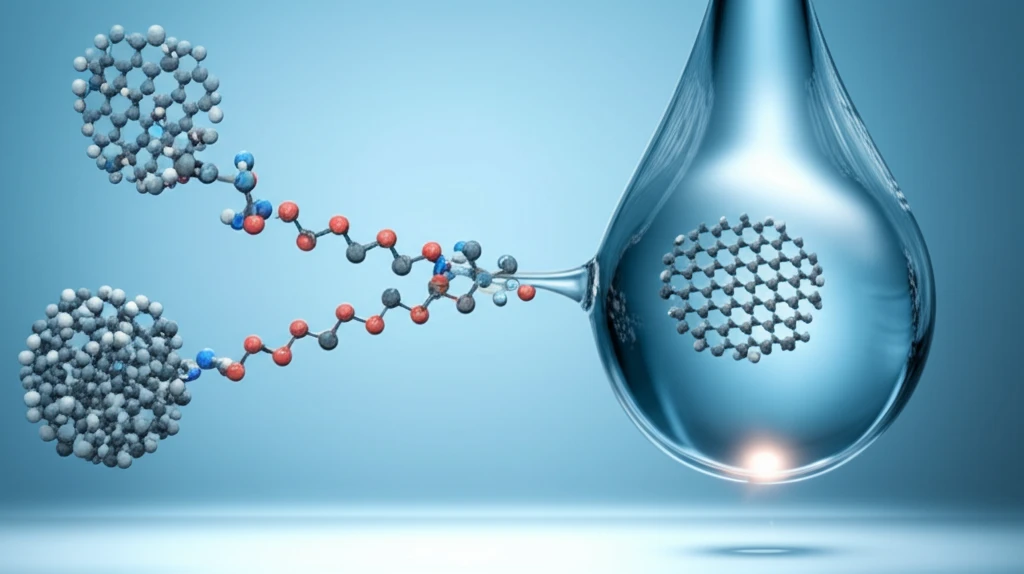
Recent scientific advancements have introduced a novel technique using poly(ionic liquid)s (PILs) to facilitate the dispersion of graphene oxide liquid crystals (GOLCs) from aqueous solutions into non-polar organic phases. This groundbreaking approach not only broadens the range of solvents in which GOLCs can exist but also opens new possibilities for material design and application.
Market Growth and Fundamental Properties
The global graphene oxide liquid crystal market reached USD 369.6 million in 2025 and is projected to grow at a CAGR of 18.4% during the forecast period. Graphene oxide liquid crystals (GO LCs) consist of macroscopically ordered GO flakes dispersed in water or polar organic solvents. Since their first report in 2011, GO LCs have attracted considerable attention for their fundamental properties and potential device applications. This combination of strong market trajectory and rich scientific potential underscores the material's significance in both industry and research.
The Polar-Solvent Paradigm and Its Constraints
Conventional GO liquid crystal preparation relies on dispersing graphene oxide flakes in water or polar organic solvents, a well-established route since the material's initial demonstration. Despite many production methods, applications of graphene-based structures are hindered by high costs, lack of scalability, and limitations in spatial patterning. These practical barriers have constrained the transition of GO LCs from laboratory curiosities to widespread commercial deployment. Overcoming these hurdles—particularly the dependency on polar solvents—remains a key challenge for the field.
From Discovery to Mass Production Potential
Graphene oxide liquid crystals emerged as a new class of carbon-based liquid crystals when GO was first shown to form ordered mesophases in dispersion. The material is the oxygenated form of monolayer graphene platelets, giving it amphiphilic character essential for liquid crystal formation. A significant milestone is that GO liquid crystals could be mass produced from naturally abundant graphite, offering a new route to high-performance nanocomposites. Several contributions have since been made in graphene-based liquid crystalline fiber spinning, one of GOLC's most popular research areas.
The Science Behind the Breakthrough
The key innovation involves using poly(ionic liquid)s (PILs), specifically a novel PIL called [PEP-MIM]DBS, to act as a phase-transfer agent. This agent enables the transportation of GO from water to organic solvents, all while preserving the GOLC phase. The PIL works by noncovalently interacting with GO, effectively decorating the GO nanosheets and preventing them from aggregating. This is crucial because once water is removed from GO, the sheets tend to clump together due to electrostatic and π-π interactions, making it difficult to redisperse them in organic solvents.
- Overcoming Aggregation: PILs prevent GO sheets from clumping together in non-polar solvents.
- Expanding Solvent Options: Previously limited to polar solvents, GOLCs can now exist in non-polar environments.
- Non-Covalent Interaction: The PILs interact with GO without forming strong chemical bonds, preserving the GO's structure.
- Versatile Applications: This method opens doors to new material designs and applications for graphene-based composites.
Structure-Property Relationships and Phase Control
Recent comprehensive reviews have overviewed the structure-property relationship of graphene oxide liquid crystals, providing a unified framework for understanding mesophase behavior. Researchers have highlighted various synthetic methods and parameters that can be optimized for GOLC phase formation, advancing the field's predictive capability. GO LCs are described as the latest class of 2D nanomaterials exhibiting colloidal liquid crystallinity arising from the intrinsic disc-like shape anisotropy of the flakes. These reviews collectively mark a maturation of the field from discovery-oriented work toward systematic, design-driven research.
Persistent Limitations in Polar-Solvent Systems
Despite sustained research attention since the first report in 2011, GO liquid crystals formed in water or polar organic solvents continue to face unresolved practical challenges. The reliance on polar media limits compatibility with many industrial processes and non-polar matrix materials. Scalability and spatial patterning remain difficult, with cost barriers further impeding commercial adoption. These persistent limitations suggest that the standard aqueous and polar-solvent approaches may not alone be sufficient for broad real-world deployment.
Graphene Oxide LCs Among 2D Material Liquid Crystals
Among 2D material liquid crystals for optoelectronics and photonics, graphene oxide stands out for its electro-optic switching capabilities in back-illuminated liquid crystal display applications. The large Kerr coefficient of graphene oxide liquid crystals, as observed by Shen and colleagues, facilitates electro-optic switching and positions GO LCs competitively against other 2D material LC platforms. This comparative advantage in Kerr-effect response makes GO LCs a particularly promising candidate for display technologies where fast switching and low power consumption are required. The field of 2D material LCs continues to expand, with GO remaining a leading material due to its unique combination of optical and rheological properties.
The Future of Graphene Oxide
This research marks a significant step forward in graphene oxide research, providing a practical method to prepare non-polar solvent-soluble GO sheets that can form LCs. By using PILs to decorate the GO sheets, scientists can now explore a wider range of applications for these materials, potentially leading to breakthroughs in areas such as advanced electronics, sensors, and composite materials. The ability to manipulate GO in non-polar solvents opens up new avenues for creating innovative materials with tailored properties and functionalities.
Giant Flakes and Biphasic Transitions
Researchers have reported liquid crystals formed by giant graphene oxide flakes with aspect ratios above 10,000 suspended in water, demonstrating that even extremely large GO particles can self-assemble into ordered mesophases. As concentration increases, these giant flakes undergo transitions from isotropic dispersion to a biphasic system and then to a discotic nematic liquid crystal. This progressive phase behavior provides a clear roadmap for controlling GO LC properties through concentration tuning. GO-dispersed colloidal liquid crystals are now considered to offer more opportunities for functional material design.
Novel Trends in Lyotropic Liquid Crystals
Novel trends in lyotropic liquid crystals point toward graphene oxide as a driving force for the next wave of innovation in the field. Research into GO liquid crystals, their properties, and dispersions with other lyotropic liquid crystal classes is expected to be an exciting area in the coming years. One promising direction involves liquid crystalline dispersions of graphene oxide for multifunctional textiles, bridging the gap between fundamental soft-matter science and applied materials engineering. These emerging trends suggest the field is expanding well beyond traditional display applications into diverse functional material domains.
Environmental and Health Considerations
As graphene oxide liquid crystals move toward broader application, their environmental and health implications require careful scrutiny. Studies have demonstrated that graphene affects a wide range of living organisms, including prokaryotes, bacteria, viruses, plants, micro and macroinvertebrates, and mammals. These findings raise important questions about the lifecycle impacts of GO-based materials, from production through disposal. Addressing these systemic challenges will be essential for ensuring that the promise of GO LCs does not come at an unacceptable environmental cost.
From Lab Bench to Industrial Application
Graphene oxide is playing a crucial role in the large-scale production of minimal-layer-stacked graphene, serving as a bridge between academic research and real-world industrial application. The half-liquid, half-solid state of GO LCs flows like a viscous fluid while its molecules assemble into neat rows, making liquid crystals an ideal starting material for fiber spinning—a process analogous to Kevlar production. Lyotropic liquid crystals based on GO also exhibit lubricating properties due to their ordered assembly and fluidity, with mesogens characterized by amphiphilic properties. These real-world characteristics position GO LCs as versatile materials for energy, structural, and biomedical applications.