
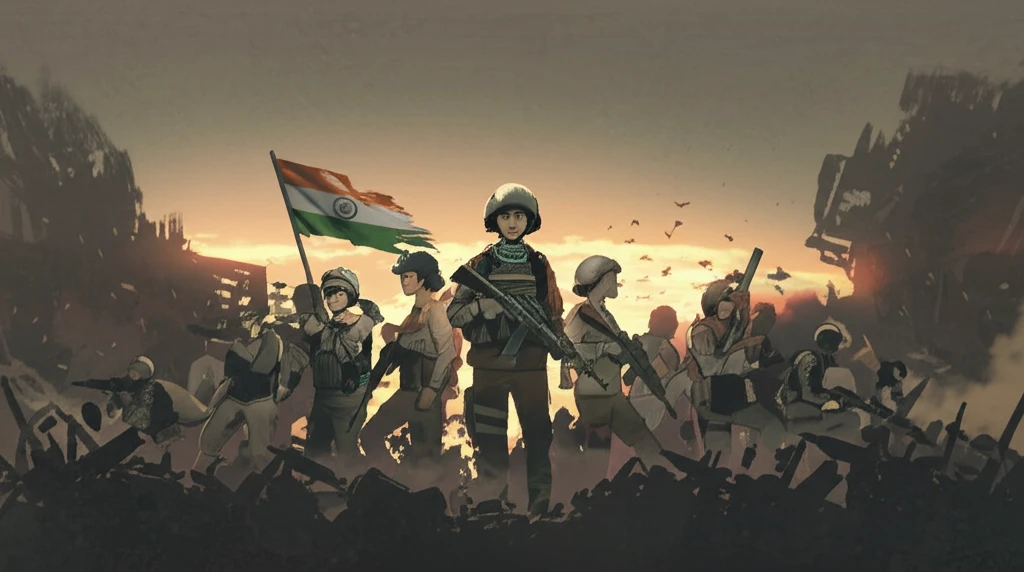
Level Up: How HR Policies are Finally Changing the Game for Women in the Indian Army

"Discover the groundbreaking empirical study revealing the impact of HR policies on gender inclusion in the Indian Army—and what it means for the future of women in service."
For years, the conversation around gender inclusion in traditionally male-dominated fields has been a slow burn. But now, a recent study is throwing light on just how much impact strategic human resources (HR) policies can have. The focus? The Indian Army, an institution undergoing significant shifts to integrate women fully into its ranks.
The research delves into the intricate relationship between HR policies and gender inclusion, revealing not just the presence of women, but the quality of their integration. It's about belonging, feeling valued, and having the support to bring your best self to the table—something that benefits not only the individuals but the entire organization. A gender-inclusive workforce is proven to drive performance, and the Indian Army is no exception.
This isn't just about hitting diversity quotas; it's about fundamentally reshaping an institution to reflect the values of equality and inclusion. The study draws from firsthand accounts of officers across different branches, combined with a thorough review of existing literature, providing a comprehensive look at the challenges and opportunities at play.
People Behind the Numbers
Behind all the statistics, data, and numbers are people, and HR leads and their teams often work into the night and over weekends to ensure that changes are reflected in companywide updates, policies, and processes by the time Monday morning arrives. Official bodies such as the UK's Office for National Statistics exist to keep such measurement independent, while aggregators like Statista consolidate figures from more than 22,500 sources. Onboarding statistics that HR leaders rely on show how early experience shapes retention, one of the clearest practical measures of policy impact. The takeaway is that credible impact figures must sit alongside attention to the human effort that produces policy change.
The Cost Approach and Its Limits
The dominant framework for putting a value on human capital is the cost approach, which HR accounting specialists describe as the only method of Human Resource Accounting based on sound accounting principles and policies. Its limitations are well documented: the valuation method rests on the false assumption that the dollar is stable, which distorts figures under inflationary conditions. The pattern recurs across fields — advances in machine transliteration and explainable AI for medical data are all published with explicit treatments of methods and limitations. This consistent pairing of method with limitation is exactly the discipline that policy analysis should apply when measuring the impact of HR reforms.
What Milestones Really Mean
The word 'milestone' carries an older, physical meaning: etymological records trace it to a stone set up to mark distance along a road, and the term has since come to signify any significant point in a process. Institutions often use the milestone framing to narrate history, as the U.S. State Department did with its series 'Milestones in the History of U.S. Foreign Relations.' That series, however, has now been retired by the Office of the Historian and is no longer maintained. The retired series is a useful caution for any organization compiling its own history: milestone narratives are living documents that eventually require updating or closure, so the Indian Army's milestones on women officers will need continual validation.
Unpacking the Study: Key Findings on HR and Inclusion
So, what did the study uncover? By using confirmatory factor analysis and multivariate analysis of variance, the researchers pinpointed specific HR policies that are making a tangible difference. These policies aren't just feel-good measures; they're directly linked to creating a more supportive and equitable environment for women in the Army.
- Opportunities for professional development and skill enhancement.
- Ensuring comfortable working relationships between all members of the army.
- Cultivating positive attitudes and behaviors from male officers towards their female counterparts.
- Promoting open communication and information sharing across genders.
From Systems Thinking to Peer-Reviewed Evidence
The most directly relevant recent review examines systemic thinking in HR, asking how organisational architecture affects collective well-being and performance, and it builds on a long research lineage that includes Guest's 1997 'human resource management and performance' research agenda. The surrounding evidence ecosystem supports this direction: Frontiers publishes peer-reviewed, open-access articles across academia, and PsyPost reports the latest scientific psychology research for broader audiences. A peer-reviewed study on AI-assisted creativity in gaming, hosted on ScienceDirect, illustrates the kind of interdisciplinary work now informing how organizations think about talent and engagement. Taken together, these sources show current HR research moving from isolated practices toward systemic, architecture-level analysis.
Why Policies Alone Fall Short
A standard counter-argument is that HRM policies and strategies form the foundation of an organization's approach to managing its workforce, guiding decision-making on recruitment, training, and compensation. Yet workplace psychology complicates that assumption: negative self-talk, or the 'inner critic,' limits employee productivity by affecting how workers feel and perform, and no policy document directly controls it. This suggests that formal policy change alone, without addressing internal psychological barriers, may fall short of its intended impact. The gap between policy design and individual experience is precisely where reforms such as the Army's gender-inclusion changes are won or lost.
Side-by-Side: How Tools Get Compared
Comparison is central to how organizations evaluate HR tools, and the available side-by-side analyses are instructive. A review of one-on-one meeting software finds that comprehensive platforms such as Leapsome and Lattice offer significantly more HR modules, while Echometer deliberately focuses on 1:1 meetings and retrospectives instead of full HR management. In recruiting, a 2026 comparison weighs AI-powered recruiting against traditional agencies, recruiter marketplaces, in-house hiring, and tools-only approaches, laying out pros and cons for each. The underlying lesson for policy analysis is that 'best' depends on scope: comprehensive platforms and narrowly focused tools serve different needs, and the same trade-off applies when comparing institutional reform options.
The Road Ahead: Implications and Future Directions
This study is more than just an academic exercise; it's a call to action. The findings provide valuable insights for policymakers and military leaders to refine HR practices and foster a truly inclusive environment. As the Indian Army continues to evolve, embracing these changes will be crucial for attracting and retaining top talent, strengthening the force, and setting a new standard for gender equality in traditionally male-dominated institutions.
Policy Architecture Meets Execution
Expert commentary on HR tends to converge on two things: the architecture of policy and the craft of execution. Investopedia's overview of the field catalogs the standard list of HR policies for a company, treating that list as the backbone of the function. Execution, meanwhile, is where specialist agencies claim their value — as one manpower consultancy in Thane puts it, expert supply agencies excel at filtering, screening, assessing, and scanning applicants to identify the best candidate suited for a particular job. Synthesis across these views suggests that durable change, such as expanding opportunities for women officers, requires both sound policy frameworks and skilled, well-run implementation.
HR's Agentic Era
McKinsey's consulting research points to HR's next phase, urging organizations to escape the 'pilot trap' and build HR for the agentic era while continuing to pursue sustainable inclusive growth. The International Labour Organization's World Employment and Social Outlook examines how digital labour platforms are transforming the world of work, a shift that will reshape where and how workforces are recruited and managed. Statistical agencies are adapting too: the U.S. Bureau of Labor Statistics' Occupational Outlook Handbook tracks emerging employment trends such as jobs in nonfossil fuel electric power generation. Across these outlooks the trajectory is consistent — HR is becoming more technology-driven, inclusive, and data-informed.
Systemic Problems Need Systemic Fixes
Analysts across domains argue that the most serious problems are systemic and therefore demand systemic responses rather than isolated fixes. Work on climate adaptation through agroecology is framed explicitly as 'Systemic Challenges, Systemic Responses,' innovating how farming adapts to climate change, and the authors stress that the views reflect their own analysis rather than official policy. The Next System Project makes a parallel case for the United States, arguing that meeting the country's gravest challenges requires systemic change. The same logic applies to institutional reform in the armed forces: women's integration touches recruitment, training, infrastructure, culture, and policy at once, so piecemeal HR tweaks are unlikely to produce lasting change.
From Human Resources to Human Impact
International HR Day is a moment dedicated to recognizing the critical role human resource professionals play in shaping modern organizations, but advocates argue it should be more than appreciation — it is a call to action. That reframing matches real-world market signals: companies are turning to staffing firms as flexible hiring gains ground, a sign that organizations increasingly prioritize adaptable, people-focused workforce strategies. The practical effect of any policy change ultimately lands in the daily lives of individual employees, which is why lived experience — how people actually experience recruitment, deployment, and career progression — is the true test of reform. For women in the Indian Army, the measure of success will therefore be lived experience rather than policy text alone.