
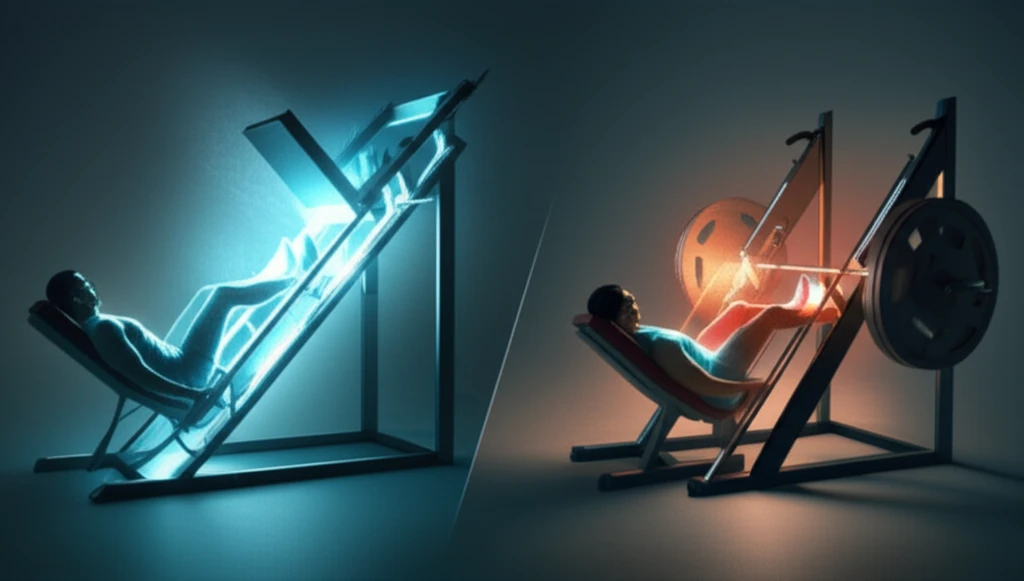
Leg press machine versus Smith machine for quadriceps workout.

Leg Press vs. Smith Machine: Which Builds Stronger Quads?

"Unlock the secrets to maximizing your quadriceps workout: comparing leg press and Smith machine for activation and perceived effort."


When it comes to strengthening your lower body, two exercises often come to mind: the leg press and the Smith machine squat. Both are staples in gyms and rehabilitation centers, but how do they truly stack up against each other? Many believe Smith machine squats provide more instability, requiring greater trunk and lower limb muscle recruitment. On the other hand, leg presses are often considered easier for beginners and those recovering from injuries.

While individual preferences and training goals play a significant role, understanding the specific muscle activation and perceived exertion levels of each exercise is crucial. This knowledge allows athletes and coaches to make informed decisions about exercise selection and load management, ensuring optimal results and minimizing the risk of injury.

This article dives into a study comparing quadriceps activation and perceived exertion during leg press and Smith machine exercises. The goal is to provide insights into how to effectively convert loads between these two exercises to achieve similar levels of muscle engagement and perceived effort. Ultimately, it aims to equip you with the knowledge to fine-tune your leg workouts for maximum effectiveness.

Decoding Muscle Activation: Leg Press vs. Smith Machine

Leg press machine versus Smith machine for quadriceps workout.

Researchers set out to compare the activity of the vastus lateralis and vastus medialis—two key quadriceps muscles—during both leg press and Smith machine exercises. They also measured the overall perceived exertion (RPE) reported by participants at different load levels. Sixteen experienced male athletes participated in the study, performing both exercises with increasing weight until exhaustion.

The study used electromyography (EMG) to measure muscle activity, capturing the electrical signals produced by the vastus lateralis and vastus medialis. Participants also rated their perceived exertion using the CR10 scale, a common tool for assessing exercise intensity.

The key findings revealed some interesting differences:
  • Muscle Activation: While both exercises activated the quadriceps, the relationship between load and muscle activity varied between individuals, making it difficult to create a universal equation for predicting muscle activation.
  • Perceived Exertion: RPE proved to be a more reliable indicator of overall effort, showing a stronger correlation with the exercise load compared to individual muscle activity.
Based on these findings, the researchers developed two sets of equations: one for predicting muscle activation and another for predicting perceived exertion. The RPE-based equations proved more accurate due to the high variability in muscle activation patterns among individuals. This suggests that perceived exertion is more closely tied to the overall intensity of the exercise than the activity of specific muscles.

Fine-Tuning Your Leg Day: Practical Applications

So, what does this mean for your workouts? The study offers some practical insights for athletes and coaches looking to optimize their training:

While converting loads between leg press and Smith machine exercises can be tricky, perceived exertion can be your guide. Pay attention to how hard an exercise feels, and adjust the load accordingly to achieve your desired intensity level.

The researchers emphasize that the equations they developed are a starting point. Individual factors, such as training experience, muscle coordination, and even limb length, can influence muscle activation patterns. Therefore, it's essential to listen to your body and adjust your training based on your own unique needs and responses.

About this Article -

This article was crafted using a human-AI hybrid and collaborative approach. AI assisted our team with initial drafting, research insights, identifying key questions, and image generation. Our human editors guided topic selection, defined the angle, structured the content, ensured factual accuracy and relevance, refined the tone, and conducted thorough editing to deliver helpful, high-quality information.See our About page for more information.

This article is based on research published under:

DOI-LINK: 10.3389/fphys.2018.01481, Alternate LINK

Title: Leg Press Vs. Smith Machine: Quadriceps Activation And Overall Perceived Effort Profiles

Subject: Physiology (medical)

Journal: Frontiers in Physiology

Publisher: Frontiers Media SA

Authors: Gian Mario Migliaccio, Antonio Dello Iacono, Luca Paolo Ardigò, Pierre Samozino, Enzo Iuliano, Zoran Grgantov, Johnny Padulo

Published: 2018-10-23

Everything You Need To Know

1

What was the main objective of the study comparing the leg press and Smith machine exercises?

The primary goal was to compare the muscle activation of the vastus lateralis and vastus medialis, which are key muscles in the quadriceps, during both the leg press and Smith machine exercises. Researchers also aimed to measure and compare the rate of perceived exertion (RPE) experienced by participants during each exercise at varying load levels. Ultimately, the intention was to provide a foundation for converting loads between exercises while maintaining similar levels of muscle engagement and effort.

2

What were the key differences observed in muscle activation and perceived exertion between the leg press and Smith machine exercises?

The study revealed that while both the leg press and Smith machine activated the quadriceps muscles (vastus lateralis and vastus medialis), the correlation between the load and muscle activation varied significantly among individuals. This variability made it challenging to establish a universal equation for predicting muscle activation. However, the rate of perceived exertion (RPE) showed a stronger correlation with the exercise load, making it a more reliable indicator of overall effort than individual muscle activity measurements.

3

What practical implications can athletes and coaches derive from the research on leg press versus Smith machine?

The key takeaway is that rate of perceived exertion (RPE) appears to be a more consistent and reliable measure of exercise intensity than individual muscle activation when comparing the leg press and Smith machine. Due to individual variability in muscle activation patterns, using RPE can help athletes and coaches more accurately gauge and manage the effort levels during workouts. This information allows for better load management and exercise selection, optimizing training outcomes while minimizing injury risks.

4

Which specific methods were employed to measure muscle activation and perceived exertion during the leg press and Smith machine exercises?

The researchers utilized electromyography (EMG) to precisely measure the muscle activity of the vastus lateralis and vastus medialis during both the leg press and Smith machine exercises. Additionally, they employed the CR10 scale to quantify the participants' rate of perceived exertion (RPE), providing a subjective measure of exercise intensity. This combination of objective and subjective measures allowed for a comprehensive comparison of the two exercises.

5

How does the study's emphasis on perceived exertion over muscle activation impact our understanding of exercise intensity and training design for exercises like the leg press and smith machine?

The findings suggest that perceived exertion is more closely tied to the overall intensity of the exercise than the activity of specific muscles like the vastus lateralis and vastus medialis. This is crucial because it highlights the importance of considering individual experiences of effort when designing training programs. For example, if an athlete perceives a higher exertion level during Smith machine squats compared to the leg press at a similar load, it might indicate that the Smith machine recruits more stabilizing muscles or places greater demand on the nervous system. This understanding allows for more personalized and effective training adjustments.

Newsletter Subscribe

Subscribe to get the latest articles and insights directly in your inbox.