
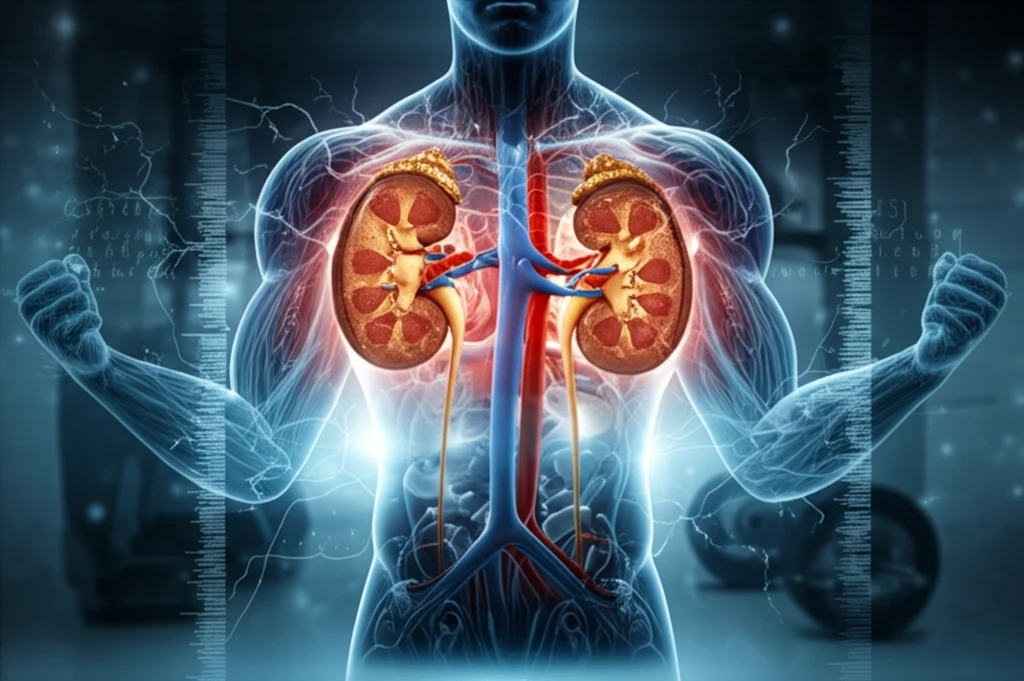
Kidney Health Check: The Ultimate Guide to Muscle Strength & Exercise

"Discover how monitoring muscle health and resistance exercise can transform chronic kidney disease (CKD) management."
Chronic Kidney Disease (CKD) is a major global health concern, affecting a significant portion of the population and increasing the risk of mortality and other health issues. Recent studies highlight a strong connection between CKD and the loss of skeletal muscle mass, which can lead to reduced physical function and a higher risk of cardiovascular problems. Understanding this link is crucial for managing CKD effectively.
The good news is that resistance exercise has emerged as a promising way to counteract muscle loss in CKD patients. By incorporating specific exercises, individuals can improve their muscle strength and overall health. However, more research is needed, especially for those in the early stages of CKD, to fully understand how to optimize these exercise programs. The major evidence comes from studies in patients with end-stage renal disease (ESRD).
This article aims to provide a clear overview of how CKD affects skeletal muscle, why it's important to monitor muscle health, and how to design effective resistance exercise plans to help those with CKD.
A Global and National Health Burden
The World Health Organization estimates that 674 million people worldwide have chronic kidney disease, with most living in low- and middle-income countries. In the United States, NIDDK data indicate that approximately 12% of adults have CKD, which is slightly more common in women (14%) than in men (12%) and affects about 20% of non-Hispanic Black adults. UCSF reports that an estimated 2 million people worldwide currently suffer from kidney failure. Taken together, these figures show a disease that is both strikingly common and concentrated among vulnerable populations.
Defining and Measuring CKD
Chronic kidney disease is defined as the sustained presence of abnormal kidney function or structure for at least three months. The condition varies in severity but usually gets worse over time, and while treatment cannot cure it, it can slow the progression of the disease. Kidney function is tracked through the glomerular filtration rate (GFR), and advanced disease such as stage 4 CKD is marked by a severe decrease to 15-30 ml/min. Initiatives such as the SONG-CKD core outcome project exist in part because standard outcome measures across CKD trials have historically been inconsistent.
From Recognition to Routine Screening
Chronic kidney disease is understood as a gradual loss of kidney function over time, most often caused by diabetes and high blood pressure. It is a common condition estimated to affect roughly nine to thirteen percent of the adult population worldwide. Diagnosis hinges on documenting abnormal kidney function or structure that persists for more than three months. Because the disease is so widespread, taking a careful renal history - including asking about the cause and natural course of a patient's CKD - has become a cornerstone of clinical evaluation.
Understanding Muscle Wasting in CKD
Muscle wasting is a significant concern in CKD because it directly impacts patient outcomes. Studies have shown that muscle loss is associated with a higher risk of death and major cardiovascular events. Maintaining muscle mass is essential for overall health, as it affects protein synthesis and degradation. In CKD, this balance is disrupted, leading to accelerated muscle loss.
- Reduced Physical Function: Individuals with CKD often experience declines in strength and balance.
- Increased Risk of Sarcopenia: The combination of muscle loss and reduced function increases the risk of sarcopenia.
- Mortality Risks: Physical function is a strong predictor of survival in CKD patients.
Earlier Detection and Cost-Effective Care
Recent research highlights both new diagnostic tools and the value of early intervention. Nature reports that a nine-protein plasma signature can predict kidney events and mortality in individuals with a high-risk APOL1 genotype and preserved estimated glomerular filtration rate, outperforming existing clinical and genetic risk tools. A Lancet review concludes that if health-care services ensure early use of cost-effective pharmacological and non-pharmacological treatments across all resource settings, the global burden of CKD complications could be substantially alleviated. A narrative review in PMC notes that with limited treatment options and an aging population carrying more comorbidities, CKD prevalence is set to rise. Newer studies are also exploring approaches such as survival analyses based on time-dependent covariates and heart rate variability to better predict individual disease progression.
The Failure of Early Detection
One of the most persistent failures in CKD care is late diagnosis. Mayo Clinic notes that chronic kidney disease, characterized by progressive damage and loss of kidney function, affects about one in seven American adults. Yet the disease often progresses silently over many years. According to reporting covered by Medical Xpress, many clinicians postpone addressing chronic kidney disease until symptoms emerge or test results worsen, leaving many early-stage patients undiagnosed and poorly informed about their condition.
CKD vs. Acute Kidney Failure: A Contrast in Trajectories
Chronic kidney disease differs sharply from acute renal failure in its trajectory. As Healthline explains, unlike acute renal failure, CKD develops gradually, and the two conditions may each be a risk factor for the other. There is no cure for CKD, though patients can take steps to preserve kidney function for as long as possible, and untreated disease can advance to complete kidney failure. Late-stage disease requires dialysis or transplantation, treatments that Cleveland Clinic and a PMC review both describe as very detrimental and expensive.
The Path Forward
Resistance exercise offers a way to improve muscle health and overall well-being. By understanding the principles of exercise and considering individual needs, healthcare professionals can design effective programs that help people with CKD maintain their strength and live better lives. As research continues, we can expect even more refined strategies to emerge, further enhancing the potential of exercise in CKD management.
Expert Judgment Meets Clinical Trial Data
When projecting long-term outcomes, researchers are increasingly blending formal expert opinion with trial data. One study developed a method that incorporates formally elicited expert opinion into a Bayesian analysis to extrapolate survival in the placebo arm of DAPA-CKD, a phase 3 trial of dapagliflozin in patients with chronic kidney disease. The approach was designed specifically to minimize uncertainty in long-term projections. In clinical practice, SGLT2 inhibitors such as dapagliflozin (marketed as Farxiga) have become a focus of CKD management discussions, with sources outlining both their benefits and risks on the basis of clinical trial evidence.
Slowing the Curve Through Early, Systematic Care
Chronic kidney disease is a long-term condition in which the kidneys don't work as well as they should, usually caused by other conditions that put a strain on the kidneys. Early diagnosis and treatment can help slow the progression of kidney disease, though advanced disease such as stage 4 may require dialysis or other medical interventions. Guidance such as the KDIGO 2012 clinical practice guideline for the evaluation and management of chronic kidney disease has shaped standard care and remains a foundational reference. The future outlook depends largely on how well health systems translate early detection and treatment into routine practice.
A Silent Disease Puts Pressure on Health Systems
Chronic kidney disease often develops quietly and goes unnoticed until it reaches an advanced stage, making it one of the most pressing public health challenges in countries such as Malaysia. Many patients are told a similar story: that CKD is a slow, inevitable decline, driven step by step by high blood pressure, diabetes, and glomerular damage toward dialysis or transplant. Treatment plans tend to follow a familiar sequence rather than seizing earlier opportunities for intervention. That framing, critics argue, overlooks the possibility that CKD progression is not always inevitable and points to a systemic need for earlier, more proactive kidney care.
Millions Affected, Most Unaware
Chronic kidney disease is currently the ninth leading cause of death globally and is projected to become the fifth leading cause by 2040. In Australia alone, an estimated 2.7 million people have biomedical markers of CKD, yet less than 10 percent are aware they have the condition, according to reporting by The Epoch Times. Beyond its toll as a cause of death, CKD presents complex diagnostic and therapeutic challenges because of its heterogeneity and progressive nature, which is prompting efforts to integrate genetic testing into clinical management. These realities underscore how much of the disease's burden remains hidden until it becomes personal.