
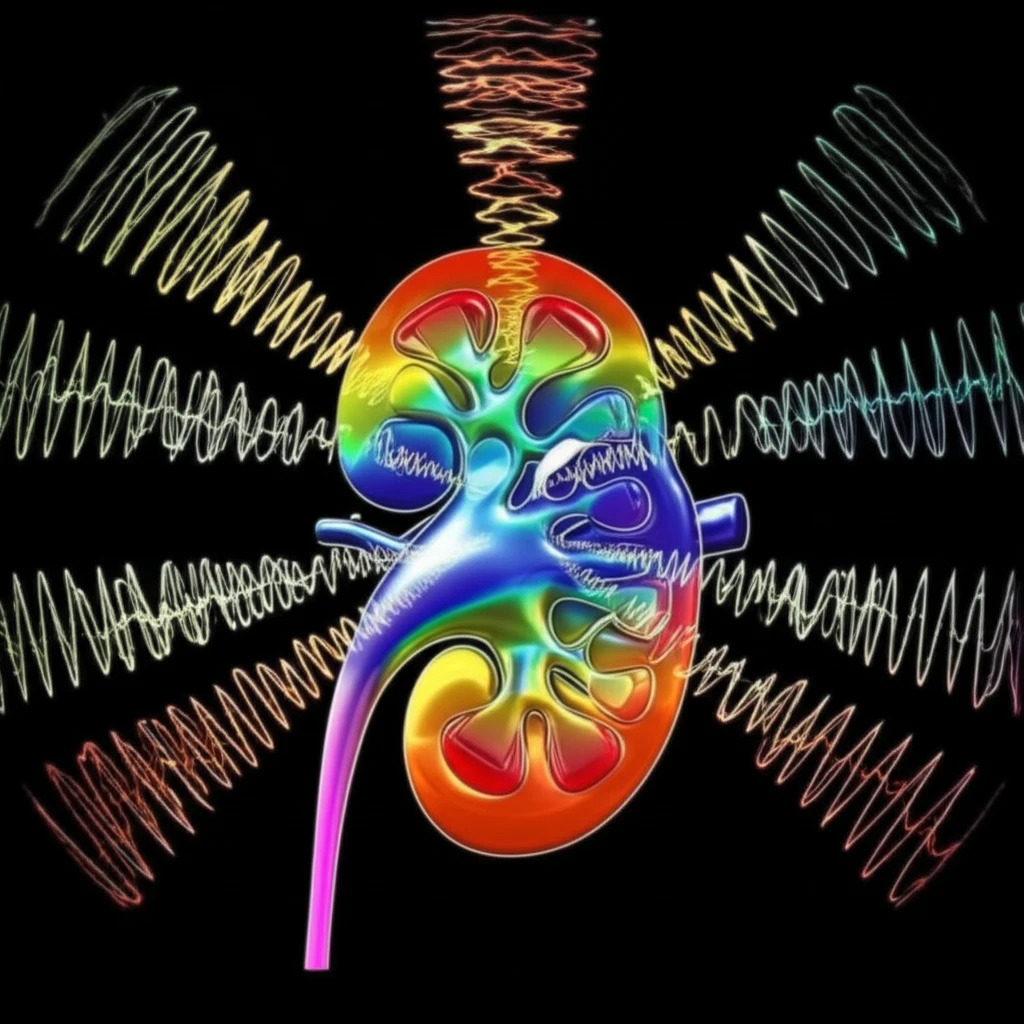
Kidney Health Check: The Latest in Non-Invasive Elastography

"Discover how full-field-of-view time-harmonic elastography (THE) offers a breakthrough in kidney assessment, providing detailed and reproducible insights without the need for biopsies."
Maintaining healthy kidneys is vital, as they play a crucial role in filtering waste and regulating blood pressure. Traditionally, doctors have relied on blood tests to estimate kidney function. However, these tests don't reveal the underlying causes of any issues. Kidney biopsies, while informative, are invasive and carry risks.
That's why researchers are constantly seeking non-invasive methods to assess kidney health. One promising technique is ultrasound elastography (USE), which evaluates tissue stiffness. A new approach within this field, called time-harmonic elastography (THE), offers detailed, full-field-of-view maps of kidney stiffness.
This article explores how THE works, its potential benefits for understanding kidney health, and how it compares to traditional methods. We'll delve into the findings of a recent study that demonstrates THE's reproducibility and ability to differentiate stiffness in different kidney regions.
What is Time-Harmonic Elastography (THE) and How Does It Work?
Time-harmonic elastography (THE) is an advanced ultrasound technique that assesses tissue stiffness by measuring shear wave speed (SWS). Unlike conventional methods that only measure small areas, THE can generate full-field-of-view maps, providing a comprehensive overview of the entire kidney. Here's a breakdown of the process:
- An ultrasound device captures these shear waves.
- Data is then processed by a computer to create a detailed elastogram, a visual map showing the shear wave speed (SWS) throughout the kidney. Areas with higher SWS are stiffer, while areas with lower SWS are softer.
The Future of Kidney Assessment: Non-Invasive and Detailed
Time-harmonic elastography represents a significant step forward in non-invasive kidney assessment. By providing detailed, reproducible maps of kidney stiffness, THE offers a valuable tool for understanding kidney health and potentially detecting problems earlier.
While further research is ongoing, the initial findings are promising. THE's ability to differentiate stiffness in different kidney regions and its high reproducibility make it a strong candidate for clinical applications.
As technology advances, non-invasive techniques like THE are likely to play an increasingly important role in preventative healthcare, enabling earlier detection and more effective management of kidney disease. This could significantly reduce the need for invasive procedures like biopsies and improve patient outcomes.