
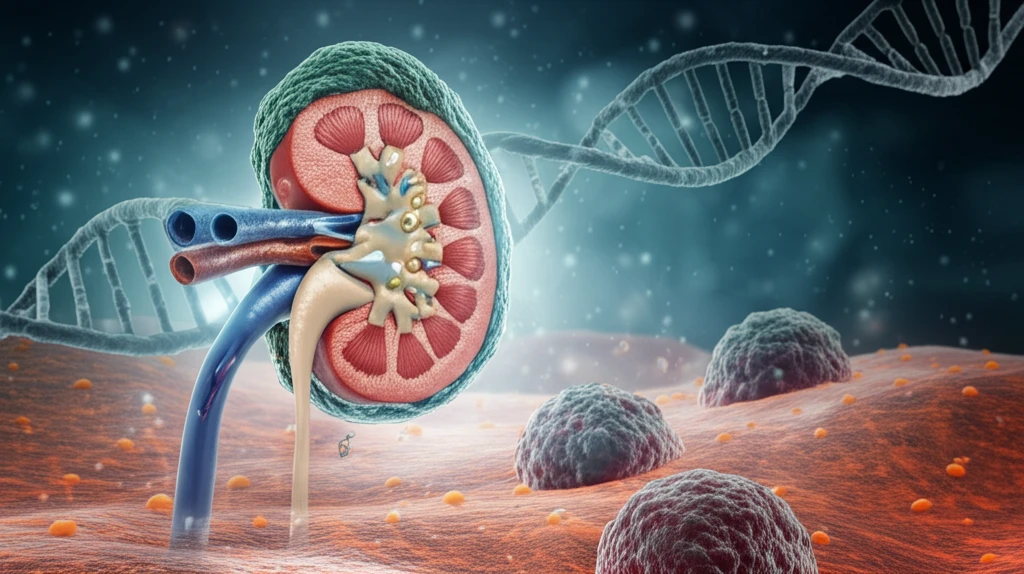
Kidney Health Breakthrough: Silencing TCF8 Gene Prevents Damage from High Glucose and Angiotensin II

"New research reveals how targeting the TCF8 gene could protect podocytes, specialized kidney cells, from the harmful effects of diabetes and hypertension, paving the way for novel therapies to prevent kidney disease."
Our kidneys, the unsung heroes of bodily filtration, work tirelessly to cleanse our blood and maintain overall health. Within these vital organs reside podocytes, specialized cells attached to the glomeruli, which are essential for filtering waste. When conditions like diabetes or hypertension run rampant, these delicate podocytes can suffer, leading to kidney disease and potential failure. Understanding how to protect these cells is a major focus of medical research.
Epithelial-mesenchymal transition (EMT) is a cellular process often associated with embryonic development and wound healing. However, when EMT occurs inappropriately, it can contribute to various diseases, including kidney fibrosis. In the context of kidney health, EMT can cause podocytes to lose their specialized function, leading to protein leakage into the urine and progressive kidney damage. Imagine your kidney's filters slowly clogging and losing their effectiveness – that's the impact of EMT on podocytes.
Now, a groundbreaking study sheds light on a potential new strategy for preserving kidney health. Researchers have discovered that targeting a specific gene, TCF8, can prevent the harmful effects of high glucose levels and angiotensin II, two key culprits in diabetic kidney disease and hypertension. By 'silencing' this gene, scientists were able to protect podocytes from undergoing EMT, offering a promising avenue for future therapies.
Tracking Health Data Across Global Platforms
Major health data platforms, including China's National Bureau of Statistics portal, provide national-level demographic and health statistics that can help contextualize chronic disease burden. The Worldometer platform tracks real-time disease statistics such as COVID-19 cases, demonstrating how publicly accessible data dashboards support population health monitoring. Statistical methodology, including population variance and dispersion measures, underpins the quantitative analysis needed to understand disease prevalence across populations. However, general-purpose statistical tools and gaming leaderboards, while technically sophisticated in data presentation, serve different analytical domains than clinical epidemiology.
Research Methodologies in Academic Study
Correlational research methods, as outlined in established academic literature, offer both strengths and weaknesses when applied to medical investigations. These methods allow researchers to identify associations between variables—such as gene expression and disease outcomes—but cannot alone establish causation. Educational standards frameworks, such as the Common Core ELA-Literacy standards, emphasize critical reading and analytical skills that are foundational for evaluating research quality. Academic textbook solutions also underscore the importance of structured problem-solving approaches when interpreting complex scientific data.
Historical Context and Foundational Events
The World History Encyclopedia provides extensive records of civilizations and scientific milestones that shaped modern understanding of biology and medicine. U.S. diplomatic history archives, maintained by the Office of the Historian, document key policy milestones from 1776 onward that influenced public health infrastructure and research funding. Tracking limit resets and historical records across various domains demonstrates how longitudinal data helps identify patterns and inflection points. These historical frameworks, while not specific to nephrology, illustrate how foundational discoveries in genetics and molecular biology built the groundwork for modern gene-silencing research.
TCF8: The Gene Holding the Key to Podocyte Protection
The study, conducted by researchers at Shandong University in China, investigated the role of TCF8 in the progression of kidney damage. They focused on how high glucose concentrations, mimicking diabetes, and angiotensin II, a hormone that raises blood pressure, affect podocytes. The team found that both high glucose and angiotensin II significantly increased the expression of TCF8 in podocytes, triggering EMT and cellular damage. Think of TCF8 as a switch that, when flipped, causes podocytes to lose their specialized function and contribute to kidney disease.
- Reduced EMT: Silencing TCF8 reversed the transition of podocytes from an epithelial to a mesenchymal state.
- Preserved Morphology: The cells maintained their normal shape and structure, essential for proper filtration.
- Inhibited Migration and Invasion: TCF8 knockdown prevented the abnormal movement and spread of podocytes, which contributes to kidney damage.
- Reversed Biomarker Expression: The expression of key EMT markers was normalized, indicating a return to healthy cellular function.
Emerging Scientific News and Peer-Reviewed Research
ScienceDaily serves as a major aggregator of breaking scientific research news from leading universities and journals, covering health, environment, and technology. PsyPost focuses on psychological and neuroscience research, including studies on cognitive function and mental health. A review of remote work studies published in Taylor & Francis journals demonstrates how systematic literature reviews synthesize findings across multiple investigations. Neuroscience and Biobehavioral Reviews publishes peer-reviewed research that contributes to understanding the biological mechanisms underlying complex diseases.
Disagreements and Limitations in Analytical Approaches
In comparative analyses of computational models, researchers have found that even models achieving the same overall accuracy can have genuinely different failure surfaces—disagreeing on roughly one in six problems in both directions. This phenomenon suggests that apparent consensus in results can mask underlying disagreements about how and why outcomes occur. AMD chipset driver release notes illustrate how software updates carry terms and limitations that affect performance and reliability. TCF French exam case studies demonstrate that even highly skilled individuals can underperform under pressure, highlighting how external factors confound expected outcomes.
Comparative Platforms and Multi-Factor Evaluations
Versus.com operates as a comparison platform with over 100 categories, enabling side-by-side evaluations with detailed specifications, filters, and data visualizations. Smartprix provides a similar comparative shopping tool for mobile phones, offering granular specification comparisons. Workflow automation tools such as n8n and its alternatives are evaluated across multiple dimensions including cost, scalability, and integration capabilities. Scientific comparisons, such as those assessing bacterial and fungal biodiversity in Turkish kefir grains, demonstrate how multi-variable analysis yields insights that single-factor studies cannot.
Hope for the Future: Targeting TCF8 for Kidney Protection
While this research is still in its early stages, the findings offer a promising new direction for treating kidney disease. By targeting TCF8, scientists may be able to develop therapies that specifically protect podocytes from the damaging effects of diabetes and hypertension. This could translate into new treatments that prevent or slow the progression of kidney failure, improving the lives of millions at risk. The journey to understanding and conquering kidney disease is ongoing, but this new breakthrough provides a beacon of hope for a healthier future.
Expert Analysis and Interpretive Frameworks
DeepSeek-V4-Flash documentation describes explicit chain-of-thought reasoning for logical analysis and planning, with a maximum reasoning effort mode requiring substantial computational resources. Expert commentary videos on complex political and legal analyses illustrate how interpretation of evidence requires structured analytical frameworks. Russian-language exam preparation systems like Vmig.Expert demonstrate how systematic review of structured knowledge builds competency in specialized domains. Military intelligence analysis from SouthFront provides an example of how synthesizing multiple data streams supports comprehensive situational assessment.
Forward-Looking Projections and Emerging Trends
The IMF World Economic Outlook provides biannual projections and policy analyses for the global economy, demonstrating how structured forecasting methodologies inform long-term planning. Research notes on U.S. gas-power linkages from the University of Texas model future energy sector projections, with implied 2030 predictions significantly exceeding prior estimates. High-dynamic-range video technology showcases advances in visual fidelity that parallel improvements in medical imaging resolution. Consumer technology platforms like Future Store illustrate how market infrastructure evolves to meet emerging demand for integrated digital solutions.
Systemic Barriers in Global Health Infrastructure
A multifaceted approach to tackling global diagnostic delays reveals systemic challenges within primary care settings, including limited resources, time constraints on consultations, and inadequate access to specialist referrals. Breakdowns in communication between different care providers further compound these delays, creating gaps in patient management. Gaming community leaderboards demonstrate how data-driven profiling and ranking systems can provide granular performance insights. Microsoft's ProcDump utility illustrates how system-level monitoring tools must balance concurrency limits with performance impact—a parallel to resource allocation challenges in clinical settings.
Human Dimensions and Population-Level Implications
The global population has reached approximately 8.3 billion people, according to Worldometer's live tracker, with demographic data showing distribution across major religious and cultural groups based on Pew Forum research. Allen Eghrari, MD, MPH, has published research demonstrating that missense mutations in the TCF8 gene cause late-onset Fuchs corneal dystrophy and interact with FCD4 on chromosome 9p, establishing TCF8 as a gene with disease-causing potential in human tissue. His longitudinal study of Ebola sequelae in Liberia further illustrates how long-term follow-up reveals the persistent human impact of acute disease events. Enterprise infrastructure platforms like Cantor8 are built for real-world financial systems, showing how technology designed for institutional use must integrate seamlessly with existing human workflows.