
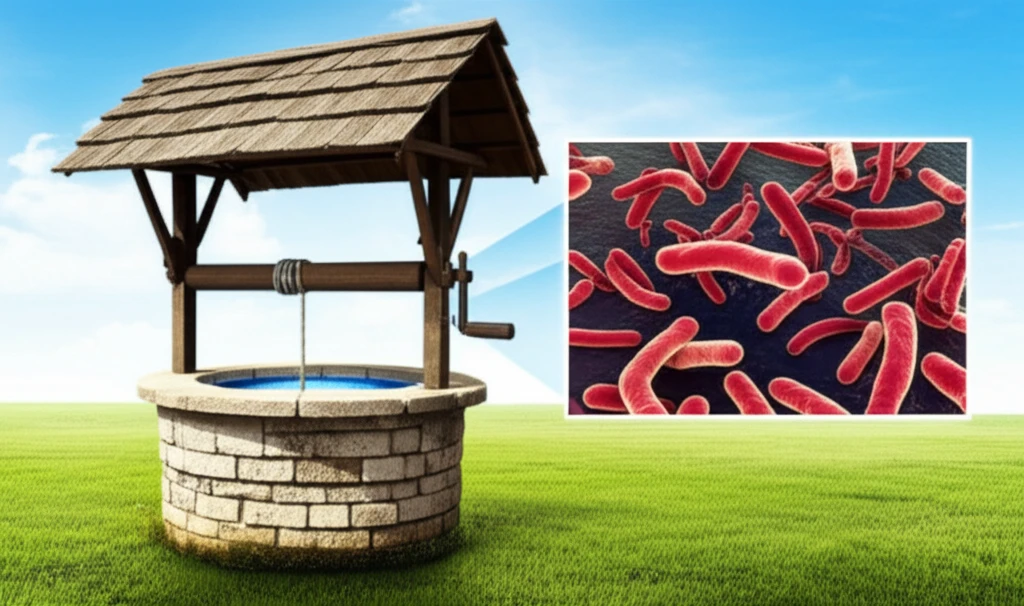
Surreal illustration of a well with E. coli bacteria to emphasize water safety

Is Your Well Water Safe? Uncover the Hidden Risks of E. coli Contamination

"A comprehensive look at the spatial analysis of private well water in Southern Ontario, revealing potential health hazards and what you can do to protect your water supply."


Access to clean and safe drinking water is a fundamental right, yet it remains a significant concern in both developed and developing nations. The integrity of our water sources is constantly threatened by various contaminants, with microbiological agents like bacteria, viruses, and protozoa posing the greatest risk to human health. Among these, private well water supplies are particularly vulnerable to contamination, highlighting the need for continuous monitoring and proactive safety measures.

In North America, contaminated drinking water is estimated to cause thousands of deaths and millions of illnesses each year. This alarming statistic underscores the importance of effective water quality management as a crucial component of public health. While municipal water systems are subject to stringent regulations and regular testing, private wells often rely on the vigilance and responsibility of individual owners.

Faecal contamination of well water is a serious public health issue, linked to outbreaks of water-borne infections. Private well water systems remain the responsibility of the owner. Approximately three to four million people in Canada, or 1 in 10 persons rely on private well water sources.

Mapping the Risks: Understanding E. coli Contamination in Southern Ontario's Wells

Surreal illustration of a well with E. coli bacteria to emphasize water safety

A groundbreaking study conducted in Southern Ontario provides critical insights into the prevalence and spatial distribution of E. coli contamination in private well water. The research, which analyzed over 90,000 private well water submission records from 2008 to 2012, identified numerous statistically significant clusters with elevated risk of contamination. This spatial analysis offers a vital foundation for future investigations into the underlying causes of bacterial groundwater contamination.

The study employed a spatial scan statistic to delineate clusters with elevated risk of E. coli contamination. This method involves using a circular window of variable radius that systematically moves across the map, comparing observed cases within the current radius of the window to the number of expected cases, provided they are randomly distributed.

  • Data Collection: Over 90,000 private well water submission records were analyzed from 2008-2012.
  • Geocoding: Records were geocoded using Google Earth, LIOcoder, and ArcGIS to determine the precise location of each well.
  • Spatial Analysis: SaTScan software was used to perform spatial analysis and identify clusters of E. coli contamination.
The study identified a single statistically significant cluster for each of the 5 years when using a maximum population size of 50% within the cluster. These clusters are primarily located in the southern portion of Hastings Prince Edward County (HPEC) and Kingston Frontenac Lennox & Addington (KFL&A) Public Health Units (PHUs). A total of 10 clusters using the maximum of 5% of the population parameter were identified among the five years, with between one to three clusters per year.

Protecting Your Well: What You Can Do

This research underscores the importance of regular well water testing and proactive well management. If you rely on a private well for your drinking water, it's crucial to understand the potential risks and take steps to protect your health. While this spatial analysis has identified potential hotspots, individual responsibility remains paramount in ensuring the safety of your water supply.

About this Article -

This article was crafted using a human-AI hybrid and collaborative approach. AI assisted our team with initial drafting, research insights, identifying key questions, and image generation. Our human editors guided topic selection, defined the angle, structured the content, ensured factual accuracy and relevance, refined the tone, and conducted thorough editing to deliver helpful, high-quality information.See our About page for more information.

Everything You Need To Know

1

What was the focus of the study on well water in Southern Ontario, and why is it important?

The study focused on private well water in Southern Ontario, analyzing over 90,000 well water submission records from 2008 to 2012. It used a spatial scan statistic to identify clusters with elevated E. coli contamination risk. The goal was to understand the prevalence and spatial distribution of E. coli in these wells. The importance of this study lies in its ability to highlight potential hotspots of contamination, allowing for more targeted public health interventions and informing well owners about risks. Spatial analysis is vital for understanding environmental contamination patterns.

2

Where were the statistically significant clusters of E. coli contamination found in Southern Ontario, and why is knowing this information crucial?

The study identified statistically significant clusters of E. coli contamination in Southern Ontario. These clusters were mainly located in the southern portion of Hastings Prince Edward County (HPEC) and Kingston Frontenac Lennox & Addington (KFL&A) Public Health Units (PHUs). The clusters were identified using SaTScan software and a spatial scan statistic. Knowing the locations of these clusters is critical because it allows resources and attention to be focused on the areas with the highest risk, which are then prioritized for monitoring and remediation efforts to protect public health.

3

What are the health implications of E. coli contamination in well water, and why is it important to understand these risks?

E. coli contamination in well water can have serious health implications, leading to water-borne infections. This is because E. coli is an indicator of faecal contamination, suggesting that other harmful bacteria, viruses, and protozoa may also be present in the water. Consuming contaminated water can result in gastrointestinal illnesses, and in severe cases, it can be life-threatening, especially for vulnerable populations. The importance of understanding the risks associated with E. coli is essential for preventing outbreaks and ensuring the safety of drinking water.

4

What methods were used to identify the clusters of E. coli contamination in the study, and why are these methods important?

The study used a spatial scan statistic which employs a circular window of variable radius that systematically moves across the map, comparing observed cases within the current radius of the window to the number of expected cases, provided they are randomly distributed, to identify clusters of E. coli contamination. This method is crucial because it allows researchers to pinpoint areas where contamination is significantly higher than what would be expected by random chance. The spatial analysis involved the use of SaTScan software.

5

What should I do if I have a private well, based on the findings regarding E. coli contamination?

If you have a private well, you should regularly test your well water for contaminants like E. coli. Understanding the potential risks and taking proactive measures to protect your water supply are essential. Individual responsibility is paramount. While the study identifies potential hotspots, it's up to each well owner to ensure their water is safe. Regular testing and proper well maintenance, combined with the knowledge from spatial analysis, can significantly reduce the risk of contamination.

Newsletter Subscribe

Subscribe to get the latest articles and insights directly in your inbox.