
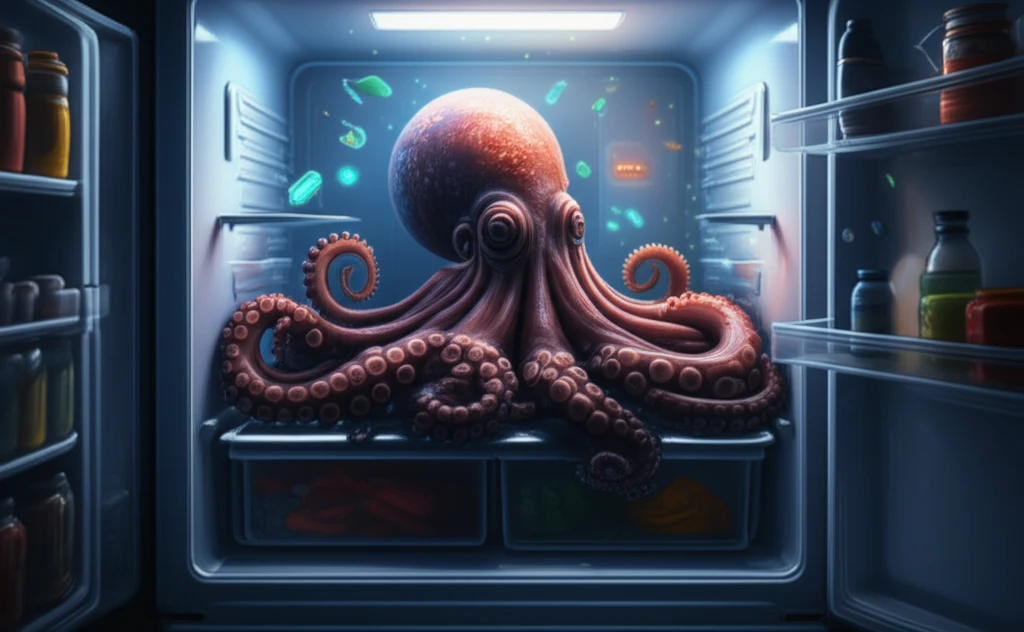
Octopus in refrigerator with bacteria

Is Your Seafood Safe? Unmasking Histamine Risks in Refrigerated Octopus

"Dive into the unseen world of histamine-producing bacteria in refrigerated octopus and learn how to protect your health."


Octopus is a popular seafood choice worldwide, and Mexico ranks among the top exporters of octopus to the United States. Red octopus (Octopus maya), endemic to the Yucatan Peninsula, is particularly prized. However, the journey from the ocean to your plate can be fraught with risks, especially concerning histamine production. These risks arise because octopus can be a highly perishable product, even when refrigerated.

Histamine (C5H9N3) is the main culprit behind scombrotoxic fish poisoning, often misleadingly called "histamine poisoning." This condition occurs when certain marine fish species, and other seafood, contain elevated histamine levels and biogenic amines (BAs). The severity of symptoms varies, influenced by the amount ingested and individual sensitivity. Because handling significantly affects BA production, histamine is a regulated chemical hazard by the US Food and Drug Administration (FDA).

While there's ample information on histamine-forming bacteria (HFB) in fishery products, research is limited on cephalopods, particularly octopus. This article aims to shed light on the presence and capacity of bacteria to produce histamine in refrigerated red octopus, providing crucial insights into seafood safety.

The Hidden Culprits: Histamine-Producing Bacteria in Octopus

Octopus in refrigerator with bacteria

Researchers investigated histamine production in Gram-positive and Gram-negative bacteria isolated from Octopus maya. Out of 80 psychrotrophic microorganisms, 32 strains were identified as histamine-forming bacteria. Using recombinant DNA, they looked for histidine (hdc), ornithine (odc), and lysine decarboxylases (ldc) genes, which are key to histamine production.

The study revealed that:

  • Certain bacteria, like Hafnia alvei, Enterobacter xianfengensis, and Enterobacter cloacae, were identified as histamine producers.
  • The hdc gene from Hafnia alvei showed 100% identity with the hdc from Morganella morganii, a known histamine producer.
  • Other genes, like ldc and odc, were also detected, indicating the potential for producing other biogenic amines.
  • All isolates were identified as weak histamine-formers.
While small amounts of histamine might have little effect, the formation of biogenic amines often signals poor hygiene. This highlights the importance of improving management practices and storage.

Protecting Yourself: Simple Steps for Safer Seafood

This study reinforces that psychrophilic HFB are indeed prevalent in refrigerated octopus, emphasizing the importance of better handling and storage. Although some enteric bacteria are naturally present in octopus tissues, many seem to appear from harvesting and storage handling.

The isolated strains were found to produce a low level of histamine in the culture broth. However, rapid chilling and refrigeration are still mandatory to prevent microbial growth and histamine formation.

Here are some simple steps for safer seafood: Ask your fishmonger about the storage of seafood; Make sure that seafood is stored adequately in the fridge or freezer; Consume seafood as fresh as possible.

About this Article -

This article was crafted using a human-AI hybrid and collaborative approach. AI assisted our team with initial drafting, research insights, identifying key questions, and image generation. Our human editors guided topic selection, defined the angle, structured the content, ensured factual accuracy and relevance, refined the tone, and conducted thorough editing to deliver helpful, high-quality information.See our About page for more information.

This article is based on research published under:

DOI-LINK: 10.3390/ht7030025, Alternate LINK

Title: Molecular Characterization Of Histamine-Producing Psychrotrophic Bacteria Isolated From Red Octopus (Octopus Maya) In Refrigerated Storage

Subject: Biomedical Engineering

Journal: High-Throughput

Publisher: MDPI AG

Authors: Mariel Gullian Klanian, Mariana Delgadillo Díaz, Maria Sánchez Solís

Published: 2018-09-04

Everything You Need To Know

1

What is histamine, and why is it a concern in seafood like octopus?

Histamine, with the chemical formula C5H9N3, is the main biogenic amine responsible for scombrotoxic fish poisoning, sometimes called histamine poisoning. This condition occurs when certain seafood, including specific fish species and even octopus, contains elevated levels of histamine. The US Food and Drug Administration (FDA) regulates histamine as a chemical hazard because its production is significantly affected by handling and storage practices.

2

What specific methods did researchers use to investigate histamine production in red octopus (Octopus maya)?

The study focused on identifying histamine-forming bacteria (HFB) in refrigerated red octopus (Octopus maya). Researchers examined Gram-positive and Gram-negative bacteria isolated from the octopus, looking for the presence of histidine decarboxylase (hdc), ornithine decarboxylase (odc), and lysine decarboxylase (ldc) genes. These genes are crucial for histamine production and the formation of other biogenic amines.

3

What specific types of bacteria contribute to histamine production in refrigerated red octopus?

Certain bacteria found in red octopus (Octopus maya), specifically Hafnia alvei, Enterobacter xianfengensis, and Enterobacter cloacae, were identified as histamine producers. The hdc gene from Hafnia alvei showed a high degree of similarity (100% identity) with the hdc gene from Morganella morganii, a known potent histamine producer. However, all isolates were identified as weak histamine-formers.

4

What are the implications of finding histamine-forming bacteria in refrigerated red octopus regarding food safety?

The presence of histamine-forming bacteria in refrigerated red octopus (Octopus maya) suggests that even under refrigeration, there's a risk of histamine production. Although the identified bacteria were weak histamine-formers, the formation of biogenic amines, in general, indicates poor hygiene and inadequate handling practices. This underscores the need for improved management and storage procedures to ensure seafood safety and minimize the risk of scombrotoxic fish poisoning.

5

The study identified weak histamine-formers, does this mean histamine production is not a concern?

While the presence of hdc, odc, and ldc genes in bacteria isolated from Octopus maya indicates the potential for histamine and biogenic amine production, the study identified the isolates as weak histamine-formers. This means that while the risk exists, the histamine production capacity of these specific bacteria is not as high as some other known histamine producers like Morganella morganii. However, it highlights the importance of proper handling and storage to prevent any biogenic amine formation.

Newsletter Subscribe

Subscribe to get the latest articles and insights directly in your inbox.