
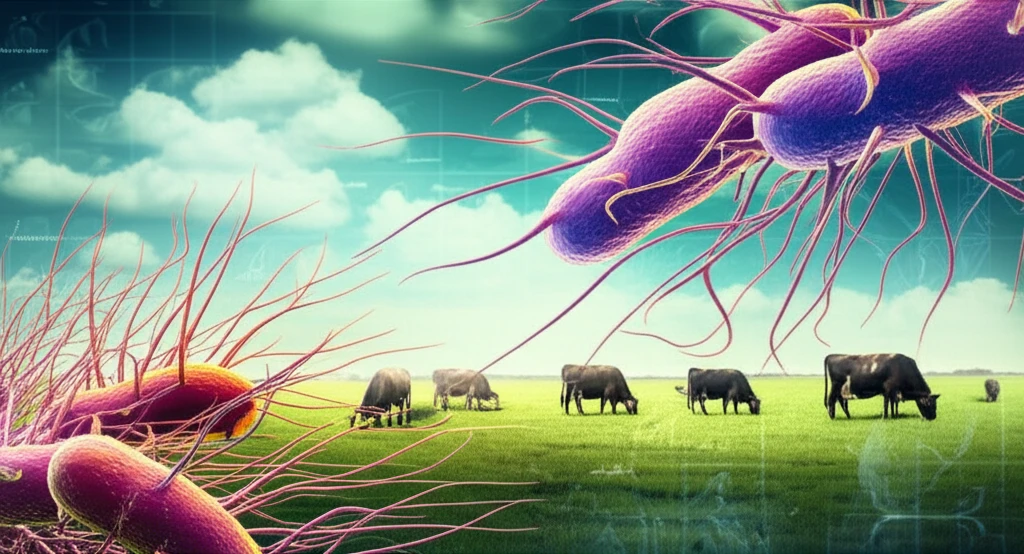
Decoding E. coli O157: What Cattle Can Teach Us About Food Safety

"A deep dive into how long polar fimbriae in E. coli O157 strains could be a key to understanding and preventing foodborne illnesses."
Escherichia coli, commonly known as E. coli, is a diverse group of bacteria, with some strains being harmless residents of our intestines while others can cause serious illness. Among the pathogenic strains, E. coli O157 stands out as a significant cause of foodborne diseases worldwide. Understanding the genetic factors that contribute to the virulence of E. coli O157 is crucial for developing effective strategies to prevent outbreaks and protect public health.
Recent research has focused on long polar fimbriae (Lpf), which are adhesive structures found on the surface of E. coli cells. These Lpf are increasingly recognized as important genetic markers for identifying pathogenic strains. A study published in Acta Veterinaria Hungarica investigated the prevalence and diversity of Lpf operons in E. coli O157 strains isolated from both cattle and humans, shedding light on the potential role of these structures in bacterial adhesion and pathogenesis.
This article delves into the findings of this study, explaining how the analysis of Lpf allelic types can provide valuable insights into the genetic characteristics of E. coli O157 strains. By exploring the connection between cattle, human infections, and the genetic makeup of these bacteria, we aim to enhance understanding of food safety and public health strategies.
Attributing Illness to Food Sources
The Interagency Food Safety Analytics Collaboration (IFSAC) 2023 annual report attributes foodborne illness to 17 food categories for three priority pathogens—Salmonella, Escherichia coli O157, and Listeria monocytogenes—using multi-year outbreak surveillance data. The estimates draw on 49,848 illnesses linked to 1,390 foodborne disease outbreaks. As the U.S. Department of Agriculture's Food Safety and Inspection Service explains, E. coli O157:H7 causes disease by producing a toxin called Shiga toxin, and it is typically this serotype behind news reports of E. coli outbreaks. These attribution figures are designed to inform food safety decision-making and provide pathogen-specific direction for reducing foodborne illness.
Physical, Chemical, and Detection Controls and Their Limits
Reviews in Frontiers in Microbiology describe control strategies for E. coli O157:H7 in food processing that fall into physical and chemical categories. Physical methods are effective at eliminating the pathogen, but some are costly, complex, and may compromise food quality, while chemical methods such as acidic preservatives and chlorine-based disinfectants can pose health risks with long-term and excessive use. Because E. coli O157:H7 can cause severe diseases such as hemorrhagic colitis, diarrhea, and hemolytic uremic syndrome, researchers argue it is important to deepen research on antibacterial methods. On the detection side, a comprehensive review notes that the pathogen poses a major threat to human health and public safety worldwide, that early detection is essential, and that novel strategies for rapid, specific, and sensitive detection have emerged in recent years.
From the 1982 Hamburger Outbreaks to a Global Pathogen
E. coli O157:H7 was first linked to human infections in 1982, when it was recognized as a human pathogen after outbreaks in Oregon and Michigan traced to undercooked hamburgers at a restaurant chain—an episode in which 33 patients in Michigan were hospitalized. Today it is a public health problem worldwide and one of the most reported foodborne pathogens to have emerged in recent decades. As a Shiga-like toxin–producing serotype, it causes illness through contaminated or raw food, including raw milk and undercooked ground beef, and can lead to hemorrhagic diarrhea or kidney failure. Genome sequencing later revealed the full extent to which this pathogen differs from the normally harmless E. coli of the gut.
Unlocking the Secrets of Long Polar Fimbriae
The research screened a collection of 97 E. coli O157 strains, isolated from healthy cattle and human patients across different countries, for the presence and genotype diversity of Lpf operons. Using PCR techniques, individual structural genes of Lpf were scanned, and allelic variants were identified based on a recently developed typing scheme. The study revealed that 95 of the strains carried at least one complete Lpf operon.
- EHEC and EPEC Strains: Consistently carry two Lpf operons (allele 3 of lpfA1 and allele 2 of lpfA2).
- Atypical Bovine Strains: Often carry only one complete Lpf operon (allele 1 of lpfA2).
- Phylogenetic Groups: Atypical strains belong to main phylogenetic groups A and B1, while EHEC and EPEC strains are from group D.
Phage Biocontrol and a Growing Research Base
A bibliometric analysis and scholarly review of Escherichia coli O157 research places the strain among the pathogens implicated in an estimated 600 million foodborne infections and approximately 420,000 deaths annually, casting it as a prominent pathogen associated with severe outbreaks. The same review, which serves researchers, policymakers, and healthcare professionals dedicated to mitigating E. coli O157 outbreaks, surveys both traditional and emerging antimicrobial strategies. Complementing that big-picture work, a 2025 systematic review and meta-analysis examines the efficacy of bacteriophages in controlling E. coli O157:H7, reporting different levels of mean log reduction when vegetables are treated with phages. This focus reflects a worldwide push to find practical and cost-effective methods for controlling exposure to the pathogen.
What Goes Wrong: Contamination, Resistance, and Severe Outcomes
A review in MDPI's Foods notes that Shiga-toxin-producing Escherichia coli is typically detected on food products mainly due to cross-contamination with faecal matter, underscoring that controls in the food chain do not always prevent contamination. The same line of research highlights a major complicating factor: rising multi-drug resistance among foodborne pathogens such as E. coli O157:H7, coupled with an upsurge of foodborne infections caused by these pathogens. The consequences of failure are stark—E. coli O157:H7 can cause hemolytic uremic syndrome, a life-threatening kidney failure, with onset occurring 5 to 10 days after the initial infection. Safety guidance accordingly urges seeking emergency care immediately if bloody diarrhea develops, especially in children under 5.
Comparing Strains and Detection Strategies
Comparing E. coli O157:H7 with non-O157 STEC strains reveals important differences and detection blind spots. Highly pathogenic non-O157 serogroups include O26, O111, and O103, and although non-O157:H7 E. coli are on average less likely to cause severe illness, some serogroups have been discovered to cause the most severe forms of illness. Research on non-O157 STEC remains limited because these serogroups are difficult to detect with current E. coli testing methods. In the context of food safety, that detection gap matters: molecular and microbiological approaches to detecting E. coli O157 are essential, since the pathogen is associated with severe diseases such as hemorrhagic colitis and hemolytic uremic syndrome and must be found in foods like ground beef.
Implications for Food Safety and Public Health
The identification of specific Lpf allelic combinations in different E. coli O157 strains has significant implications for food safety and public health. By understanding the genetic markers associated with highly virulent strains, we can develop more targeted and effective strategies for detecting and preventing outbreaks.
What Farm and Rural Interventions Do Experts Trust
A paper in Epidemiology and Infection describes the use of a novel technique—best-worst scaling (BWS)—to elicit expert opinion on the 'effectiveness' and 'practicality' of measures to manage E. coli O157 risk in the farm and rural environment. By forcing experts to weigh trade-offs, the approach surfaces distinct judgments about which interventions reduce human exposure and are realistic to implement. The authors critically reflect on the technique's use, addressing both its promise and its limitations for informing risk management.
Where the Field Heads Next
Looking ahead, momentum in E. coli O157 research will likely continue toward rapid detection, alternative antimicrobial strategies, and a deeper understanding of transmission through farm and rural environments. Because the pathogen persists in cattle and agricultural settings, integrated approaches spanning farm-level interventions, processing controls, and consumer education may advance together. Early-stage findings will probably need field and scale-up validation before their practical value is clear. For now, the direction of travel appears to be toward tools and policies that are both effective and practical to deploy.
Food Safety as a Systems Problem
E. coli O157 food safety is ultimately a systems problem rather than a single-point fix, and no single intervention is likely to be fully reliable on its own. Challenges are magnified by modern supply chains, in which one contaminated ingredient can spread an outbreak across many states, and by the pathogen's ability to persist and develop resistance to existing controls. Sustained progress will probably depend on coordinated action across regulators, researchers, producers, and consumers. This framing helps explain why food safety guidance emphasizes prevention and monitoring at multiple stages of production rather than reliance on any one method.
Outbreaks in the Real World
Real-world outbreak investigations show how E. coli O157:H7 incidents unfold and how difficult they can be to solve. In one multistate outbreak described in CDC's Morbidity and Mortality Weekly Report, investigators linked infections to eating at a national fast-food chain, yet even after states tested food from restaurants and the FDA tested foods and environmental samples from the supply chain, the outbreak strain was not identified in the tested samples. Traceback investigations have remained an essential component of such efforts: leafy greens contaminated with Shiga toxin-producing E. coli have continued to cause foodborne illness outbreaks in recent years, and determining the source of the outbreak vehicle through traceback is a key step. These cases illustrate how much of outbreak response depends on tracing contaminated products through complex, commercially distributed food systems.
Furthermore, the discovery of distinct genetic lineages in atypical bovine E. coli O157 strains raises concerns about their potential to cause zoonotic infections. Additional research is needed to determine the pathogenic potential of these strains and the role of Lpf in the process of infection.
Ultimately, unraveling the genetic complexities of E. coli O157 and its interactions with cattle can pave the way for innovative approaches to minimize the risk of foodborne illnesses and protect public health. This study underscores the importance of continued research in this area to safeguard our food supply and promote healthier communities.