
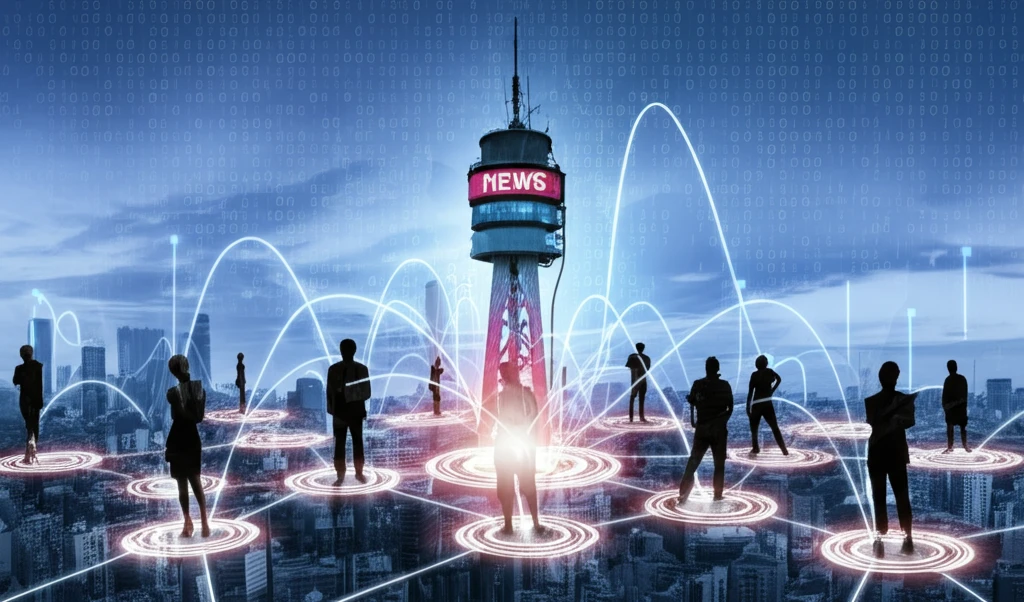
Is Your News Brand Connecting? How to Build a Loyal Audience in a Digital World

"Unlocking the secrets to consumer-based brand equity for news media firms: A guide for building trust, loyalty, and engagement in today's competitive landscape."
In today's fast-paced digital world, news organizations face unprecedented competition for audience attention. Building a strong brand is no longer a luxury—it's a necessity for survival. But what exactly makes a news brand successful? It goes beyond just delivering the news; it's about creating a connection with your audience, fostering trust, and establishing a clear identity that resonates with their values.
Consumer-Based Brand Equity (CBBE) offers a powerful framework for understanding how consumers perceive and value news brands. CBBE emphasizes that a brand's worth lies in the minds of its audience—their awareness, loyalty, perceived quality, and associations. For news organizations, this means building a brand that not only informs but also engages, inspires, and reflects the values of its audience.
This article dives deep into the concept of CBBE for news media firms, exploring how to build a loyal audience by understanding their needs and perceptions. We'll examine the key dimensions of CBBE, provide practical strategies for strengthening your brand, and show you how to measure your progress along the way.
Trust, Consistency, and a Digital-First Audience
Recent branding data consistently ties loyalty to intangible trust signals: one 2026 compilation shows that trust, consistency, design, and brand perception influence buying decisions, customer loyalty, and long-term growth across industries. Another 2026 data roundup tracks the same drivers, focusing on brand recognition, awareness, consistency, and authenticity. On channel-level figures, marketingltb reports that in 2025 roughly 81% of marketers practiced content branding and that about 70% of brand interactions were expected to become digital-first, with social media driving brand recognition at a rate 12% higher than websites or blogs. Taken together, these figures suggest a news brand's payoff lies less in raw reach than in dependable, recognizable, consistent presentation.
Measuring Brand Equity: Methods and Gaps
The dominant lens for studying news brands is brand equity, and methods to measure it have multiplied since the 1980s. A 2024 systematic review characterizes these as ranging from theoretical and pragmatic approaches to qualitative methods that rank remembrance, emotionality, and the likelihood of purchase, and the review set out to identify gaps in the literature. Applied to journalism, a study of national news media analyzed how news media attributes and perceived uniqueness impact news media brand equity in an environment transformed by digitalization, using regression and decision-tree techniques to estimate the most influential attributes. The authors emphasize that distinctiveness is a key driver, which marks the limits of purely awareness-based measurement.
From Cattle Marks to Digital Brands
A 2025 review divides the last seven decades of branding into three eras: the roots of modern branding (1955–1979), branding's growth as a management priority (1980–1999), and the personal, social, cultural, and digital dimensions that took over from 2000 onward. The same periodization appears in a separate summary of that review. Looking further back, branding in its most primitive form dates to ancient civilizations, where markings on pottery, livestock, and other goods signified ownership, quality, and origin. That lineage matters for news media: the notion of a name carrying accumulated trust is thousands of years old, even if the digital era reshaped how it operates.
Understanding the Three Pillars of News Brand Equity
CBBE in news media is built upon three core dimensions, each playing a vital role in shaping audience perceptions and loyalty:
- Basic Utility: Does your news brand provide clear, concise, and easily understandable information? Are you making it easy for your audience to access the news they need?
- Journalistic Quality: Do you adhere to the highest standards of journalistic ethics? Are you committed to accuracy, objectivity, and thorough reporting?
An Emerging, Still-Thin Evidence Base
No single research line has yet settled how digital news brands should measure loyalty, and recent academic work on this specific question is sparse, often framed within broader brand-equity frameworks. Anyone reading the field today should hedge: evidence is accumulating rather than conclusive, with varied samples and fast-moving platforms making claims provisional. The most defensible working hypothesis is that a connected news brand is built on coherent, consistent identity and repeated audience experience. That remains a direction of inquiry rather than a settled finding.
Branding Is Not a Fix-All
Branding is not a guaranteed remedy for a news organization's reach or revenue, and enough failures exist that enthusiasm should be calibrated. A distinctive logo or tagline does not by itself reverse trust deficits, and in a fragmented digital environment a brand that overpromises can deepen audience disappointment. Evidence for a precise return on news-brand investment is limited and uneven across markets and platforms. Any claim that branding alone builds loyalty should be treated as an assumption to test rather than a proven fact.
How News Brands Differ From Consumer Brands
Scholarly work on media branding repeatedly stresses that news media brands are naturally distinct from non-media brands, which is why some researchers argue media branding studies must focus specifically on news media brands. Converging evidence treats consumer experience as a key influence on brand associations, implying that a reinvention of the customer experience is required when managing brand equity. A 2024 study goes further, specifying consumer-based brand equity (CBBE) as a mediator of media brands' effect on audience quality evaluation, tested across five quality dimensions and a global quality measure. The consistent thread is that distinctiveness and lived audience experience, not mere awareness, separate strong news brands from weak ones.
The Future of News Branding: Building Connections in a Changing World
Building a strong news brand in the digital age requires a deep understanding of your audience, a commitment to quality journalism, and a willingness to adapt to the ever-changing media landscape. By focusing on functional, experiential, and symbolic associations, news organizations can cultivate a loyal audience, build trust, and create a brand that resonates with the values of their community. Ultimately, a strong brand is the key to sustainability and success in today's competitive media market.
Consumption and Uniqueness Drive Brand Equity
This line of research applies a decision-tree method to predict the news media attributes that contribute most to news media brand equity and to the perceived uniqueness of the news media brand. Its results demonstrate the influence of content-consumption-related brand attributes and of uniqueness on media brand equity. A practical synthesis is that what audiences actually consume shapes brand equity more than cosmetic elements, and standing out from the crowd amplifies that effect. These findings are best read as one study's results rather than a universal rule.
Personalization, AI, and Fragmented Touchpoints
Looking ahead, the next frontiers for news branding appear to lie in personalization, AI-assisted distribution, and platform-native storytelling, though published research on these specifics is still thin. Any forward-looking claim about news brands should be presented as tentative, since the platform landscape shifts quickly and audience habits are volatile. A plausible near-term hypothesis is that brands able to deliver a consistent identity across many fragmented touchpoints will hold loyalty better than those optimizing any single channel. This is a direction of travel, not a confirmed outcome.
Branding as a Bulwark Against Misinformation
Contextual research links branding to trust at a systemic level, framing strong visual identity as a tool against misinformation. One analysis concludes that applying strong visual elements and emotion-based multimedia strategies can help counter misinformation by strengthening media brand equity. The same research offers practical guidance for news media to use visual design as an effective means of building trust and enhancing information literacy in the digital age. This positions brand building as not merely commercial but as a defense of journalism's credibility itself.
Loyalty as a Human Relationship
At its core, audience loyalty in news is a human relationship built on repeated, emotionally resonant experiences with a name people feel they can depend on. Real-world impact shows up in habits: readers returning out of routine, recommending a brand, and defending it when its reporting is challenged. Hard numbers on these human dynamics remain scarce, but the qualitative picture is consistent, with connection compounding through trust. As with the surrounding literature, these observations are reasonable extrapolations rather than rigorously established claims.