
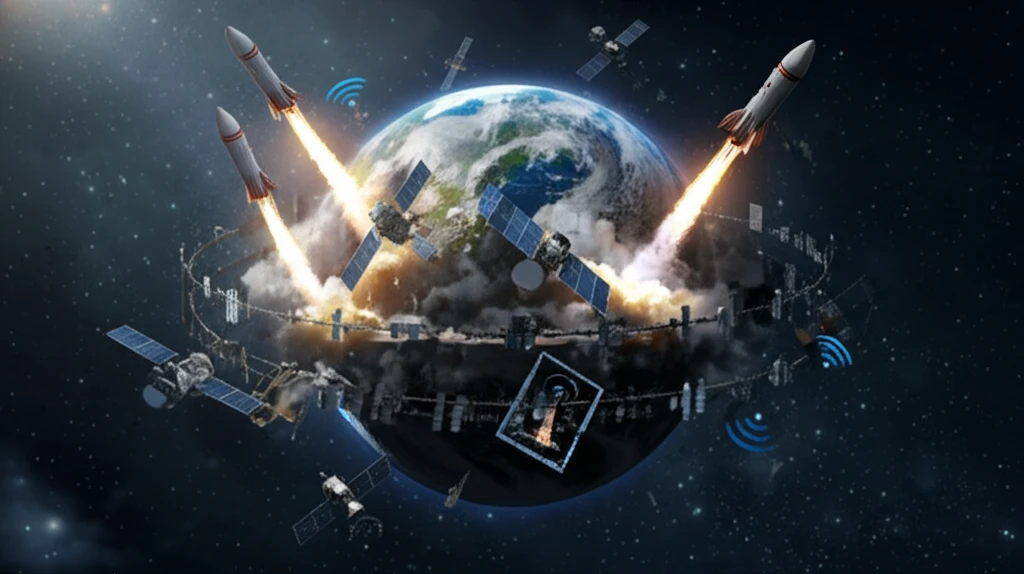
Is Your Internet Footprint Killing the Planet? The Hidden Cost of Satellite Broadband

"LEO satellite broadband offers connectivity to remote areas but comes with a significant environmental price tag. Uncover the surprising carbon footprint of your internet."
In an increasingly interconnected world, the promise of broadband internet reaching every corner of the globe has become a driving force behind technological innovation. Low Earth Orbit (LEO) satellite constellations, like those proposed by Amazon’s Kuiper, Eutelsat Group’s OneWeb, and SpaceX’s Starlink, represent a significant step toward achieving this goal. These megaconstellations aim to bridge the digital divide, bringing high-speed internet to rural and remote communities where traditional infrastructure is lacking.
However, this rapid expansion into space comes with a hidden cost: a substantial environmental footprint. The increasing number of rocket launches required to deploy and maintain these satellite networks is raising concerns about the impact of rocket fuel emissions on the Earth's atmosphere. While LEO satellite broadband offers the potential to connect billions and achieve Sustainable Development Goals(SDGs), understanding and mitigating its environmental consequences is paramount.
This article dives into the sustainability assessment of LEO satellite broadband megaconstellations, exploring the trade-offs between connecting unconnected communities and preserving our planet. We'll examine the environmental impact of these ambitious projects, comparing them to terrestrial alternatives and discussing the policy implications for a sustainable future.
The Sky-High Environmental Cost of Connectivity
The deployment of LEO satellite constellations relies on a continuous stream of rocket launches, each contributing to a complex web of environmental impacts. Rockets release a variety of emissions into the atmosphere, including nitrogen gas, carbon dioxide, carbon monoxide, black carbon, water vapor, hydrogen gas, aluminum oxide, hydrochloric acid, and radicals of chlorate, hydrate, and nitrate. These emissions have the potential to affect climate change, ozone depletion, and overall air quality.
- Global Warming Potential (GWP): Measures the radiative forcing of carbon dioxide equivalents over a 100-year horizon.
- Ozone Depletion Potential (ODP): Assesses the potential for steady-state depletion in chlorofluorocarbon-11 equivalents.
- Mineral & Metal Resource Depletion Potential: Evaluates abiotic resource depletion in antimony equivalents.
- Freshwater Aquatic Ecotoxicity Potential: Determines the comparative toxic units for ecosystems.
- Human Toxicity Potential: Estimates the increase in morbidity (cases) for humans.
Navigating the Space Sustainability Paradox
The expansion of LEO satellite broadband presents a classic “space sustainability paradox.” While offering the potential to connect billions and drive progress toward Sustainable Development Goals, it also carries significant environmental risks. Decision-makers must carefully weigh the economic, social, and environmental benefits against the growing environmental footprint of the satellite sector. As phase 2 plans to launch an order-of-magnitude more satellites loom on the horizon, the time to address these concerns is now.