
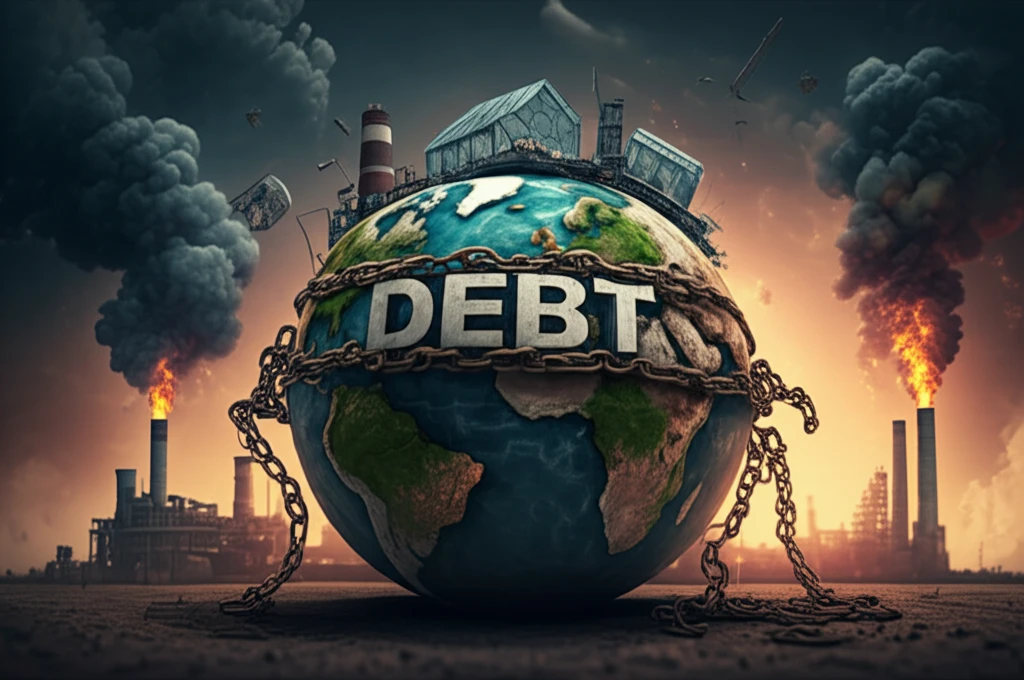
Is Your Country's Debt Hurting the Planet? The Surprising Link Between National Debt and Greenhouse Gas Emissions

"New research reveals a concerning connection between a nation's external debt and its environmental impact, particularly its greenhouse gas emissions."
Climate change is one of the most pressing issues of our time, demanding immediate and comprehensive action. While much attention is paid to individual behaviors and corporate practices, the role of national economic factors often remains overlooked. One such factor is external debt, particularly in emerging market and developing economies (EMDEs). These nations, striving for economic growth, often rely on external financing, but new research suggests this reliance may come at an environmental cost.
A recent study sheds light on the intricate relationship between external debt and greenhouse gas (GHG) emissions in EMDEs. Unlike previous research, this study employs advanced analytical techniques to address the potential for skewed results and more accurately reveals the true impact of external debt on the environment.
The findings expose a troubling paradox: as developing nations accumulate external debt, their ability to enforce environmental regulations weakens, leading to increased GHG emissions. This article delves into the study's methodology, findings, and implications, highlighting the urgent need for a more sustainable approach to economic development and debt management.
The Debt-Emissions Connection: How External Borrowing Impacts the Environment
The study, encompassing 78 EMDEs over the period 1990-2015, moves beyond simple observation to establish a causal link. Researchers used international liquidity shocks – unexpected changes in the availability of funds on the global market – as external instruments to isolate the impact of external debt on GHG emissions. This approach addresses a critical issue known as 'endogeneity,' which can skew results when cause and effect are not clearly distinguishable.
- Compromised Environmental Enforcement: Governments burdened by debt may prioritize economic growth and debt repayment over environmental protection. This can lead to lax enforcement of environmental regulations, allowing industries to pollute more freely.
- Tax Base Focus: Heavily indebted countries often focus on expanding their tax base to service their debts. This can incentivize industries that generate revenue, even if they are environmentally harmful.
- Private Sector Capture: In some cases, governments may be unduly influenced by private sector entities that hold the debt. These entities may lobby against stricter environmental regulations that could negatively impact their profits.
Reversing the Trend: Sustainable Finance for a Greener Future
The study's findings present a call to action. If EMDEs are to meet their global and individual environmental commitments, the relationship between external debt and GHG emissions must be reversed. This requires a shift towards sustainable finance models that prioritize environmental protection alongside economic development. International institutions, advanced economies, and private markets must collaborate to provide financing that supports green technologies, sustainable infrastructure, and effective environmental governance in developing nations. Only then can EMDEs pursue economic growth without compromising the health of the planet.