
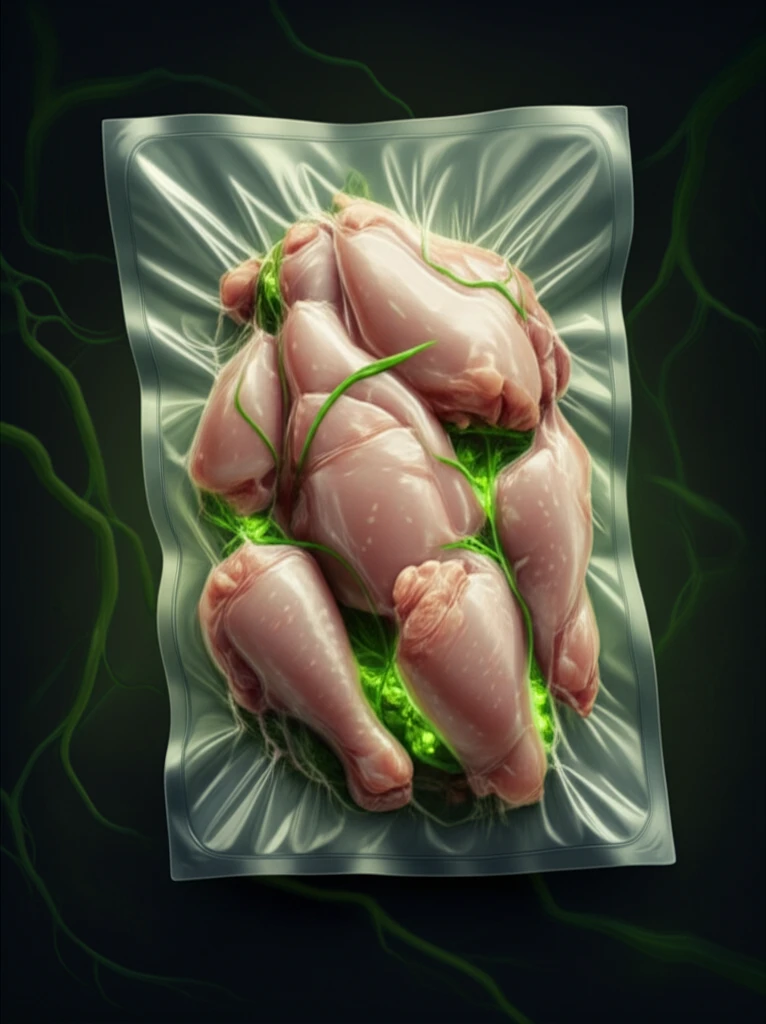
Vacuum-packed chicken with plant extracts.

Is Your Chicken Safe? Natural Extracts Extend Shelf Life and Fight Bacteria

"Discover how a combination of Alpinia malaccensis and Terminalia catappa extracts can combat foodborne pathogens and extend the freshness of your vacuum-packed chicken."


In today's world, ensuring food safety has become a critical concern due to the globalization of food supply chains, the rise of mass catering, and evolving consumer preferences. Nowadays, people demand processed, frozen, ready-to-eat, or ready-to-cook meals, driven by busy lifestyles and a desire for diverse food options. With increasing interest in foods free from synthetic preservatives and enhanced with functional benefits, the food industry faces pressure to innovate.

Consumers want minimally processed foods without artificial additives to reduce health risks and improve overall well-being. This demand has led to the popularity of marinated poultry products, known for their enhanced flavor, convenience, and functional properties. However, poultry is vulnerable to foodborne pathogens like Listeria monocytogenes and Staphylococcus aureus, which can cause illness and spoilage.

Synthetic preservatives have been the go-to solution, but concerns about their impact on health have sparked the search for natural alternatives. Researchers are now exploring underutilized plant extracts as natural preservatives, aiming to enhance food safety without compromising consumer health. The focus has shifted to innovative combinations of plant extracts and other preservation methods to ensure the safety and quality of food products.

How Do Plant Extracts Protect Your Chicken?

Vacuum-packed chicken with plant extracts.

A recent study tested the combined antibacterial activity of Alpinia malaccensis and Terminalia catappa extracts on ready-to-cook (RTC) chicken. Scientists tested the combination against Listeria monocytogenes, Staphylococcus aureus, and common spoilage bacteria. Chicken pieces were marinated in a mixture of these extracts and then vacuum-packed for storage at 4°C or 8°C for up to 12 days. Researchers monitored microbial counts, lipid oxidation, pH levels, and color changes to assess the effectiveness of the treatment.

The results were remarkable. The plant extracts significantly inhibited the growth of S. aureus, with reductions of 1.80, 2.13, 2.36, and 2.97 log CFU/g over 3, 6, 9, and 12 days at 8°C. Similarly, L. monocytogenes was significantly inhibited at 4°C. The combination also reduced lipid oxidation, a key factor in preserving freshness. Here’s a quick breakdown of the key findings:

  • Significant inhibition of S. aureus and L. monocytogenes
  • Reduced lipid oxidation, keeping chicken fresher
  • Extended shelf-life of marinated chicken
  • Maintained acceptable total plate counts for safe consumption
These findings have significant implications for the food industry. By using these plant extracts, marinated RTC chicken can remain safe for consumption longer, specifically six days at 4°C and nine days at 8°C. This method offers an economically viable way to extend the shelf life of fresh chicken meat products while meeting consumer demand for natural preservatives.

A Fresh Future for Chicken Preservation

The study demonstrates the potential of A. malaccensis and T. catappa extracts as effective, natural alternatives for preserving chicken. These extracts act as antimicrobials and antioxidants, stabilizing lipid oxidation, color, and microbial growth. By incorporating these plant extracts, the food industry can produce safer, fresher chicken products that meet consumer preferences for natural preservation methods. This approach promises to revolutionize how we keep our food safe and extend its shelf life, opening up new possibilities for food preservation.

About this Article -

This article was crafted using a human-AI hybrid and collaborative approach. AI assisted our team with initial drafting, research insights, identifying key questions, and image generation. Our human editors guided topic selection, defined the angle, structured the content, ensured factual accuracy and relevance, refined the tone, and conducted thorough editing to deliver helpful, high-quality information.See our About page for more information.

Everything You Need To Know

1

What are the key benefits of using Alpinia malaccensis and Terminalia catappa extracts in chicken preservation?

The combination of *Alpinia malaccensis* and *Terminalia catappa* extracts offers several key benefits for chicken preservation. Primarily, they act as antimicrobials, effectively inhibiting the growth of foodborne pathogens like *Staphylococcus aureus* and *Listeria monocytogenes*. Moreover, these extracts act as antioxidants, reducing lipid oxidation, which helps maintain the freshness and quality of the chicken. The extracts also help in extending the shelf life of marinated ready-to-cook (RTC) chicken, making it safer for a longer duration. These benefits align with consumer demands for minimally processed foods without artificial additives, enhancing both food safety and consumer well-being.

2

How do *Alpinia malaccensis* and *Terminalia catappa* extracts compare to synthetic preservatives in chicken preservation?

Traditional synthetic preservatives have been widely used to extend the shelf life of food products. However, rising consumer concerns about the potential health impacts of synthetic additives have spurred the search for natural alternatives. *Alpinia malaccensis* and *Terminalia catappa* extracts offer a natural alternative. Unlike synthetic preservatives, these plant extracts provide antimicrobial and antioxidant properties without the negative health connotations associated with artificial additives. This shift meets the growing consumer preference for foods that are perceived as healthier and more natural, thereby supporting both food safety and consumer trust.

3

What specific results did the study reveal regarding the effectiveness of *Alpinia malaccensis* and *Terminalia catappa* extracts?

The study showcased remarkable results. The combination of *Alpinia malaccensis* and *Terminalia catappa* extracts significantly inhibited the growth of *Staphylococcus aureus* and *Listeria monocytogenes*. The extracts reduced lipid oxidation, thus keeping the chicken fresher. The treatment successfully extended the shelf life of marinated ready-to-cook (RTC) chicken, with acceptable total plate counts for safe consumption. These findings demonstrate their efficacy in maintaining food safety and extending the usability of chicken products.

4

How does the use of *Alpinia malaccensis* and *Terminalia catappa* extracts impact the shelf life of marinated chicken?

The application of *Alpinia malaccensis* and *Terminalia catappa* extracts significantly extends the shelf life of marinated ready-to-cook (RTC) chicken. Specifically, the study showed that the chicken could remain safe for consumption for up to six days at 4°C and up to nine days at 8°C. By inhibiting microbial growth and reducing lipid oxidation, these extracts slow down spoilage processes, which is crucial in maintaining the quality and safety of the chicken over a longer period. This shelf-life extension is a crucial factor for food producers and consumers, offering increased food safety and reduced waste.

5

What are the implications of using *Alpinia malaccensis* and *Terminalia catappa* extracts for the food industry and consumers?

The adoption of *Alpinia malaccensis* and *Terminalia catappa* extracts has significant implications for both the food industry and consumers. For the food industry, it offers a cost-effective and sustainable way to extend the shelf life of fresh chicken meat products while meeting consumer demand for natural preservatives. This could open up new market opportunities and reduce food waste. For consumers, this approach ensures safer and fresher chicken products without the use of synthetic additives, aligning with preferences for healthier, minimally processed foods. Overall, this method represents a shift towards a more sustainable and consumer-friendly approach to food preservation, enhancing both food safety and consumer satisfaction.

Newsletter Subscribe

Subscribe to get the latest articles and insights directly in your inbox.