
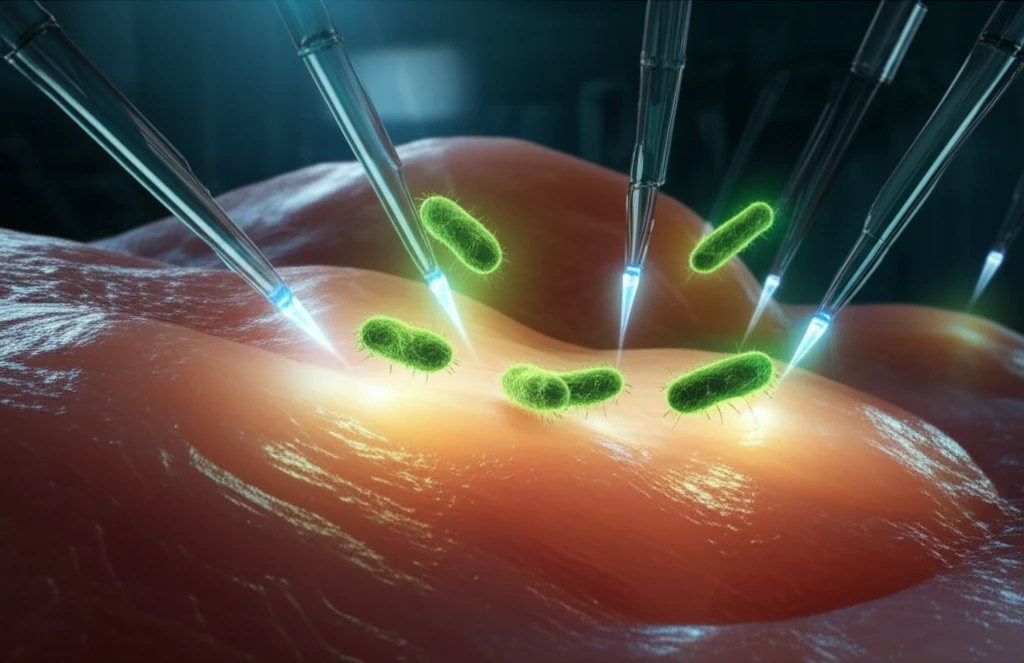
Microscopic view of chicken meat with Salmonella bacteria under detection.

Is Your Chicken Safe? A New Way to Spot Salmonella Faster

"Real-time LAMP assay offers a quicker, more sensitive method for detecting Salmonella in chicken products, ensuring safer meals for you and your family."


Salmonella is a bacteria which is a major cause of foodborne illnesses, and it often lurks in one of our favorite foods: chicken. Imagine preparing a family dinner, confident in your cooking skills, only to unknowingly serve a dish contaminated with Salmonella. This isn't just a kitchen mishap; it's a public health concern. According to the World Health Organization, poultry products, especially chicken, are principal carriers of these pathogens.

Traditional methods of detecting Salmonella are slow, often requiring days to produce results. These methods involve culturing, which demands a lot of time and effort. In contrast, new techniques like immunological assays, while faster, sometimes lack specificity, leading to false positives. What if there was a way to quickly and accurately determine if your chicken is safe to eat?

Real-time Loop-mediated Isothermal Amplification (LAMP) assay is here, to change the game. This innovative method amplifies specific DNA sequences of Salmonella, offering a rapid, sensitive, and convenient way to detect contamination. Unlike traditional methods that take days, real-time LAMP can deliver results in just a few hours, potentially preventing countless cases of foodborne illness. Let's explore how this technology works and how it can help ensure the safety of your next chicken dinner.

How Does Real-Time LAMP Work?

Microscopic view of chicken meat with Salmonella bacteria under detection.

The real-time LAMP assay targets a specific genetic sequence in Salmonella, known as gene62181533. Six specifically designed primers recognize eight distinct regions of the target DNA, and a strand-displacing Bst DNA polymerase amplifies the DNA. This process occurs under isothermal conditions, which means it doesn't require the complex temperature cycling of traditional PCR methods.

The reaction releases pyrophosphate ions, which react with magnesium ions, creating a detectable signal. A real-time turbidimeter measures the turbidity, or cloudiness, of the solution, providing a quantitative assessment of Salmonella presence. This method doesn't require specialized instrumentation, making it accessible for various settings.

  • Speed: Results are available in a few hours compared to days with traditional methods.
  • Sensitivity: Detects even small amounts of Salmonella.
  • Specificity: Accurately identifies Salmonella without cross-reacting with other bacteria.
  • Convenience: Easy to use with portable equipment.
Unlike traditional PCR methods that require sophisticated thermal cycling machines, the LAMP assay is conducted at a constant temperature. Think of it as a highly efficient photocopier for DNA, producing many copies of the Salmonella DNA if it’s present. The best part? It's so specific that it only amplifies Salmonella DNA, ignoring other bacteria that might be present, reducing the chance of false alarms.

The Future of Food Safety

The real-time LAMP assay represents a significant step forward in ensuring the safety of our food supply. Its speed, sensitivity, and convenience make it a valuable tool for detecting Salmonella in chicken products, reducing the risk of foodborne illnesses. As technology advances, we can anticipate even more innovative solutions to safeguard our health and well-being.

About this Article -

This article was crafted using a human-AI hybrid and collaborative approach. AI assisted our team with initial drafting, research insights, identifying key questions, and image generation. Our human editors guided topic selection, defined the angle, structured the content, ensured factual accuracy and relevance, refined the tone, and conducted thorough editing to deliver helpful, high-quality information.See our About page for more information.

This article is based on research published under:

DOI-LINK: 10.1111/jfs.12564, Alternate LINK

Title: Development And Evaluation Of Real‐Time Loop Mediated Isothermal Amplification Assay For Rapid And Sensitive Detection OfSalmonellaSpp. In Chicken Meat Products

Subject: Microbiology

Journal: Journal of Food Safety

Publisher: Wiley

Authors: Narong Arunrut, Wansika Kiatpathomchai, Chiraporn Ananchaipattana

Published: 2018-10-25

Everything You Need To Know

1

Why is it important to quickly detect Salmonella in chicken?

Quickly detecting Salmonella is crucial because this bacteria is a major cause of foodborne illnesses, and chicken is a common carrier. Traditional detection methods are slow, taking days for results, while faster but less accurate methods may produce false positives. The real-time LAMP assay offers a quicker and more accurate solution, potentially preventing countless cases of foodborne illness by rapidly identifying contamination before consumption.

2

How does the real-time LAMP assay differ from traditional Salmonella detection methods?

Traditional Salmonella detection methods, like culturing, are time-consuming, often requiring days to produce results. Immunological assays, while faster, may lack specificity, leading to false positives. The real-time LAMP assay, on the other hand, rapidly amplifies specific DNA sequences of Salmonella, providing results in just a few hours. It's more sensitive and specific, reducing the chance of false alarms compared to other rapid methods.

3

What are the key advantages of using the real-time LAMP assay for detecting Salmonella?

The real-time LAMP assay has several advantages including speed, providing results in a few hours, high sensitivity, allowing detection of even small amounts of Salmonella, high specificity, accurately identifying Salmonella without cross-reacting with other bacteria, and convenience, as it's easy to use with portable equipment. Also, it doesn't require specialized instrumentation, making it accessible for various settings.

4

Can you explain how the real-time LAMP assay actually works to detect Salmonella in chicken?

The real-time LAMP assay works by targeting a specific genetic sequence in Salmonella, specifically gene62181533. Six specifically designed primers recognize eight distinct regions of the target DNA, and a strand-displacing Bst DNA polymerase amplifies the DNA. This amplification occurs under isothermal conditions, eliminating the need for complex temperature cycling like traditional PCR. As the DNA is amplified, pyrophosphate ions are released, reacting with magnesium ions to create a detectable signal, which is measured by a real-time turbidimeter to quantify the Salmonella presence.

5

What is the significance of using gene62181533 in the real-time LAMP assay, and are there other potential target genes that could be used in the future?

Targeting gene62181533 is crucial for the real-time LAMP assay's accuracy because it's a specific genetic sequence unique to Salmonella. This ensures that the assay only amplifies Salmonella DNA, minimizing false positives from other bacteria. While gene62181533 is effective, future assays could explore other potential target genes to improve detection rates for diverse Salmonella strains or to target multiple genes simultaneously for enhanced reliability. The continuous advancement in genomics and molecular biology may lead to the identification of even more specific and sensitive markers for Salmonella detection, further refining the real-time LAMP assay and similar technologies.

Newsletter Subscribe

Subscribe to get the latest articles and insights directly in your inbox.