
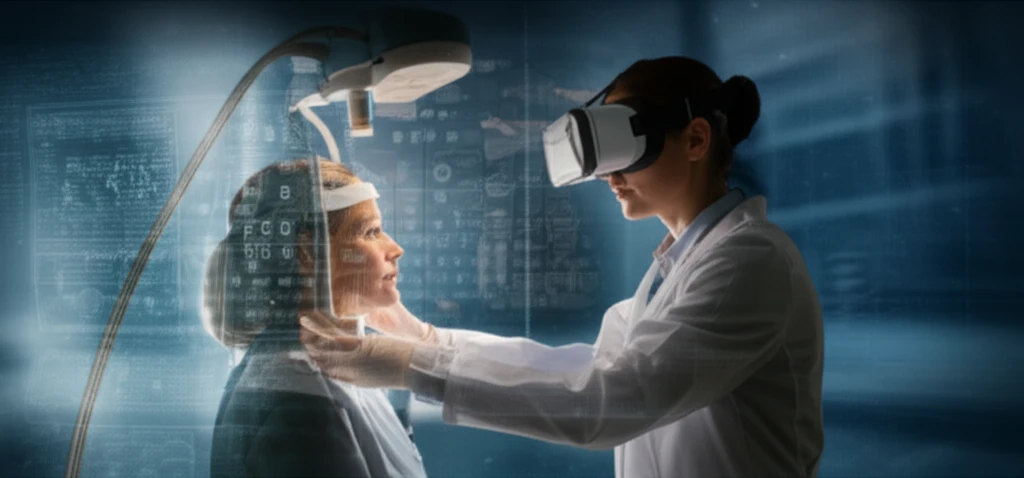
Is Virtual Reality the Future of Eye Exams? A Look at VR-Based Ophthalmoscopy Training

"Explore how virtual reality simulators are transforming direct ophthalmoscopy training, offering a new way to master essential eye exam skills and improve patient outcomes."
Direct ophthalmoscopy, a crucial skill for young physicians, is often challenging to master due to limited practical experience and confidence. Traditional teaching methods typically involve an instructor guiding students without providing a direct view of what the student sees through the ophthalmoscope, thus hindering contextual feedback.
Virtual reality (VR) simulators are emerging as a promising solution, offering the potential to deliver contextual feedback that traditional methods cannot. However, it is essential to validate these simulators to ensure they provide relevant and effective training, avoiding the pitfalls of expensive, irrelevant training or misdiagnosis.
A recent study examined the validity of automated assessments provided by the EyeSi Direct Ophthalmoscope Simulator (v1.4, VRmagic, Mannheim, Germany). The study included 13 novice medical students and eight experienced ophthalmology consultants to evaluate the simulator's effectiveness in training and assessment.
How VR Simulators Enhance Ophthalmoscopy Training
The EyeSi Direct Ophthalmoscope Simulator assesses various aspects of fundoscopic examination through pre-specified modules. To align the assessment content more closely with actual ophthalmoscopy skills, two key modifications were made based on expert recommendations. First, questions covering general knowledge in ophthalmology were removed from module D, as they were deemed unrelated to direct ophthalmoscopy skills. Second, the score adjustment for the percentage of total retinal area examined was disabled, recognizing that experienced professionals tend to focus on specific areas rather than conducting a comprehensive examination.
- Content: Experienced participants found the simulator realistic and confirmed that the training program met the needs for learning direct ophthalmoscopy techniques.
- Response Process: A pilot study addressed potential biases in data collection. The simulator automatically collected all scores, and a standardized information script was used for all participants. A 20-minute warmup period was implemented to mitigate any familiarization effects.
- Internal Structure: The internal consistency between the simulator modules was high, with a Cronbach's alpha of 0.79.
- Relations to Other Variables: Scores from each module, the total score, and the total training time significantly differed between novice and experienced participants.
- Consequences: A pass/fail score of 2615 was calculated using the contrasting groups method. All novices failed, while all experienced participants passed, demonstrating clear differentiation.
Future Directions in VR Ophthalmoscopy Training
The established pass/fail standard of 2615 points represents a benchmark for sufficient training in direct ophthalmoscopy, whether on the simulator or through other methods. These results establish a proficiency test for direct ophthalmoscopy training on the simulator and can also be used for exams for medical students. Future research should focus on refining the weighting and composition of modules to optimize training programs. Additionally, exploring shorter programs to balance time consumption and reliability and assessing cheaper eye models will further enhance the accessibility and effectiveness of VR ophthalmoscopy training.