
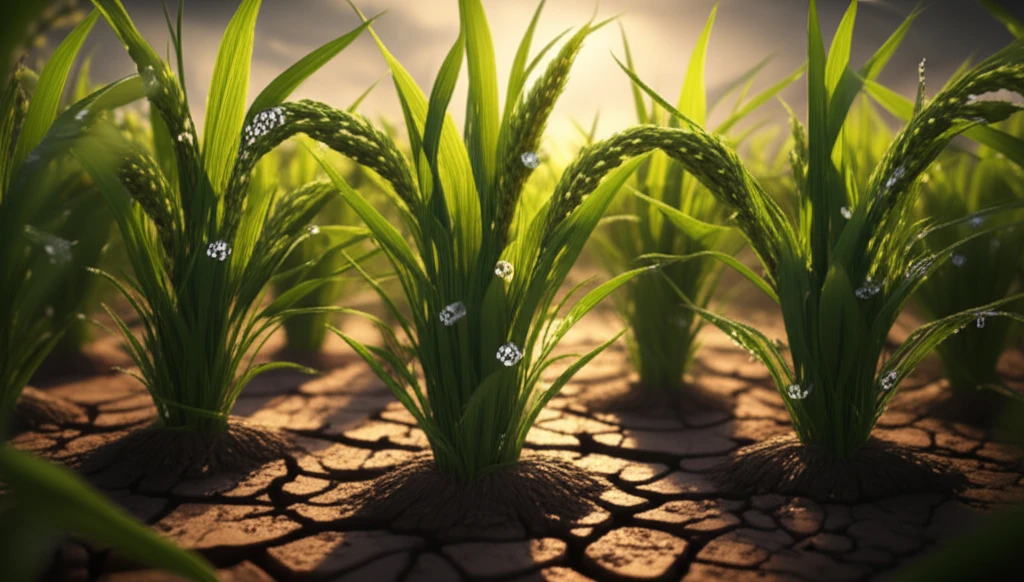
Rice plants thriving in a dry landscape, protected by silicon.

Is Silicon the Secret to Drought-Resistant Rice?

"New research reveals how silicon fertilization can help rice crops thrive under water deficit conditions, offering a promising solution for sustainable agriculture."


Rice is a staple crop for billions worldwide, particularly in Asia and Oceania, where it sustains a large portion of the developing world's population. However, rice cultivation faces increasing challenges from water scarcity, making drought tolerance a critical trait for ensuring food security. Two major ecosystems exist for rice cultivation: flooded paddy fields and upland areas, the latter relying on rainfall or supplemental irrigation and often exhibiting greater drought tolerance.

Silicon (Si) has emerged as a key nutrient that can enhance rice plant development in water-deficient environments. This element reduces water loss through transpiration, boosts photosynthetic rates, and activates the plant's enzymatic defense system, priming it to withstand environmental stresses. These benefits position silicon as a vital tool in mitigating the impacts of drought on rice production.

This article explores the findings of a recent study investigating the effects of silicon fertilization on two rice cultivars (Curinga and IAC 202) subjected to water deficit. The research analyzes enzymatic activity, physiological responses, and overall productivity, providing insights into how silicon can help rice plants thrive even when water is scarce.

How Silicon Bolsters Rice Against Drought Stress

Rice plants thriving in a dry landscape, protected by silicon.

The research involved a controlled experiment where rice plants were subjected to varying levels of water stress, combined with the presence or absence of silicon fertilization. Researchers measured several key indicators, including the activity of antioxidant enzymes (Superoxide dismutase, Catalase, and Ascorbate Peroxidase), the rate of CO₂ assimilation, and grain yield.

The results indicated that silicon fertilization significantly enhanced the activity of antioxidant enzymes, even under severe water deficit conditions. Furthermore, the rate of CO₂ assimilation and grain production also increased with the addition of silicon, suggesting that silicon plays a crucial role in maintaining plant function and productivity during drought.

  • Enhanced Antioxidant Defenses: Silicon boosts the activity of key enzymes that combat oxidative stress caused by drought.
  • Improved Photosynthesis: Silicon helps maintain CO₂ assimilation rates, crucial for energy production.
  • Increased Grain Yield: Silicon fertilization leads to higher grain production, even when water is limited.
These findings highlight silicon's role in mitigating the adverse effects of water stress in rice plants. By enhancing antioxidant defenses and maintaining photosynthetic efficiency, silicon enables rice to better withstand drought conditions and sustain productivity.

The Future of Rice Cultivation: Silicon as a Key Player

The study's findings suggest that silicon fertilization holds considerable promise for enhancing rice production in drought-prone areas. By alleviating the effects of water stress, silicon can help ensure more stable and productive rice yields, contributing to food security in regions facing increasing water scarcity.

Further research is needed to explore the optimal application methods and silicon sources for different rice cultivars and environmental conditions. Understanding the specific mechanisms by which silicon enhances drought tolerance will also be crucial for maximizing its benefits.

As climate change continues to exacerbate water scarcity in many rice-growing regions, silicon fertilization may become an increasingly important tool for ensuring sustainable and resilient rice production. These insights pave the way for developing agricultural practices that promote both productivity and environmental sustainability.

About this Article -

This article was crafted using a human-AI hybrid and collaborative approach. AI assisted our team with initial drafting, research insights, identifying key questions, and image generation. Our human editors guided topic selection, defined the angle, structured the content, ensured factual accuracy and relevance, refined the tone, and conducted thorough editing to deliver helpful, high-quality information.See our About page for more information.

This article is based on research published under:

DOI-LINK: 10.5433/1679-0359.2015v36n5p3013, Alternate LINK

Title: Respostas Antioxidativas, Fisiológicas E Produtiva De Arroz Cultivado Sob Deficiência Hídrica E Adubação Silicatada

Subject: General Agricultural and Biological Sciences

Journal: Semina: Ciências Agrárias

Publisher: Universidade Estadual de Londrina

Authors: Adriana Lima Moro, Fernando Broetto, Edemar Moro

Published: 2015-10-21

Everything You Need To Know

1

How does silicon fertilization help rice plants survive drought conditions?

Silicon fertilization enhances rice's drought resistance by reducing water loss through transpiration, increasing photosynthetic rates, and activating the plant's enzymatic defense system. This helps rice plants withstand environmental stresses caused by water scarcity.

2

What specific antioxidant enzymes are enhanced by silicon in rice plants facing drought?

Silicon boosts the activity of antioxidant enzymes like Superoxide dismutase, Catalase, and Ascorbate Peroxidase in rice plants. These enzymes combat oxidative stress caused by drought, protecting the plant from damage and helping it to function more efficiently.

3

How does silicon fertilization affect CO₂ assimilation in rice plants experiencing water stress?

The research found that silicon fertilization increased the rate of CO₂ assimilation in rice plants subjected to water stress. This means that the plants were able to maintain their ability to convert light energy into chemical energy, which is essential for growth and grain production.

4

Which rice cultivars were specifically studied in the research, and how might the results differ for other varieties?

The study focused on two rice cultivars, Curinga and IAC 202. While both benefited from silicon fertilization under drought conditions, it is important to conduct further research to understand how different rice varieties respond to silicon and to determine the optimal application methods for maximizing its benefits in diverse agricultural settings.

5

What are the potential long-term implications of using silicon fertilization to improve rice production in drought-prone areas?

Silicon fertilization shows potential for enhancing rice production in regions prone to drought. By improving antioxidant defenses, maintaining photosynthetic efficiency, and increasing grain yield, silicon can help ensure stable and productive rice harvests, contributing to food security amidst increasing water scarcity challenges. However, further studies are needed to understand the economic implications and scalability of silicon fertilization in different rice cultivation systems.

Newsletter Subscribe

Subscribe to get the latest articles and insights directly in your inbox.