
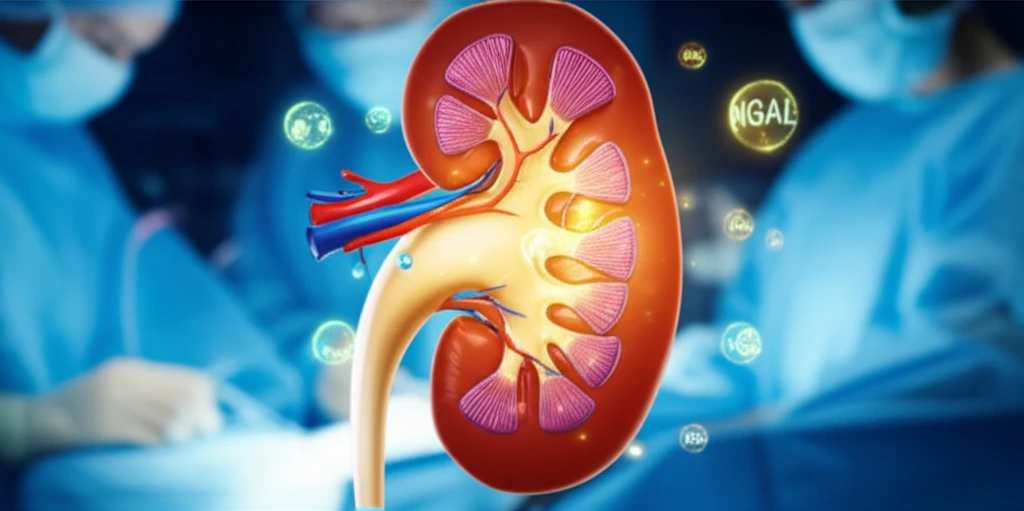
Is NGAL the Future of Kidney Protection? Predicting Risk After Heart Procedures

"Discover how a novel biomarker, NGAL, could revolutionize the way doctors prevent kidney damage after common heart procedures, offering earlier detection and intervention."
When you undergo a heart procedure like a coronary angiography or percutaneous coronary intervention (PCI), the last thing you're probably thinking about is your kidneys. However, these procedures often involve contrast dyes that, while helping doctors see your heart clearly, can sometimes harm your kidneys, leading to a condition called contrast-induced nephropathy (CIN). CIN is essentially an acute kidney injury (AKI) triggered by these dyes.
CIN isn't a minor issue; it's a significant cause of hospital-acquired acute renal failure and can lead to poor outcomes. The tricky part is that traditional methods of detecting CIN, like measuring serum creatinine (SCr) levels, are slow and can delay timely intervention. SCr levels usually peak 2-3 days after the contrast exposure, making it unsuitable for early detection as most patients are discharged within 24 hours post-procedure.
Enter neutrophil gelatinase-associated lipocalin (NGAL), a promising biomarker that might just change the game. Recent research has explored NGAL's potential as an early predictor of CIN, offering a faster and more sensitive way to identify patients at risk. This could lead to earlier interventions and better protection for your kidneys. In this article, we will explore the findings of a prospective study investigating the effectiveness of NGAL in predicting CIN in moderate-risk patients undergoing cardiac catheterization.
NGAL: A Game-Changer in Early Kidney Damage Detection
The traditional way to detect CIN relies on monitoring serum creatinine (SCr) levels, which isn't ideal because of the delay in detection. NGAL, on the other hand, shows up much sooner after kidney injury. A study published in the Journal of Clinical and Experimental Cardiology explored how NGAL could be used to predict CIN in patients undergoing coronary angiography, a common heart procedure. The study enrolled 42 moderate-risk participants (based on the Mehran score, a tool to assess CIN risk) and measured their NGAL levels before and 4 hours after the procedure, comparing it with SCr levels measured later.
- Sensitivity: 91.67% (meaning it correctly identified 91.67% of those who developed CIN)
- Specificity: 93.33% (meaning it correctly identified 93.33% of those who did not develop CIN)
- Accuracy: 92.86%
- Area Under the ROC Curve: 0.93 (indicating excellent predictive ability)
The Future of Kidney Protection in Heart Procedures
The study's findings open up exciting possibilities for preventing kidney damage in patients undergoing heart procedures. By measuring NGAL levels shortly after contrast exposure, doctors could identify high-risk individuals and implement strategies such as:
<ul><li>Intravenous fluids: To help flush out the contrast dye.</li><li>Medications: Such as N-acetylcysteine, which may protect the kidneys.</li><li>Avoiding further kidney-damaging agents: Temporarily holding off on other medications that could harm the kidneys.</li></ul>
While more research is always needed, NGAL holds considerable promise as a tool to improve patient outcomes and reduce the incidence of CIN. Further studies could explore its effectiveness in diverse populations and refine the optimal timing and cutoff values for NGAL measurement. By integrating NGAL testing into clinical practice, healthcare providers could take a proactive step toward safeguarding kidney health during essential heart procedures.