
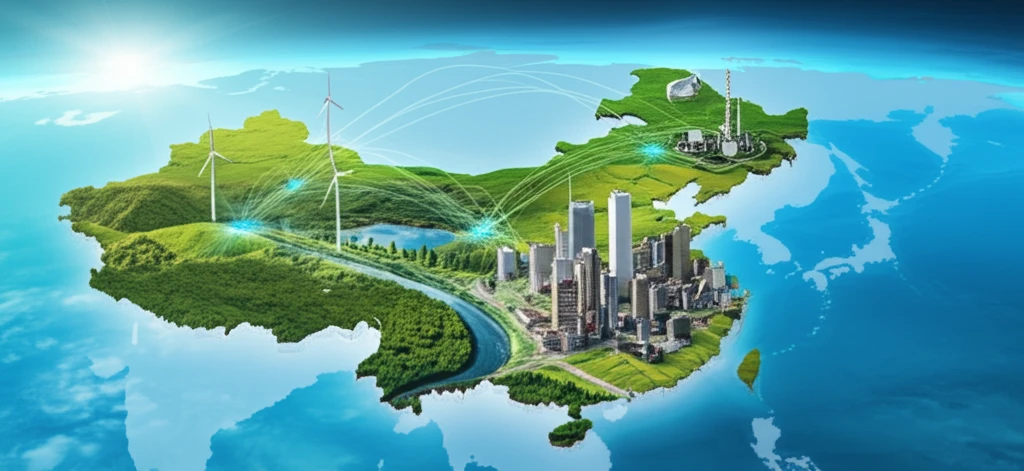
Is China's Economic Boom Sustainable? Unveiling the Nation's Ecological Security

"A deep dive into how China's provinces balance growth with environmental health, and what the future holds."
For decades, China has experienced unprecedented economic growth, transforming itself into the world's second-largest economy. This rapid development, however, has come at a cost. Increased industrialization, urbanization, and resource consumption have placed immense pressure on the nation's ecosystems, raising concerns about ecological security. Balancing economic progress with environmental sustainability is now a critical challenge for China.
Ecological security, in essence, refers to the state of ecological conditions that support human well-being and socio-economic development without compromising the integrity of natural systems. It encompasses various factors, including resource availability, pollution levels, biodiversity, and the overall health of ecosystems. A nation with strong ecological security can sustainably provide for its citizens while protecting its natural heritage.
This article delves into the complexities of ecological security in China, examining the dynamic changes occurring across its provinces. By analyzing emergy-ecological footprint hybrid indicators, we'll gain insights into the ecological challenges and opportunities facing different regions of the country. Furthermore, we will explore potential future scenarios and policy recommendations aimed at fostering a more sustainable path forward.
Measuring Ecological Pressure in Context
Assessments of whether China's rapid economic growth can be sustained alongside its ecological security typically hinge on measures of resource use, pollution, and ecosystem health. Because the underlying data and methodologies vary across studies, precise current figures are difficult to state with confidence. What is broadly agreed is that the country's growth model has come under increasing environmental strain. A cautious reading of the available evidence suggests ecological factors are now central to any evaluation of the sustainability of China's economic boom.
Defining Ecological: The Standard Analytical Lens
Across standard reference works, the term 'ecological' is defined as relating to the science of ecology, which studies how living things interact with their environment. Multiple dictionaries agree that the word denotes matters concerning ecology or the environment. One reference source explains that the term derives from the Greek 'oikos,' meaning house, and 'logy,' meaning knowledge, so it literally translates as 'the study of our house,' centered on how organisms interact with one another and the physical world. This widely accepted framing provides the analytical foundation for examining whether economic growth can be sustained without degrading environmental security. A limitation of this approach is that it defines the scope of inquiry while leaving questions of measurement and thresholds to empirical research.
Ecology as the Study of Life and Environment
A vocabulary reference defines anything ecological as relating to the science of ecology, described in plain terms as the study of how living things and the environment 'do their thing.' This kind of definitional account frames ecology as the foundational discipline whose core concern is the interplay between organisms and their surroundings. Because the available source material is definitional rather than historical, specific milestones and founding discoveries of the field are not detailed here. Still, the description points to ecology's enduring purpose of understanding how life and environment interact, a lens increasingly applied to questions of national sustainability.
What are Emergy-Ecological Footprint Hybrid Indicators?
Traditional methods of assessing ecological impact often fall short by not fully accounting for the various forms of energy and resources consumed by a system. The emergy-ecological footprint hybrid indicator offers a more comprehensive approach. This method combines the principles of emergy analysis, which quantifies the total energy required to produce a good or service, with the ecological footprint, which measures the amount of land needed to support resource consumption and waste assimilation.
- Emergy: Measures the total energy, both direct and indirect, used to make a product or service.
- Ecological Footprint: Calculates the amount of land needed to sustain consumption and handle waste.
- Hybrid Indicator: Combines these measures for a comprehensive view of ecological impact.
Signals From an Evolving Field
Research on ecological security in China's fast-growing economy is characterized by emerging work on resource constraints, emissions, and land use rather than by settled consensus. Findings are frequently preliminary, and measurement approaches vary, so the literature reports cautious and mixed results. Reviews tend to agree that environmental pressures have risen alongside economic output, though the magnitude and trajectory remain actively debated. Given the rapid pace of publication in this area, specific findings should be treated as provisional.
Contested Findings and Implementation Gaps
Counterarguments to more optimistic assessments of China's ecological security point to enforcement shortfalls, conflicting data, and the slow pace of structural change away from heavy industry. Some analyses suggest that policy targets have been met on paper while on-the-ground conditions lag behind, although such claims vary by region and indicator. Failures are also attributed to the difficulty of reconciling short-term growth objectives with long-term environmental goals. Because sources behind any single claim may differ, these accounts are best read as competing interpretations rather than established conclusions.
Weighing Ecological Against Economic Priorities
Comparative assessments of ecological security typically contrast economic growth metrics with environmental indicators such as air and water quality, forest cover, and carbon intensity. Such comparisons are complicated by differing baselines, definitions of 'ecological security,' and the scales at which data are collected. As a result, rankings across regions and countries vary depending on methodology. Without a shared analytical framework, comparative conclusions should be read as conditional on the indicators chosen.
Toward a Greener Future for China
China's journey toward ecological security is an ongoing process, filled with challenges and opportunities. By embracing innovative assessment methods like the emergy-ecological footprint hybrid indicator, and by implementing targeted policies that promote resource efficiency and environmental protection, China can strive to achieve a more sustainable balance between economic prosperity and ecological well-being. The future hinges on a collective commitment to building a greener, more secure, and resilient nation for generations to come.
Expert Views Converge on Balance
Expert commentary on China's economic boom and its ecological security generally converges on a balancing act: growth and environmental protection must be pursued together rather than sequentially. Commentators caution that no single metric captures the full picture, and that aggregate figures can obscure local successes and failures. Most commentary frames the central challenge as managing trade-offs among economic output, resource use, and ecosystem resilience. Given the evolving evidence base, expert assessments emphasize prudence over certainty.
Frontiers of Sustainable Growth
Looking ahead, the frontiers of research and policy lie in cleaner energy systems, circular resource use, and monitoring technologies capable of tracking ecological change in near real time. Exactly how these frontiers will develop remains uncertain, and projections are often scenario-based rather than definitive. Many anticipated pathways depend on sustained investment and on economic and political conditions that are difficult to forecast. Future assessments of sustainability in China will likely hinge on whether these tools and policies deliver measurable ecological gains.
Systemic Pressures Beyond the Numbers
China's ecological security sits within broader systemic challenges, including global supply chains, climate change, urbanization, and demographic shifts. These forces interact in ways that single-sector analysis often misses, making systemic thinking essential. Efforts to sustain economic growth while protecting ecosystems must therefore contend with influences that span national borders and decades. Fully grasping these dynamics will require integrated analysis rather than isolated metrics.
People at the Center of Environmental Change
Behind the statistics are communities whose health, livelihoods, and daily environments are shaped by the interplay between economic growth and ecological conditions. Air and water quality, access to green space, and the local impacts of industrialization all translate directly into human wellbeing. A complete assessment of ecological security must therefore account for how change is experienced on the ground. Qualitative accounts of such local impacts are essential complements to aggregate quantitative indicators.