
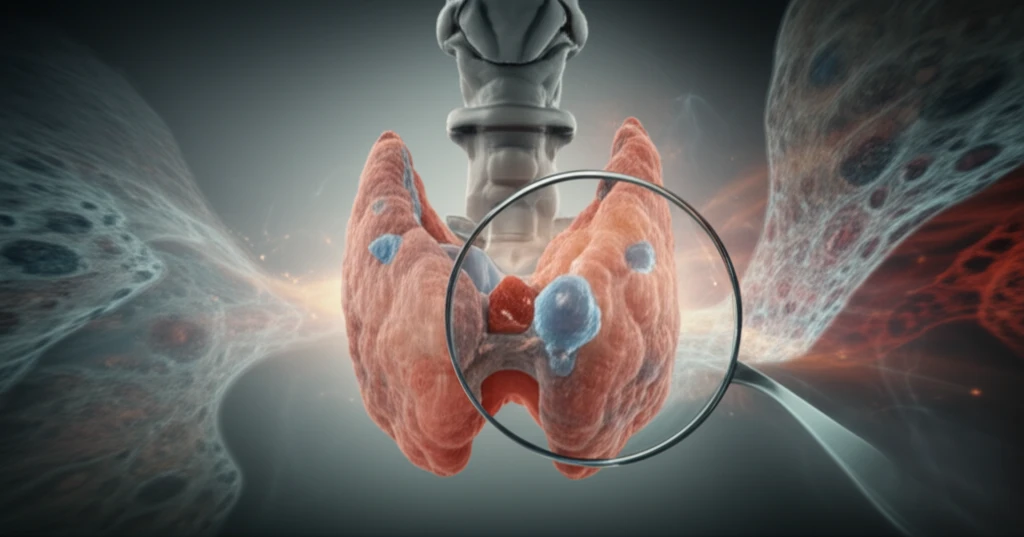
Is a Frozen Section Right for Your Thyroid Nodule? A Patient-Friendly Guide

"Unlocking the role of intra-operative frozen section analysis in thyroid nodule management: What patients need to know about accuracy, benefits, and personalized care."
Thyroid nodules are a common health concern, affecting a significant portion of the population. While many are benign, the possibility of malignancy requires careful evaluation and a strategic approach to management. This is where intra-operative frozen section (FS) analysis comes into play, offering a real-time assessment during thyroid surgery to guide the extent of the procedure.
FS biopsy involves taking a small sample of the thyroid nodule during surgery and rapidly freezing it for microscopic examination. This allows pathologists to provide surgeons with an immediate diagnosis, helping them determine whether to remove the entire thyroid gland (total thyroidectomy) or only a portion of it (lobectomy). The goal is to ensure complete removal of cancerous nodules while minimizing the extent of surgery for benign conditions.
This article aims to provide a clear and accessible overview of FS in thyroid surgery. By examining the findings of a recent study on the value of FS, we'll explore its accuracy, benefits, and limitations, empowering you to make informed decisions about your thyroid health.
Frozen Section's Shifting Role in Thyroid Surgery
The increased use of molecular testing of thyroid fine-needle biopsies has changed the frequency and extent of thyroid resection for thyroid nodules. Although the role of frozen-section analysis of the thyroid has been reduced markedly in recent years, many surgeons still routinely use it intraoperatively. Intraoperative frozen section (FS) has been recommended as a strategy to tailor the extent of the initial surgery, particularly for patients with thyroid nodules classified as follicular neoplasm. Retrospective analyses continue to assess the accuracy and intertest agreement of preoperative fine-needle aspiration cytology (FNAC) and intraoperative frozen-section analysis findings in thyroid surgery.
Frozen Section vs. the Bethesda System
Frozen section (FS) has been used extensively to help guide intraoperative management of patients with thyroid nodules. However, FS is usually insufficient to determine true capsular or vascular invasion, and deferral to a final pathologic diagnosis is often necessary in the setting of follicular lesions. Single-institution reviews have demonstrated important limitations of frozen section analysis in the context of the Bethesda system, the 2015 ATA guidelines, and recent advances in differentiated thyroid cancer management. The debate over using FS in thyroid nodules has persisted for approximately 50 years, with meta-analyses comparing FNAB and FS results across follicular and non-follicular lesions yielding mixed conclusions.
A Long-Standing Surgical Debate
The use of frozen section examination in thyroid surgery has been the subject of clinical debate for roughly half a century, with efforts to refine its diagnostic accuracy ongoing throughout that period. No specific milestone discoveries or foundational studies were identified in the available source material for this subsection.
Frozen Section Analysis: What Does the Research Say?
A retrospective study analyzed the results of 1110 frozen sections of thyroid specimens over a 10-year period (2003-2012) and compared these to the final, more detailed, histopathological examination. Here's a breakdown of the key findings:
- Specificity: FS was highly specific (99.3%), meaning it was very good at correctly identifying benign nodules.
- Sensitivity: Sensitivity was lower (64.7%), indicating that FS missed some malignant nodules. The sensitivity varied depending on the type of thyroid cancer, with higher sensitivity for follicular and anaplastic carcinomas than for papillary carcinoma.
- False Negatives: A significant portion of the false-negative diagnoses were due to papillary microcarcinomas (very small tumors), which can be challenging to detect on frozen section.
- Predictive Value: The positive predictive value (PPV) was 94.4%, meaning that if FS indicated malignancy, it was highly likely to be correct. The negative predictive value (NPV) was 93.9%, meaning that if FS indicated benignity, it was usually accurate.
Evolving Evidence on Intraoperative Frozen Section
The performance of frozen section analysis is strongly influenced by the experience of surgeons and pathologists, and its effectiveness varies across care settings. Recent reviews have analyzed its indications, results, and consequences in secondary care hospitals, where surgical and pathologic expertise may differ from university centers. Technological advances over the past 30 years have significantly improved diagnostic management of thyroid nodules, though thyroidectomy remains a reliable method to identify malignancy. Future research directions continue to focus on refining which patients benefit most from intraoperative frozen section versus alternative diagnostic approaches.
Limitations and Diagnostic Uncertainties
A retrospective analysis of 312 patients operated on for thyroid nodules between 2014 and 2015 evaluated the impact of frozen section analysis on surgical strategy, with 193 patients included who underwent preoperative ultrasound, fine needle aspiration cytology, intraoperative frozen section, and postoperative definitive pathology. The study highlighted that frozen section results do not always align with final pathology findings, creating diagnostic uncertainty. These discrepancies can lead to either unnecessary completion thyroidectomy or inadequate initial resection, underscoring the inherent limitations of intraoperative frozen section for certain nodule types.
Comparing Diagnostic Approaches
The available source material for this subsection did not provide sufficient specific comparative data to construct a detailed evidence-based comparison. Further research would be needed to rigorously compare frozen section analysis against molecular testing, FNA alone, and other diagnostic modalities for thyroid nodules.
The Bottom Line: Is Frozen Section Right for You?
The study supports the use of intraoperative FS in confirming malignancy in thyroid nodules. Its high specificity means it's reliable for identifying benign cases, potentially allowing for less extensive surgery when appropriate. However, the lower sensitivity and possibility of false negatives highlight the importance of careful interpretation and consideration of other factors.
Expert Perspectives on Frozen Section Utility
While no dedicated expert commentary sources were identified for this subsection, the overall body of evidence suggests that frozen section remains a relevant but imperfect tool in thyroid surgery. Its utility is most clearly supported when surgical decisions about the extent of resection must be made in real time, though its limitations in distinguishing follicular lesions and assessing capsular or vascular invasion temper enthusiasm for its universal application.
Precision Medicine and the Next Era of Thyroid Nodule Management
Precision medicine approaches now enable more tailored management of thyroid nodules, with active surveillance recommended for low-risk nodules and molecular profiling guiding surgical decision-making. Future directions include liquid biopsy techniques, improved dynamic risk stratification models, and enhanced integration of multiomics data. A 2026 study published in precision-medicine-focused literature noted that these advances could complement or partially replace traditional frozen section analysis. Intraoperative frozen section remains a valuable tool, particularly in unilateral lobectomy and for patients presenting with suspicious thyroid nodules, where it can guide appropriate one-stage surgical management.
Surgical Decision-Making and Systemic Considerations
Rapid intraoperative frozen pathological examination is an important strategy to control the scope of surgery and reduce excessive resection in thyroid cancer care. Ultrasound remains an important tool in the preoperative diagnosis of thyroid nodules, working alongside frozen section to inform surgical planning. Intraoperative rapid frozen section pathological examination is favored in departments of thyroid cancer surgery because it can distinguish the benign and malignant nature of thyroid lesions and identify lymph node metastases, thus playing an important role in surgical decision-making. The indolent feature of papillary thyroid cancer (PTC) has recently led to an increase in less aggressive treatment options instead of total thyroidectomy, adding complexity to intraoperative decision-making.
Real-World Diagnostic Accuracy
The accurate screening of malignant nodules has long been a major challenge in the management of thyroid disease. For suspicious nodules detected by B-ultrasound, guidelines across different countries differ in diagnostic methods such as fine-needle aspiration (FNA) and frozen sections (FS). A July 2026 study specifically examined the diagnostic performance of intraoperative frozen section in Bethesda III thyroid nodules, assessing robustness through risk-of-bias assessment and leave-one-out analysis. Single-institution reviews have demonstrated the practical limitations of frozen section in real-world clinical settings, where preoperative, intraoperative, and postoperative pathology findings do not always converge.
Ultimately, the decision to use FS should be made in consultation with your surgeon and endocrinologist, taking into account your individual risk factors, the characteristics of your nodule, and the availability of experienced pathologists. Discuss the potential benefits and limitations of FS in your specific case to determine the best approach for your thyroid health.
By staying informed and actively participating in your care, you can work with your medical team to achieve the best possible outcome for your thyroid nodule.