
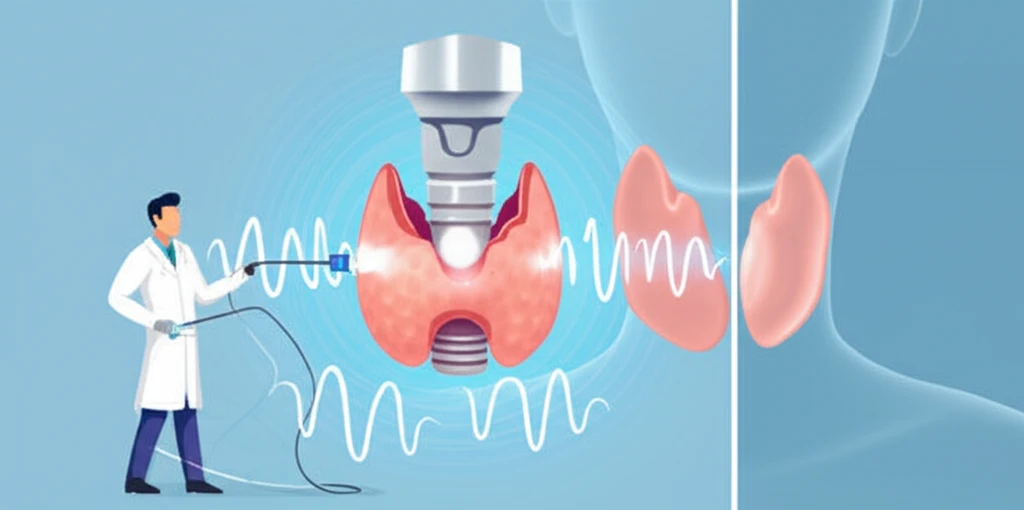
HIFU vs. Thyroid Surgery: Is a Scar-Free Future for Thyroid Nodules Possible?

"A groundbreaking study compares two leading treatments for thyroid nodules, offering hope for less invasive options and improved patient outcomes."
Thyroid nodules, often harmless, are a common concern for many, particularly women. While most are benign, some can grow and cause noticeable symptoms, leading to the need for medical intervention. Historically, the primary solution has been surgery, which, although effective, can come with potential complications and a visible neck scar. However, the medical field is evolving, with exciting advancements in non-invasive treatments like high-intensity focused ultrasound (HIFU).
This article dives into a pivotal study comparing HIFU with traditional open thyroid surgery (lobectomy) for benign thyroid nodules. The study, which involved a propensity-matched analysis, offers valuable insights into treatment outcomes, including the potential for a scar-free solution, shorter recovery times, and reduced costs. We'll explore the findings and what they mean for patients seeking the best possible care for their thyroid health.
Our focus is on translating complex medical research into clear, actionable information. We'll break down the study's key findings, discuss the advantages and disadvantages of each treatment, and highlight what these advancements mean for you and your thyroid health.
Current Evidence and Impact
HIFU ablation is described as a safe, minimally invasive option for benign symptomatic thyroid nodules, but reported outcomes remain variable. One cohort found only 20-46% volume reduction at six months, and 31% of patients ultimately required surgery, possibly because the cohort included large nodules. A separate study reported a 75.8% treatment success rate at six months, indicating that published figures may reflect different outcome definitions and patient groups. Surgery, by contrast, is associated with visible scars and risks including bleeding, nerve injury, and hypothyroidism.
Procedure and Anatomical Limits
A 2025 overview presents HIFU as a non-invasive technique for ablation of benign thyroid nodules and reviews its procedure, safety, efficacy, limitations, and future implications. The treatment's feasibility depends strongly on nodule localization. One report found that an optimal arrangement includes a layer of healthy thyroid tissue between the treatment area and nearby neck structures and organs. These anatomical constraints can limit which nodules are suitable for HIFU.
An Emerging Treatment Path
The historical development of HIFU treatment for thyroid nodules is not established by the supplied sources. In broad terms, HIFU represents an emerging effort to treat selected nodules without conventional surgery. Its place in thyroid care is likely to depend on accumulating evidence about safety, durability, and patient selection. A detailed timeline of foundational discoveries would require additional historical sources.
HIFU and Thyroid Surgery: Unpacking the Study's Key Findings
The study, published in the journal Surgery, offers a direct comparison between HIFU and open lobectomy. Researchers analyzed data from patients who underwent either HIFU ablation or surgical removal of their thyroid nodules. The study's design used propensity score matching to ensure a fair comparison by accounting for differences in patient demographics, such as age and sex.
- Treatment Time: HIFU sessions were significantly faster than open surgery.
- Hospitalization: Patients undergoing HIFU typically experienced shorter hospital stays, often being discharged the same day.
- Cost: The overall medical cost associated with HIFU was notably lower than that of surgery.
- Nodule Shrinkage: HIFU demonstrated effectiveness in reducing nodule size, with an average shrinkage of 64% after six months.
- Symptom Improvement: Both treatments showed similar levels of symptom relief, indicating that HIFU is as effective as surgery in addressing the discomfort caused by thyroid nodules.
Current Research Direction
Recent research appears to be concentrating on how effectively HIFU can treat benign thyroid nodules and which patients are most appropriate for it. Important questions include treatment durability, nodule selection, and how outcomes compare with established care. The available evidence should be interpreted cautiously because the supplied material does not establish a single definitive standard for HIFU. Further reviews and longer follow-up may clarify its clinical role.
Where HIFU May Fall Short
HIFU should not be treated as a guaranteed replacement for thyroid surgery. Potential limitations include incomplete treatment, variable response, and the possibility that additional intervention may still be needed. Suitability can also depend on anatomy and the nodule's relationship to nearby neck structures. These concerns support careful patient selection rather than universal use of HIFU.
HIFU and Surgery
HIFU offers the possibility of treating selected benign thyroid nodules without an open surgical incision, while surgery remains a more established intervention. The trade-off is that HIFU may provide less predictable or incomplete nodule reduction and may not be feasible for every anatomical location. Surgery carries recognized risks and often leaves a visible scar, but HIFU also cannot be assumed to eliminate the need for later treatment. The appropriate choice therefore depends on the nodule, anatomy, clinical goals, and available expertise.
The Future of Thyroid Nodule Treatment: A Less Invasive Path?
The study offers a glimpse into a future where less invasive treatments like HIFU play a larger role in managing thyroid nodules. While open surgery will always have its place, the potential benefits of HIFU, including the avoidance of a neck scar, reduced recovery time, and potential cost savings, make it an appealing option for many patients. Ultimately, the best treatment for you depends on your individual circumstances. Consulting with a healthcare professional to discuss the risks and benefits of each option is essential. As research continues and technology advances, the goal remains the same: to provide the most effective and patient-friendly care possible, and the option of scar-free thyroid treatment seems increasingly within reach.
A Selective, Not Universal, Alternative
Taken together, HIFU appears best understood as a promising option for carefully selected patients with benign thyroid nodules rather than as an automatic substitute for surgery. Its appeal comes from a non-invasive approach and the potential to avoid an open neck scar. Its limitations include variable effectiveness, anatomical constraints, and the possibility of subsequent surgery. Expert decision-making should therefore balance patient preferences with diagnostic certainty, nodule characteristics, and treatment feasibility.
Toward Scar-Free Treatment
The future of HIFU for thyroid nodules is being framed around whether it can provide a safer, effective alternative to surgery while improving patient outcomes. The supplied articles specifically describe ongoing interest in comparing HIFU with surgery across safety, effectiveness, and patient experience. A scar-free future is therefore possible for some carefully selected patients, but the material does not establish that HIFU will replace surgery broadly. Further clinical evidence will be needed to determine its long-term role.
Integrating a New Modality
HIFU is presented as one of the non-surgical thermal ablation techniques that may serve as an alternative for benign thyroid nodules. Its broader adoption would require healthcare systems to integrate a newer treatment approach into existing thyroid care pathways. That integration may depend on appropriate patient selection, procedural expertise, and evidence demonstrating reliable outcomes. The supplied source does not establish how widely HIFU is currently available.
Patient Comfort and Choice
A case report described a woman in her 70s who underwent HIFU thyroid nodule ablation under hypnosis in a non-operating-room anesthesia setting. The procedure was well tolerated, and she reported comfort and satisfaction at avoiding general anesthesia. This case illustrates how treatment experience and anesthesia preferences can influence the perceived value of minimally invasive care. However, a single case report cannot establish how consistently these outcomes occur across patients.