
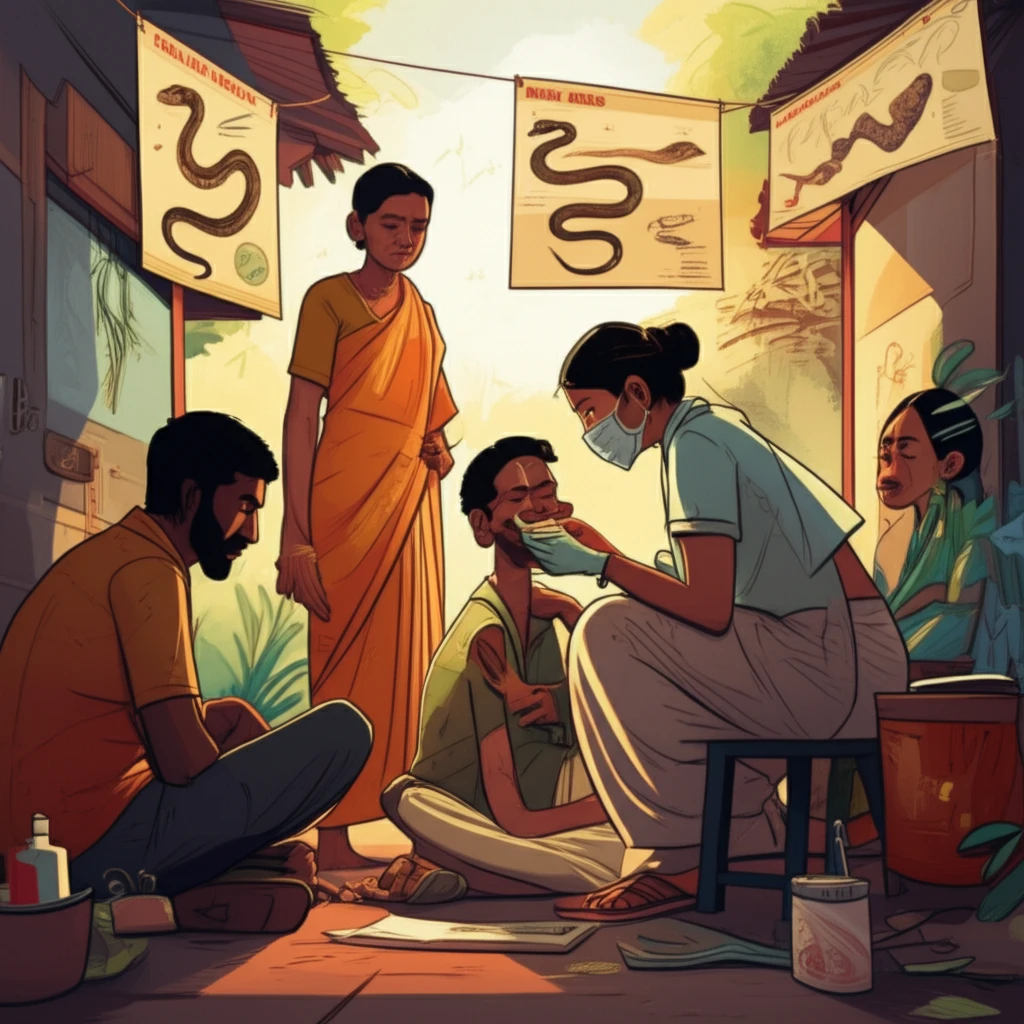
Health worker administering antivenom in rural India, with educational banners about snake identification.

India's Silent Crisis: Unveiling the Fight Against Snakebites

"Discover how the Madras Crocodile Bank is leading the charge in mitigating snakebite fatalities across rural India."


Snakebite is a significant public health problem in rural India, where encounters with highly venomous snakes are frequent, especially in agricultural zones. Four species—the spectacled cobra, Russell's viper, common krait, and saw-scaled viper—are responsible for the majority of serious and fatal bites. Although a polyvalent antivenom exists, its availability and public awareness remain insufficient, leading to tragic outcomes.

In response to this critical issue, the Madras Crocodile Bank/Centre for Herpetology (MCB) and its partners are actively involved in a comprehensive snakebite mitigation project. This initiative includes venom sampling and research, mapping snakebite treatment centers, and conducting a nationwide awareness campaign.

The project leverages the growing interest in snakes among young naturalists in India, turning them into advocates who can help reduce the loss of life and limb caused by snakebites in rural communities. Their efforts aim to bridge the gap between available treatments and those who desperately need them.

Addressing India's Most Ignored Health Issue: The Snakebite Crisis

Health worker administering antivenom in rural India, with educational banners about snake identification.

With a staggering 46,000 reported deaths each year, snakebite is one of India's most overlooked health crises. The herpetological community recognizes the urgent need for action, driven by a growing awareness of the issue among young naturalists.

The Madras Snake Park, established in 1969, serves as a vital public education and reptile research center, attracting millions of visitors annually. A primary function of the park is to educate the public about the identification and avoidance of the few snake species responsible for the majority of human fatalities, physical deformities, and psychological trauma.

  • Education and Awareness: Rural outreach services targeting schools and communities in the most affected Indian states.
  • Venom Sampling and Research: Collaboration with the Gerry Martin Project and the Evolutionary Venomics Laboratory of the Indian Institute of Science to characterize venoms and assess the effectiveness of Indian antivenoms.
  • Mapping Snake Occurrences: Working with IndianSnakes.com to map the distribution of medically significant snake species.
  • Identifying Treatment Centers: Locating clinics with antivenom stocks and experienced clinicians available 24/7.
Since 2016, the MCB team, with support from USV Pharmaceuticals, Infosys Foundation, and Deshpande Foundation, has been executing a multi-pronged snakebite mitigation project in collaboration with regional partners. This comprehensive approach is designed to tackle the problem on multiple fronts, from prevention to treatment.

Joining the Fight Against Snakebites

Students, doctors, and wildlife activists are encouraged to connect with the snakebite mitigation project team at snakebite@madrascrocodilebank.org. With continued efforts and increased awareness, there is optimism that this deadly problem affecting India's farmers can be solved. As India's chapter of the Global Snakebite Initiative, the project is building local partnerships and collaborating with national and international experts. Donor agencies are always welcome to support the work being done in the most remote parts of the country.

About this Article -

This article was crafted using a human-AI hybrid and collaborative approach. AI assisted our team with initial drafting, research insights, identifying key questions, and image generation. Our human editors guided topic selection, defined the angle, structured the content, ensured factual accuracy and relevance, refined the tone, and conducted thorough editing to deliver helpful, high-quality information.See our About page for more information.

Everything You Need To Know

1

What are the primary snake species responsible for the majority of snakebite fatalities in rural India?

The four snake species that are responsible for the majority of serious and fatal bites in rural India are the spectacled cobra, Russell's viper, common krait, and saw-scaled viper. These species are highly venomous and their presence in agricultural zones contributes to the high incidence of snakebites. The focus of mitigation efforts, including antivenom distribution and awareness campaigns, often targets these specific species.

2

What role does the Madras Crocodile Bank/Centre for Herpetology (MCB) play in addressing the snakebite crisis in India?

The Madras Crocodile Bank (MCB) is leading a comprehensive snakebite mitigation project. This includes venom sampling and research, mapping snakebite treatment centers, and conducting nationwide awareness campaigns. The MCB also collaborates with partners, such as the Gerry Martin Project and the Evolutionary Venomics Laboratory of the Indian Institute of Science. Furthermore, the MCB is building local partnerships and collaborating with national and international experts as India's chapter of the Global Snakebite Initiative.

3

Besides antivenom, what other key initiatives are being undertaken to combat snakebites, according to the text?

Beyond antivenom distribution, several initiatives are crucial. The project involves comprehensive strategies such as education and awareness programs, mapping snake occurrences, identifying treatment centers with antivenom stocks, and researching snake venoms to assess the effectiveness of antivenoms. The Madras Crocodile Bank (MCB) is also leveraging the interest of young naturalists to create advocates who can help in reducing the loss of life and limb caused by snakebites.

4

How does the Madras Snake Park contribute to reducing snakebite incidents, and what is its connection to the Madras Crocodile Bank?

The Madras Snake Park, established in 1969, serves as a public education and reptile research center. It attracts millions of visitors annually and educates the public about identifying and avoiding the snake species responsible for fatalities. It is an integral part of the Madras Crocodile Bank's (MCB) broader efforts to mitigate snakebites. Both institutions are connected, as the MCB is leading the charge in the snakebite mitigation project.

5

What are the implications of insufficient antivenom availability and public awareness regarding snakebites in India, and how are these issues being addressed?

Insufficient antivenom availability and low public awareness lead to tragic outcomes, including deaths, physical deformities, and psychological trauma. To address these issues, the Madras Crocodile Bank (MCB) is conducting education and awareness campaigns, mapping treatment centers, and conducting venom research. Furthermore, the project aims to bridge the gap between available treatments and those who need them by involving young naturalists and establishing partnerships. The MCB team has been executing a multi-pronged snakebite mitigation project with support from various organizations since 2016 to tackle the problem comprehensively.

Newsletter Subscribe

Subscribe to get the latest articles and insights directly in your inbox.