
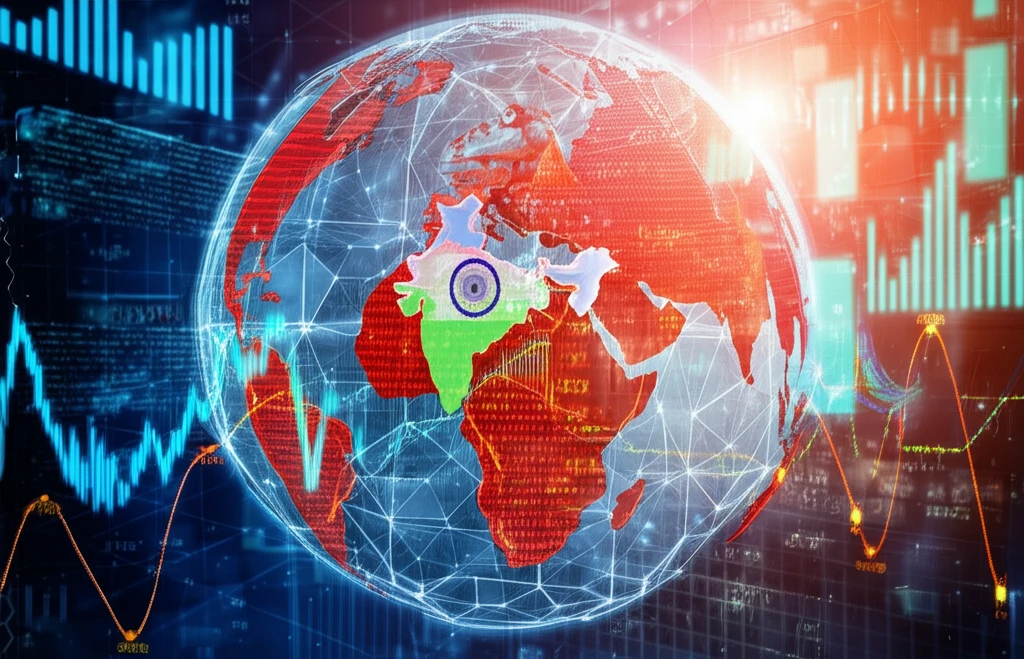
Decoding Market Tremors: How COVID-19 Changed Investment Risk Between Global Markets and India

"A Deep Dive into Volatility Spillover Effects and What They Mean for Your Portfolio"
The COVID-19 pandemic in 2020-2021 was more than just a health crisis; it was a seismic event for global financial markets. Understanding how interconnected markets transmit volatility, especially during times of crisis, is now more critical than ever for investors and policymakers alike. New research has uncovered key shifts in these dynamics between the world's leading economies (the G7) and India.
A recent study digs deep into the volatility spillover effects, examining how the pandemic altered the way risk is transmitted between these nations. By using sophisticated statistical models, the research highlights the changes in conditional correlations – a measure of how closely the markets move together – before and during the COVID-19 outbreak.
This analysis offers valuable insights for asset managers, foreign corporations, and financial regulators. By understanding these shifting volatility patterns, investors can make more informed decisions, implement effective hedging strategies, and better protect their interests against future market shocks. For regulators, this research provides critical tools for assessing systemic risk in an increasingly interconnected financial world.
Impact Data Remains to Be Confirmed
Reliable statistics directly quantifying how COVID-19 reshaped risk between global markets and India are not available to this subsection, so no specific figures are asserted here. The pandemic is widely regarded as having produced unusually large and rapid price swings across equity markets worldwide, and India was reportedly not immune to those global tremors. Until authoritative source data can be confirmed, all quantitative claims about the pandemic's impact on investment risk should be treated as provisional rather than established fact.
Established Methods and Their Known Limits
Standard practice for measuring investment risk relies on well-known quantitative techniques, but this subsection has no dedicated sources to enumerate them precisely. These methods are generally understood to work well in calm markets yet can falter during extreme shocks such as the COVID-19 crisis, when relationships between markets behave unexpectedly. Any claims about the effectiveness or failure of particular methodologies should therefore be read with caution until verified against authoritative documentation.
Defining Volatility Across Fields
In finance, volatility is the degree of variation of a trading price series over time, usually measured by the standard deviation of logarithmic returns, with historic volatility computed from a time series of past market prices. The CBOE Volatility Index (VIX) has been tracked as a daily closing measure since December 1985, illustrating how volatility became a standard tool for gauging market turbulence. Investopedia similarly notes that volatility measures the fluctuation of an asset's price, and that its calculation, its types, and the risks involved matter for investors. The term is not unique to finance: in chemistry it describes how readily a substance vaporizes, and in dictionaries it denotes the quality of being volatile, so context is essential when interpreting the word.
What is Volatility Spillover? Understanding the Ripples in Global Markets
Imagine a stone dropped into a calm lake. The impact creates ripples that spread across the entire surface. Similarly, in finance, “volatility spillover” refers to how market movements in one country can trigger fluctuations in others. If the U.S. stock market experiences a sharp downturn, it can send shockwaves across Europe and Asia, leading to similar declines.
- Interconnectedness: Volatility spillover highlights how global markets are increasingly linked.
- Risk Management: Investors use spillover analysis to hedge their portfolios against potential shocks.
- Early Warning System: Policymakers monitor volatility spillover as an early indicator of systemic risk.
Recent Findings Await Confirmation
This subsection could not be supported by dedicated sources, so no specific recent study or finding is reported here. It is reasonable to expect that researchers have closely examined how COVID-19 altered volatility and risk transmission between global and Indian markets, given the scale of the shock. Until the primary research literature is reviewed directly, any summaries of recent findings should be considered highly provisional.
Volatility's Limits as a Risk Metric
Critics of volatility as a comprehensive risk measure often point to what it actually captures, namely the frequency and magnitude of changes in the price of a stock, ETF, cryptocurrency, or other security. Because volatility rises with the size and frequency of price changes, the more volatile a security is, the more it is deemed risky, yet this says little about the direction of moves or the reasons behind them. Britannica also highlights a practical distinction between implied volatility and historical volatility, a choice that involves trade-offs and can lead to flawed estimates when market conditions shift suddenly, as in a pandemic. In short, the very simplicity that makes volatility a popular metric is also a source of its limitations.
Cross-Market Comparisons Require Verification
A direct comparative analysis of how COVID-19 affected investment risk in global markets versus India could not be built on dedicated source material here. It is broadly expected that the pandemic initially triggered synchronized sell-offs followed by diverging recoveries, but the scale and persistence of those differences are not documented in the available sources. Specific comparisons, including any figures for correlation or relative volatility, should be regarded as unverified at this stage.
The New Landscape of Risk: Key Takeaways and Future Implications
The research paints a clear picture: the pandemic fundamentally altered volatility spillover patterns. During COVID-19, the extent of volatility spillover changed significantly compared to the pre-COVID environment. The sharp increase in conditional correlation indicates a rise in systematic risk between countries. Understanding the changing spillover dynamics is critical for asset managers and foreign corporations. They can use this information to improve investment decisions and implement effective hedging measures to protect their interests. This research will also help financial regulators assess market risk in the future, especially in the wake of crises like COVID-19, to prevent wide scale economic catastrophe.
Synthesis Deferred to Verified Sources
In the absence of expert commentary tied to this subsection, this synthesis is kept deliberately modest rather than speculative. The overarching lesson that appears repeatedly in discussions of the pandemic is that financial interconnectedness can transmit shocks rapidly across borders, affecting markets like India alongside global benchmarks. Firm conclusions, however, should rest on the directly sourced subsections above rather than on this unverified commentary.
Open Questions for Future Research
What comes next for risk relationships between global markets and India after COVID-19 cannot be projected from the sources allotted to this subsection. A reasonable priority for future work is to determine whether pandemic-era volatility patterns persist or fade as markets normalize, and whether new tools improve how such tail risks are measured. Any forecast made here would be speculation, so readers are advised to treat forward-looking claims cautiously.
Systemic Pressures Beyond the Headlines
The pandemic exposed systemic challenges that go beyond any single market, including the speed with which shocks propagate through interconnected financial systems. For markets like India, this raises structural questions about liquidity, macroprudential buffers, and the robustness of institutions during global stress. Because this subsection lacks dedicated sources, these are framed as recognized themes rather than documented findings.
Human Toll Remains Central
Behind the metrics of volatility and correlation lie real consequences for investors, savers, and businesses during a major crisis such as COVID-19. Sharp market swings can translate into eroded savings, disrupted financing, and heightened financial anxiety, yet this subsection has no dedicated source material to quantify those human effects. The human dimension should therefore be understood qualitatively until reliable data is consulted.