
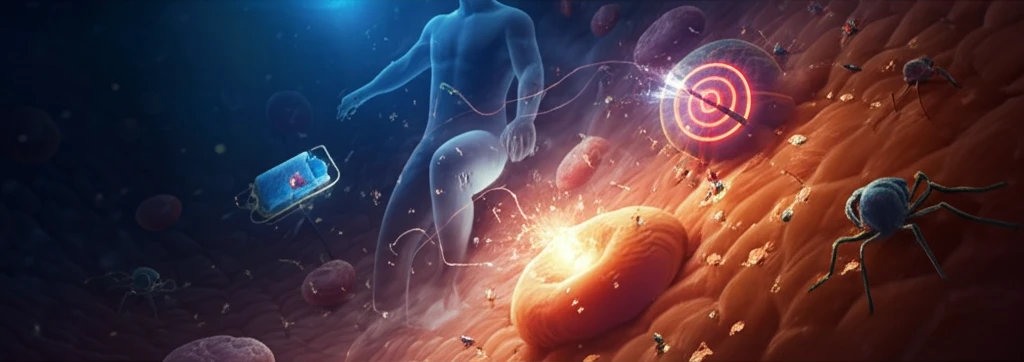
Hybrid Nanostructures: The Tiny Tech Revolutionizing Cancer Treatment

"Explore how hybrid nanostructures are emerging as innovative tools in cancer theranostics, offering new hope for targeted and effective treatments."
Imagine tiny tools, so small they can navigate the human body to repair damage at a cellular level. This isn't science fiction anymore. Hybrid nanostructures – complex materials engineered at the nanoscale – are rapidly advancing as a new frontier in cancer treatment. Combining the best properties of organic and inorganic materials, these structures offer unprecedented potential for both diagnosing and treating cancer with greater precision and effectiveness.
For decades, cancer treatment has relied on methods like chemotherapy and radiation, which, while effective, often cause significant side effects due to their impact on healthy cells. The promise of nanomedicine lies in its ability to target cancer cells directly, minimizing damage to surrounding tissues and improving patient outcomes. Hybrid nanostructures are at the forefront of this revolution, offering a versatile platform for delivering drugs, imaging tumors, and even stimulating therapeutic responses directly within the cancer cells.
This article explores the exciting world of hybrid nanostructures, delving into their potential to revolutionize cancer treatment while also acknowledging the challenges that remain in translating these technologies from the lab to the clinic. We'll examine their strengths, limitations, and the future prospects of this groundbreaking field.
The Growing Need for More Effective Cancer Therapies
Cancer treatment options now span chemotherapy, radiation, and advanced hospital networks offering patient support, with the quality of care varying widely by region and resources. In Pakistan, for example, patients face the dual challenge of weighing treatment costs against advanced options available in major cities such as Karachi, Lahore, and Islamabad. This uneven landscape has fueled interest in new technologies that could improve how cancer is treated.
Limitations of Mainstream Cancer Treatments
Mainstream cancer treatment approaches continue to face several challenges, which have formed the basis for developing targeted delivery systems that can carry and distribute therapies more precisely. Radiation therapy, a cornerstone of treatment, uses high-energy beams such as X-rays or protons to damage DNA within cancer cells, but its effectiveness is balanced against effects on surrounding tissue. These limitations have pushed researchers to pursue more selective methods of delivering treatment.
Building Hybrid Nanostructures from Multiple Disciplines
The field of hybrid nanostructures grew out of efforts to combine distinct scientific methods, including DNA nanotechnology, optical spectroscopy, and scanning probe microscopy, to study physico-chemical processes at the nanoscale. Dedicated research groups and published volumes on cancer theranostics have documented how these interdisciplinary approaches matured into tools for treatment. Together, these foundations laid the groundwork for hybrids that could serve multiple roles in a single therapy.
The Promise of Hybrid Nanostructures: A New Era in Cancer Theranostics
Hybrid nanostructures are essentially tiny assemblies that combine different types of materials at the nanoscale (one billionth of a meter). This allows scientists to create structures with customized properties, optimized for specific tasks in cancer theranostics – the simultaneous diagnosis and treatment of disease.
- Target cancer cells with pinpoint accuracy, delivering drugs directly to the tumor while sparing healthy tissues.
- Provide real-time imaging of tumors, allowing doctors to monitor the effectiveness of treatment and adjust strategies as needed.
- Deliver multiple therapeutic agents simultaneously, attacking cancer cells from different angles to overcome resistance.
- Respond to specific stimuli within the tumor environment, such as acidity or specific enzymes, triggering drug release or therapeutic action only when and where it's needed.
Recent Reviews on Hybrid Nanostructure Theranostics
Recent review work examines engineering strategies for hybrid nanostructures, whose primary goal is to enhance the targeting precision, biosafety, and drug delivery capabilities of nanocarriers while preserving their intrinsic functions. These strategies are applied not only to cancer but also to neurodegenerative disease theranostics, showing the breadth of the approach. Book-length treatments cover areas such as shape-controlled hybrid nanostructures and their strengths and limitations in cancer theranostics.
Controversial and Unproven Alternatives
Alongside nanomedicine research, discussions around unapproved drugs such as ivermectin and fenbendazole for cancer treatment have drawn attention from patients seeking alternatives. These claims illustrate how people facing cancer can be drawn to therapies that lack support from mainstream oncology. Researchers acknowledge that hybrid nanostructures also carry documented strengths and limitations that must be weighed honestly before they reach the clinic.
Comparing Hybrid Therapies with Conventional Methods
Hybrid nanostructures are explored for different treatment types, including photothermal therapy and drug delivery, offering the promise of combining multiple functions in a single treatment platform. This contrasts with conventional approaches like radiation therapy, which damages DNA inside cancer cells using high-energy beams. The comparative appeal of hybrids lies in targeting tumors more precisely, though conventional methods remain the established standard of care.
Looking Ahead: Overcoming the Challenges and Realizing the Potential
While the potential of hybrid nanostructures in cancer treatment is immense, significant challenges remain in translating these technologies from the laboratory to widespread clinical use. Issues such as scalable manufacturing, biocompatibility, long-term toxicity, and the complexity of biological systems need to be addressed before hybrid nanostructures can become a mainstream cancer therapy. However, with continued research and collaboration between scientists, engineers, and clinicians, the future of cancer treatment is poised to be transformed by these tiny, yet powerful tools.
Expert Assessment of Strengths and Limitations
Collected expert volumes on hybrid nanostructures for cancer theranostics conclude by evaluating the strengths and limitations of these platforms, including chapters specifically devoted to shape-controlled hybrid nanostructures. The consensus emerging from such reviews is that hybrid methods can lead to more effective cancer treatments when designed with care. Honest appraisal of both promise and constraints is essential as the field advances.
Toward Precise and Safer Nanocarriers
The next frontier for hybrid nanostructures lies in engineering that improves targeting precision, biosafety, and drug delivery capability while preserving the intrinsic functions of nanocarriers. As these engineering strategies mature, they may extend beyond cancer into other disease areas, including neurodegenerative disease theranostics. Sustained work on synthesis and bioconjugation will determine how quickly these platforms translate into practical treatments.
Access, Cost, and the Global Cancer Care Divide
Systemic challenges shape which treatments patients actually receive, from the cost of chemotherapy to the availability of expert oncologists and advanced hospitals. In countries like Pakistan, oncology services are concentrated in major cities such as Karachi, Lahore, and Islamabad, leaving access and affordability as central concerns. New technologies must contend with these realities to make a real-world difference.
Personalized Care at the Center
Modern oncology emphasizes that treatment must be tailored to each patient's cancer type, stage, and overall health, underscoring the human stakes behind every therapeutic choice. Supporting patients also involves lifestyle and wellness considerations that complement clinical care. Hybrid nanostructures ultimately aim to ease that human burden by making treatments more effective and less punishing.