
Hidden Dangers: Unmasking Corrosion in Plate Heat Exchangers

"Comprehensive analysis reveals how pitting, crevice corrosion, and fretting cooperate to cause internal leakage in plate heat exchangers, threatening industrial safety and efficiency."
Plate heat exchangers (PHEs) are indispensable in various industries because of their compact design, ease of maintenance, and high efficiency. From dairy and food processing to chemical industries, co-generation power plants, and central cooling systems, PHEs play a vital role in thermal management. However, the corrugated austenitic stainless steel (ASS) plates, the heart of PHEs, face relentless degradation due to harsh environmental conditions.
In China, heating power plants using PHEs are increasingly experiencing internal leakage, jeopardizing both plant safety and operational efficiency. Studies indicate that local corrosion, leading to cracking and perforation, is a primary cause of these leaks. Traditional assumptions pointed to stress corrosion cracking (SCC) in 304-type ASS plates, triggered by cold working-induced stress and chloride ion build-up. Others highlighted pitting corrosion from high chloride content. However, these explanations often fell short of fully explaining the observed failures.
This article explores a comprehensive failure analysis of 316L plates from a co-generation power plant, revealing a complex interplay of factors beyond simple corrosion. By investigating design flaws, manufacturing quality, and operational conditions, we aim to provide insights into preventing PHE failures and ensuring reliable performance.
Corrosion Risks Across Industry
Plate heat exchangers are deployed across petrochemical processing, marine engineering, and engine cooling systems, where failures can cause catastrophic outcomes including engine overheating, oil contamination, and total system damage asncooler.com. Marine heat exchangers encompass floating head, fixed tube plate, U-shaped tube, and plate types, each presenting distinct failure vulnerabilities sparepartinfo.com. Furnace heat exchangers installed in the early 1990s saw virtually universal failure rates, underscoring how widespread and severe corrosion-related degradation can become over time youtube.com. The petrochemical sector relies on robust welded plate heat exchanger designs to combine performance with maintainability, yet troubleshooting remains a persistent operational challenge china-heattransfer.com.
Design Conventions and Their Shortcomings
Plate heat exchangers use metal plates to transfer heat between two fluids, providing a major advantage over conventional designs through much larger exposed surface area en.wikipedia.org. Designing for small temperature differences is inherently more difficult, requiring careful consideration of plate count, flow arrangement, and pressure drop limitations rather than simply adding more plates pheheat.com. Seal failures in detachable plate heat exchangers represent a common failure mode, often linked to secondary corrosion within circulating waterways mcheatps.com. Temperature and pressure changes during operation should be applied as gradually as possible to reduce stress-related failure risks reapterqd.com.
Evolution of Plate Heat Exchanger Technology
Welded plate pack designs contained within high-pressure vessels represent a significant evolution, enabling applications in condensers, evaporators, and other demanding thermal environments uskoreahotlink.com. The plate heat exchanger is recognized as one of the most efficient heat transfer systems available today, though its performance depends heavily on proper operation and preventive maintenance varalka.com. Heat exchanger technology spans multiple configurations including plate, spiral, and plate-and-shell designs, each developed to address specific industrial thermal management needs uskoreahotlink.com. The foundational principle of separating fluid channels through thin metal plates has remained consistent even as materials and sealing technologies have advanced thomasnet.com.
The Cooperative Corrosion Culprits: Pitting, Crevice Corrosion, and Fretting
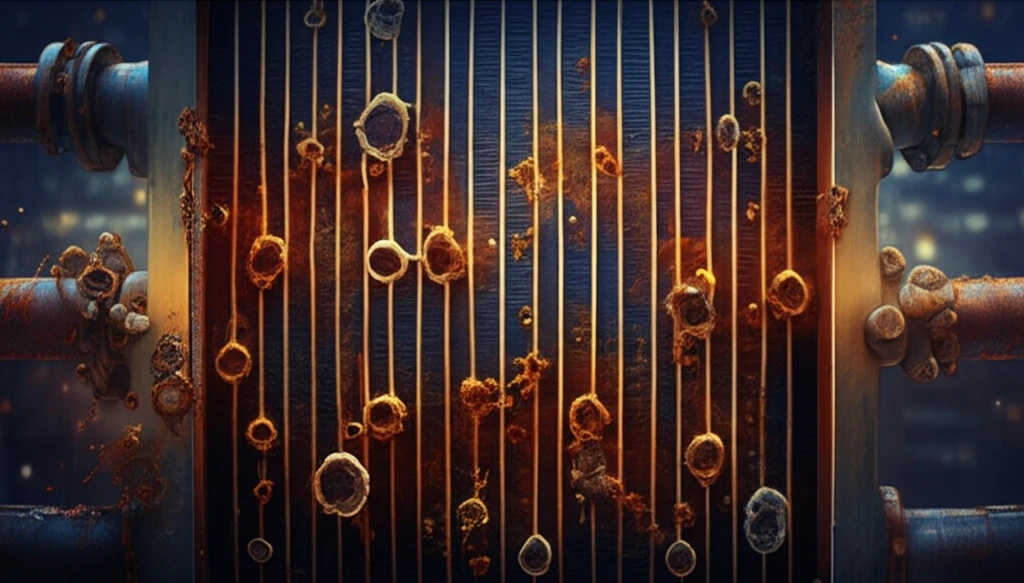
The investigation focused on bowl-like perforations regularly distributed at crossing contact points (CCPs) between the corrugated plates. While initial assessments leaned towards typical failure mechanisms, the unique characteristics of these perforations prompted a deeper analysis. It was determined that these perforations resulted from the cooperation of pitting, crevice corrosion, and fretting.
- Pitting: Localized corrosion that creates small holes.
- Crevice Corrosion: Occurs in gaps where stagnant solution can lead to concentrated corrosion.
- Fretting Corrosion: Corrosion damage accelerated by repetitive surface contact and pressure.
- Synergistic Effect: Cooperation of pitting, crevice corrosion, and fretting makes corrosion occur.
Advances in Heat Exchanger Research
Multistream plate fin heat exchangers have replaced two-stream designs in diverse applications due to their compactness and capacity to handle multiple fluid streams in a single unit researchgate.net. Plate heat exchangers are widely used across cooking, ventilation, air conditioning, and cooling sectors, yet detailed and comprehensive research on their heat transfer and fluid flow characteristics remains urgently needed academia.edu. Heat exchangers fail because they operate in hostile environments, facing daily temperature extremes, pressure fluctuations, and aggressive water chemistry nationalpumpsandboilers.co.uk. Before dismantling plate packs or replacing components, maintenance teams should first inspect external piping, valves, and circulation pumps to rule out upstream causes of low flow conditions pheheat.com.
The Detection Gap in Heat Exchanger Failure
An estimated 35% of conventional heat exchanger failures go undetected because design limitations hide heat degradation deep inside complex structures shpheglobal.com. Inspection methods struggle to pinpoint heat transfer issues within these complex configurations, allowing hidden heat loss to lead to costly unplanned downtime shpheglobal.com. Regular inspection and cleaning, combined with monitoring systems that track flow rates, pressures, and temperatures within manufacturer-recommended limits, can detect performance changes before they become critical premiersepservices.com. Heat exchangers do not typically fail because they are inherently weak; they fail because system water is full of limescale or sludge, often both simultaneously heatable.co.uk.
Comparing Heat Exchanger Designs and Failure Modes
Heat transfer in exchangers occurs by conduction through materials that separate the mediums being used, whether in pool heaters, industrial process units, or other configurations thermex.co.uk. Plate fin heat exchangers feature alternating layers of corrugated metal fins and flat metal plates known as parting sheets, creating distinct flow channels for each fluid stream iqsdirectory.com. Plate heat exchangers generally consist of multiple thin plates with alternating channels for hot and cold fluids, facilitating efficient heat transfer between them neuralconcept.com. Fouling and corrosion remain persistent failure modes across all heat exchanger types, and while cathodic protection reduces rust occurrence, it never prevents it entirely ammoniaknowhow.com.
Preventing Future Failures: Practical Recommendations
Based on the analysis, several measures can be implemented to mitigate the risk of PHE failures: Strict control of chloride levels in the LTHW, maintaining consistent pressure between HTHW and LTHW to minimize fretting, and implementing regular repassivation treatments. By addressing design vulnerabilities, manufacturing quality, and operational conditions, industries can significantly extend the lifespan and reliability of their plate heat exchangers, ensuring safer and more efficient operations.
Failure Analysis Methodologies and Findings
Analysis of plate heat exchanger failures in heat distribution systems reveals that hydraulic impact is a primary failure mechanism, with the outer shroud plate measuring just 1.3 mm thick in analyzed units archive.org. Failure analysis services encompass tube corrosion investigation, erosion assessment, fouling characterization, stress corrosion cracking evaluation, and manufacturing defect identification through metallurgical testing infinitalab.com. Deposit analyses and microbiologically induced corrosion testing are integral components of comprehensive failure diagnosis for plate heat exchangers, shell and tube designs, radiators, and coolers sa179tubes.com. Heat exchangers have expanded from large chemical manufacturing plants into everyday household applications, making failure analysis increasingly relevant across scales jiangxing-phe.com.
Why Real-World Failures Outpace Design Predictions
On paper, heat exchangers are robustly engineered using conservative codes, corrosion allowances, fouling factors, vibration analysis, and mechanical safety margins guided by ASME and TEMA standards chemicaltimes.in. Despite these safeguards, real-world failure rates consistently exceed what design calculations predict, suggesting that operational variables introduce risks not fully captured in static engineering models chemicaltimes.in. Offshore heat exchangers fail faster than expected, and the most expensive decision is often choosing lower upfront cost only to replace the unit within eighteen months linkedin.com. Furnace heat exchangers in regions like Wisconsin and the upper Midwest cycle thousands of times per year, causing repeated metal heating and expansion that accelerates fatigue failure youtube.com.
Systemic Causes of Plate Heat Exchanger Failure
Removable and sealed plate heat exchangers can experience leakage at rated working pressure when subjected to abnormal impact loads from the system, even when manufacturing quality is acceptable exheatindustries.com. Production quality alone does not determine reliability; systemic factors including hydraulic shocks, pressure surges, and operational abuse play dominant roles in failure initiation exheatindustries.com. Alfa Laval heat exchange specialist Colin Ellis identifies operational and maintenance oversights as primary reasons plate heat exchangers fail in industrial settings masterflow.net.au. The interplay between equipment design limits and real-world system dynamics means that failure prevention requires attention to both the exchanger itself and the broader system it operates within masterflow.net.au.
Lessons from Real-World Failures
Case studies reveal that fouling in HVAC systems caused preheating heat exchangers to fail, demonstrating how inadequate water treatment directly translates to equipment breakdown airmancoil.com. A shell and tube heat exchanger designed correctly on paper still experienced fouling buildup and performance drop, proving that proper design alone does not guarantee operational success processplantinsights.com. Real-world failures consistently teach that preventive maintenance, water quality management, and operational awareness are as critical as initial engineering specifications airmancoil.com. When correct design still produces the wrong outcome, the gap between engineering intent and field conditions becomes the central challenge for reliability professionals processplantinsights.com.