
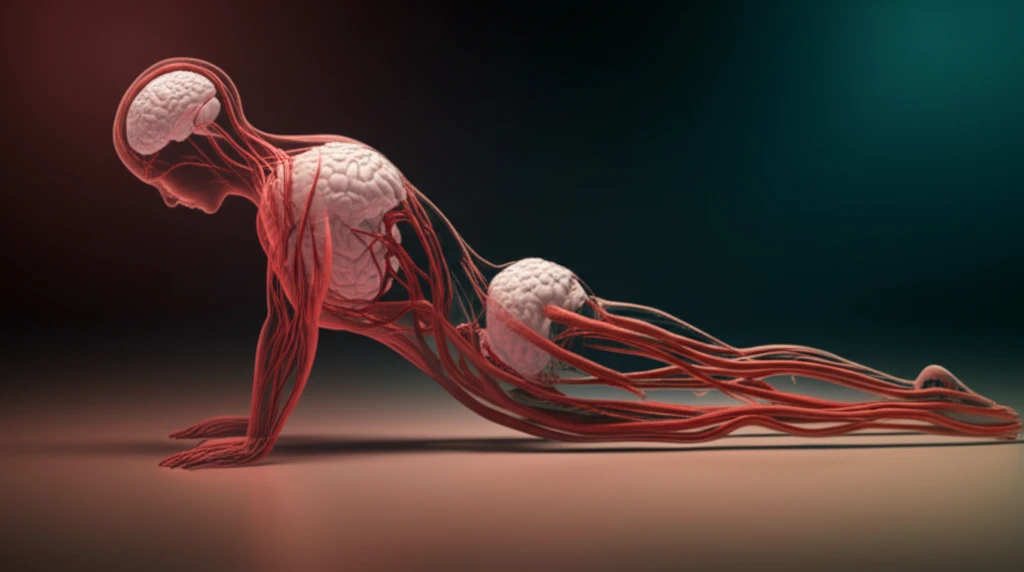
Surreal illustration of blood flow adapting with posture change.

Head Rush: How Posture Impacts Your Brain's Blood Flow

"Uncover the surprising link between sitting, standing, and your brain's ability to regulate blood flow for optimal cognitive function."


Your brain, though a small part of your body, demands a lot of energy – about 20% of your total oxygen intake. This high energy need makes it incredibly sensitive to changes in blood flow. To keep your brain working smoothly, your cerebral vasculature constantly adjusts to maintain stable blood flow, no matter what position you're in.

This automatic adjustment is called cerebral autoregulation (CA). CA includes immediate responses and longer-term adaptations to keep cerebral blood flow (CBF) steady. Scientists classify CA into two types: static and dynamic. Static CA is the blood flow relationship when mean arterial blood pressure (MABP) is constant over minutes to hours. Dynamic CA involves second-to-second blood flow compensation when MABP changes.

New research challenges the old idea that CBF stays constant when MABP is between 60-150 mmHg. Studies now suggest that range is either narrower or even nonexistent. The purpose of this study is to compare static and dynamic CA in people in the supine and seated positions to understand how posture affects cerebral pressure-flow relationships. The end goal is to reveal the actual impact of postural changes on cerebral blood flow.

Sitting vs. Supine: How Does Your Brain React?

Surreal illustration of blood flow adapting with posture change.

Researchers at the University of Colorado Colorado Springs explored how different positions affect cerebral blood flow. They measured cerebral blood flow velocity (CBFv), mean arterial blood pressure (MABP), cardiac output, and end-tidal carbon dioxide (PETCO2) in eighteen healthy adults while seated and lying down. They then used multiple regression to see how PETCO2, MABP, and hydrostatic pressure affected CBFv. Static CA was gauged by evaluating absolute changes in steady-state CBFv. Dynamic CA was measured via transfer function analysis (TFA) of CBFv response to changes in MABP.

The results showed some key differences between the seated and supine positions:

  • MABP: Significantly lower when seated (67.2 ± 7.2 mmHg) compared to lying down (84.2 ± 12.1 mmHg).
  • CBFv: Also reduced in the seated position (55.2 ± 9.1 cm/sec) compared to supine (63.6 ± 10.6 cm/sec).
  • PETCO2: Lower when seated (29.1 ± 2.6 mmHg) than supine (30.9 ± 2.3 mmHg).
Interestingly, changes in CBFv weren't explained by changes in PETCO2, MABP, or hydrostatic pressure, and a reduction in MABP to CBFv transfer function gain while seated was explained by changes in the power spectrum of MABP, not CBFv. These findings indicate that changes in steady-state cerebral hemodynamics between postures don't largely affect the dynamic regulation of CBF.

What Does This Mean for You?

The study suggests that when you move from lying down to sitting, your brain's blood flow and blood pressure decrease, yet this doesn't drastically change how well your brain regulates blood flow. While the body can and will adjust to maintain blood flow to the brain when shifting from lying down to sitting, it is still important to stand and sit up slowly in order to avoid feeling light headed or dizzy.

While this study provides valuable insights, it's important to remember some limitations. The research used CBFv as an indirect measure of CBF and acknowledged that future studies could include volumetric flow measurements. Also, noninvasive measurements may have prevented scientists from detecting the influence of all key variables on CBFv.

Further research is needed to fully understand the interplay between posture, cerebral blood flow, and brain function. However, this study contributes to understanding cerebral hemodynamics and dynamic regulation of CBF.

About this Article -

This article was crafted using a human-AI hybrid and collaborative approach. AI assisted our team with initial drafting, research insights, identifying key questions, and image generation. Our human editors guided topic selection, defined the angle, structured the content, ensured factual accuracy and relevance, refined the tone, and conducted thorough editing to deliver helpful, high-quality information.See our About page for more information.

This article is based on research published under:

DOI-LINK: 10.14814/phy2.13150, Alternate LINK

Title: Postural Effects On Cerebral Blood Flow And Autoregulation

Subject: Physiology (medical)

Journal: Physiological Reports

Publisher: Wiley

Authors: Zachary K. Garrett, James Pearson, Andrew W. Subudhi

Published: 2017-02-01

Everything You Need To Know

1

What is cerebral autoregulation, and why is it important?

Cerebral autoregulation (CA) is the automatic adjustment of cerebral vasculature to maintain stable cerebral blood flow (CBF) regardless of body position. It includes immediate responses and longer-term adaptations. There are two classifications: static CA, which relates to blood flow when mean arterial blood pressure (MABP) is constant over minutes to hours, and dynamic CA, which involves second-to-second blood flow compensation when MABP changes. The study aimed to understand how posture affects cerebral pressure-flow relationships by comparing static and dynamic CA in people who were supine versus seated.

2

What specific measurements were taken to assess the impact of posture on cerebral blood flow?

The study measured cerebral blood flow velocity (CBFv), mean arterial blood pressure (MABP), cardiac output, and end-tidal carbon dioxide (PETCO2) in eighteen healthy adults while they were seated and lying down. Researchers used multiple regression to determine how PETCO2, MABP, and hydrostatic pressure affected CBFv. Static CA was gauged by evaluating absolute changes in steady-state CBFv. Dynamic CA was measured via transfer function analysis (TFA) of CBFv response to changes in MABP.

3

How does moving from a lying down position to sitting affect blood flow and blood pressure in the brain?

The research indicated that when transitioning from lying down (supine) to sitting, both cerebral blood flow and mean arterial blood pressure (MABP) decrease. The study showed a decrease in MABP when seated (67.2 ± 7.2 mmHg) compared to when lying down (84.2 ± 12.1 mmHg). Cerebral blood flow velocity (CBFv) also decreased in the seated position (55.2 ± 9.1 cm/sec) compared to the supine position (63.6 ± 10.6 cm/sec), and end-tidal carbon dioxide (PETCO2) was lower when seated (29.1 ± 2.6 mmHg) than supine (30.9 ± 2.3 mmHg). While these changes occur, the brain's ability to regulate blood flow dynamically does not drastically change.

4

What practical advice can be drawn from the findings about changes in posture and feeling lightheaded?

The study suggests that even though cerebral blood flow velocity (CBFv) and mean arterial blood pressure (MABP) decrease when moving from a lying down (supine) to a sitting position, the brain maintains its ability to regulate blood flow without drastic changes. However, the body still needs time to adjust to postural changes. Standing or sitting up slowly is advisable to prevent lightheadedness or dizziness, allowing the cerebral autoregulation (CA) mechanisms to fully adapt to the new position.

5

What were the limitations of the study, and what future research could be done to expand upon these findings?

While the study focused on the immediate cerebral blood flow (CBF) dynamics when changing posture, it did not delve into long-term effects or adaptation mechanisms. The research also involved only healthy adults, so the findings might not be generalizable to populations with pre-existing health conditions or the elderly. Future research could explore how chronic postural habits, age, and specific medical conditions affect cerebral autoregulation (CA) and overall brain health, which would provide a more comprehensive understanding of the interplay between posture and cognitive function.

Newsletter Subscribe

Subscribe to get the latest articles and insights directly in your inbox.