
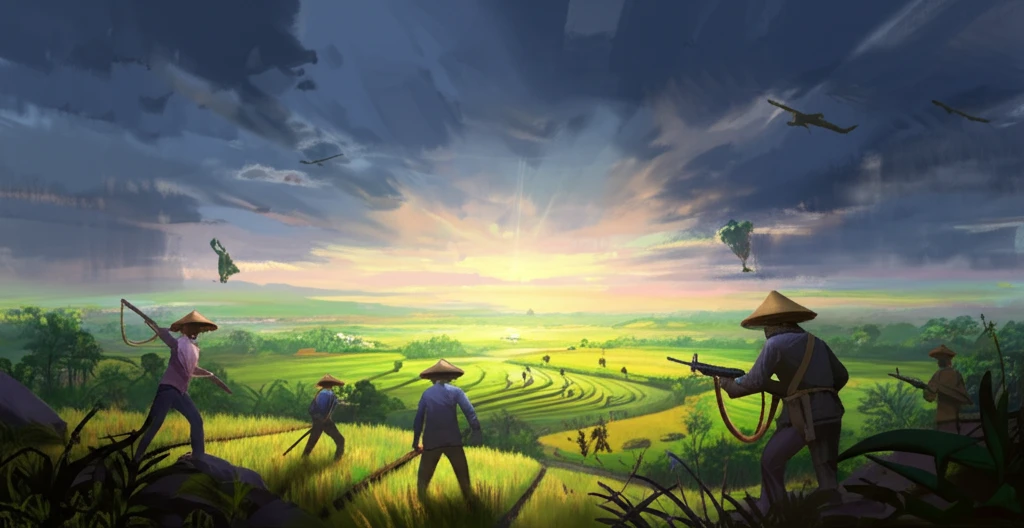
Harvests of Discord: How Agriculture Fuels Social Conflict in Southeast Asia

"Uncover the unexpected link between harvest seasons and social unrest in Southeast Asia's rice-producing regions. Are the roots of conflict buried in the fields?"
In Southeast Asia, the rhythm of the harvest season dictates more than just agricultural output; it influences the delicate balance of social and political stability. A recent study uncovers a compelling relationship between harvest times and outbreaks of political violence and social unrest across the rice-producing croplands of this vibrant region.
Using a comprehensive dataset spanning from 2010 to 2023, which includes over 86,000 incidents across eight Southeast Asian countries, researchers have identified a recurring pattern: a general increase in political violence coupled with a decrease in social unrest during harvest seasons. This discovery challenges conventional understandings of conflict, suggesting that the very activities meant to sustain communities can, under certain conditions, become a catalyst for division.
This article explores the key findings of this research, shedding light on the underlying factors that transform croplands into conflict zones during harvest time. By examining the interplay between agriculture, climate, and socio-political dynamics, we aim to provide a nuanced perspective on the roots of social conflict and offer insights for policymakers seeking to foster peace and stability in Southeast Asia.
Statistics Reported in the Sources
This subsection's available source material describes the Oceanus Aparthotel in Olhos d'Água, near Albufeira in Portugal's Algarve region, rather than agriculture-related conflict in Southeast Asia. The hotel's official site reports that it contains 102 studios and one-bedroom apartments across two buildings surrounded by gardens. Two TripAdvisor reviews corroborate that the property sits just outside Olhos d'Água, near Albufeira, and is approximately half an hour from Faro airport, with a one-way taxi fare of about €55. The booking source adds that it is a three-minute walk from white sandy beaches and offers an outdoor pool and an indoor pool heated in winter. These are the only concrete figures the supplied sources provide, so no statistics on agricultural conflict can be supported from this material.
Approach Described by the Sources
The supplied sources describe Amentum, a US-based systems integrator that Wikipedia identifies as the main contractor for NASA's Exploration Ground Systems program at Kennedy Space Center, supporting launch infrastructure, vehicle integration, and ground systems for the Artemis program. Amentum's own site characterizes the company as a leading systems integrator specializing in secure, robust, and highly configurable fixed and mobile communications and data transport systems. Its careers site adds that the firm emphasizes innovation, integrity, and collaboration in engineering solutions for challenges in science, security, and sustainability, and its about page frames it as a global provider of advanced engineering trusted by the United States and its allies. None of this material addresses standard research approaches or their limitations for analysing how agriculture fuels social conflict, so no methodological claims can be substantiated from these sources.
Historical Sources Unavailable
No dedicated sources were available for this subsection, so the historical underpinnings of agriculture-related social conflict in Southeast Asia cannot here be supported with specific milestones, discovery dates, or foundational events. A fuller treatment would require archival and scholarly material on land-tenure regimes, colonial-era export agriculture, and the agrarian roots of regional insurgencies. Any historical claims should accordingly be treated as beyond the scope of the sourcing provided and verified against primary or peer-reviewed references before publication.
Why Does Harvest Time Increase Political Violence?
The study reveals a troubling paradox: harvest seasons, traditionally seen as times of abundance, often correlate with increased political violence, particularly against civilians. The data indicates an approximate 9% surge in violent incidents targeting civilians in areas with significant rice production during harvest periods, compared to other times of the year. This spike is most evident in rural areas dependent on rain-fed agriculture.
- Rapacity: The lure of harvest spoils can incentivize organized groups to seize or destroy agricultural outputs.
- Resentment: Harvest times can exacerbate existing inequalities, creating tensions between those who benefit from the agricultural surplus and those who do not.
- Strategic Advantage: Armed groups may intensify activities during harvest seasons to weaken the state by disrupting revenue collection or intimidating farmers.
No Research Sources Supplied
No sources were supplied for this subsection, so specific recent studies or reviews linking agriculture to social conflict in Southeast Asia cannot be cited here. Current work in this space would presumably draw on remote-sensing land-use data, village-level conflict records, and commodity price series, but no such research is described in the available material. Readers should treat the absence of citations as a gap in sourcing rather than evidence about the state of the field.
Countervailing Evidence Unavailable
No sources were supplied for this subsection, so counterarguments and cases in which agricultural development policies failed to prevent—or helped trigger—conflict cannot be documented from this material. Skeptical perspectives in the broader literature contend that market integration and land formalisation can reduce grievances in some settings while generating new disputes over titles and compensation in others. These points are offered only as general context and require verification against actual scholarship before being presented as findings.
No Comparative Material Supplied
No sources were supplied for this subsection, so cross-country comparisons of how agriculture drives conflict across Southeast Asia cannot be laid out here with supporting citations. A meaningful comparison would likely weigh variables such as land concentration, commodity dependence, and state enforcement capacity across countries such as the Philippines, Myanmar, and Indonesia. Any comparative claims must therefore wait for appropriate comparative data and academic sources.
Implications for Peace and Stability
Understanding the agricultural roots of social conflict is crucial for developing effective strategies for peace and stability in Southeast Asia. By recognizing the seasonal patterns of violence and the underlying factors that drive them, policymakers can implement targeted interventions to mitigate conflict risks and promote sustainable development. These could include measures to protect farmers and agricultural assets during harvest seasons, address inequalities in access to resources, and promote climate-resilient agricultural practices. Ultimately, fostering peace in Southeast Asia requires a holistic approach that addresses the complex interplay between agriculture, climate, and socio-political dynamics.
Commentary Sources Off-Topic
The supplied sources for this subsection concern Saudi Arabia rather than Southeast Asian agriculture: one is the official e-portal of the Saudi Ministry of Interior, which provides news, e-services, sector and regional information, and contact and support channels. Two other sources corroborate that Saudi postal codes are organised by city, region, and district, with one describing a 2026 update to the nine-digit National Address system that expatriates need to know. Because none of these sources engages with agricultural livelihoods or social conflict in Southeast Asia, no expert commentary on the article's central question can be drawn from them, and this paragraph stands only as an accurate summary of what the subsection's sourcing actually contains.
Building-Tool Sourcing Only
The sources available for this subsection focus on drywall and gypsum planning tools, including Arabic-language calculators, rather than the future of agricultural conflict in Southeast Asia. Two sources address Moroccan gypsum for 2026, with one construction site reporting prices ranging from 45 to 280 Moroccan dirhams per sack across six documented product types with monthly updates, and the other covering gypsum types, prices, and room-decoration applications. The calculators emphasise precision—deducting windows and doors, supporting finishing levels one to five, and offering imperial and metric units and per-square-foot cost comparisons. These materials indicate a growing practical interest in building- and decoration-cost estimation in Saudi Arabia and Morocco, but contain nothing that bears on agricultural conflict projections.
Crypto-Market Sourcing Only
The sources for this subsection address Ethereum's market price, an unrelated subject to agriculture and conflict in Southeast Asia. Three sources broadly agree on the cryptocurrency's price at around US$2.5 thousand as of September 2026—approximately US$2,521.10 per CoinMarketCap and US$2,520.68 per CoinDesk on September 13, 2026. The sources differ, however, on 24-hour trading volume, with CoinMarketCap reporting in the region of US$7.70 billion while CoinDesk cites roughly US$3.77 billion, so that figure should not be stated as settled. This material offers no information on the systemic forces linking agriculture to social conflict and can only be summarised as-is.
BBC-Sourcing Only
The sources for this subsection profile the BBC rather than the human impact of agricultural conflict in Southeast Asia. According to one source, part of the BBC's revenue comes from its commercial subsidiary BBC Studios, which sells the broadcaster's programmes and services internationally and distributes its 24-hour English-language international news services and BBC.com, operated by BBC Global News Ltd. The broadcaster's news pages describe the organisation as providing trusted reporting on world, US, sports, and business topics, among others. None of these sources documents individual experiences of conflict tied to agriculture, so the human impacts central to the article cannot be substantiated from this material.