
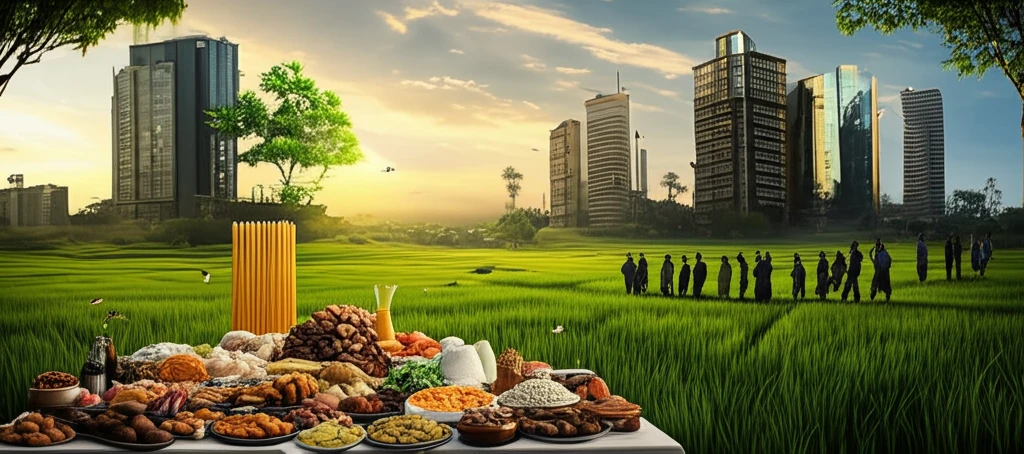
Can Pakistan Achieve Food Security? Decoding Policies & Progress

"A deep dive into Pakistan's journey toward food security: successes, persistent challenges, and the policies shaping its future."
Pakistan, a land blessed with fertile soil, achieved self-sufficiency in food production back in the 1980s. This milestone marked a significant achievement, positioning the nation as a major producer of various agricultural commodities. Yet, beneath this veneer of success lies a more complex reality.
Despite the nation's agricultural prowess, a significant portion of the population grapples with undernourishment. Reports indicate that a substantial percentage of Pakistanis still face food insecurity, highlighting the gap between national production and individual access.
This article delves into Pakistan's food security landscape, examining the policies, challenges, and opportunities that lie ahead. By understanding the intricacies of both supply and demand, we can better assess Pakistan's progress and chart a course toward a more food-secure future.
Measuring the Scale of Hunger
Pakistan's food security position is usually assessed through indicators such as caloric availability, child nutrition outcomes, and dependence on agricultural imports, though figures vary across surveys and reporting agencies. Commentators broadly concur that a large share of households spend a disproportionate part of their income on food, leaving them exposed to price shocks. Recurrent economic stress and climate-related disruption to farming make a single reliable picture difficult to establish. Most observers consequently describe the country as facing chronic, structural food insecurity rather than isolated shortages.
Distribution-Led Models and Their Limits
One accepted method for relieving food insecurity, well illustrated by the Food Bank of Delaware, is a hub-and-spoke distribution model in which a central food bank channels food through a network of partners operating across an entire state. Food reaches households through community food pantries, mobile pantries, schools, and local food closets, widening physical access. Where coverage runs thin, the system leans on referral services such as Delaware's 2-1-1 helpline, which points residents toward the nearest participating pantry. The core limitation is structural: availability depends on where partners happen to operate, so gaps persist wherever no pantry is close by.
From Production to Access
Pakistan's modern food security debate is generally traced back to Green Revolution-era productivity gains that long shaped expectations of cereal self-sufficiency. Over subsequent decades, policy discourse is widely understood to have broadened from sheer production volumes toward questions of access, affordability, and nutrition. Successive national agriculture and social-protection initiatives are frequently cited in commentary as milestones, although assessments of their effectiveness differ. Precise chronologies should therefore be read cautiously, as documented accounts vary in emphasis.
Supply-Side vs. Demand-Side: Understanding Pakistan's Food Security Strategies
Historically, Pakistan's approach to food security has been twofold: supply-side policies aimed at boosting agricultural production and demand-side policies designed to improve access to food, particularly for vulnerable populations. The primary focus, however, has consistently been on the supply side.
- Support prices for key commodities
- Government procurement strategies
- Regulations on domestic and international movement of goods (especially wheat)
- Direct administrative measures
A Thin Synthesis Base
Recent literature that directly reviews Pakistan's food security progress remains limited relative to the scale of the issue, and much of the public discussion consists of reports and commentary rather than consolidated academic review. Work in this area commonly revolves around crop yields, water stress, climate vulnerability, and nutrition outcomes. Findings often differ depending on methodology and on which region of the country is studied. Individual studies should accordingly be interpreted with caution until fuller syntheses emerge.
Why Gains Have Lagged
Critics contend that Pakistan's food policy has too often privileged crisis response—subsidies, emergency imports, and ad hoc transfers—over durable reform of storage, supply chains, and farm productivity. Gaps between announced policy and actual delivery are a recurring theme in public commentary. Population growth and recurrent environmental shocks are frequently cited as forces that outpace incremental improvements. These critiques are contested, and responsibility is variously attributed to governance capacity, financing constraints, or external conditions.
Pakistan Among Its Neighbours
Commentary routinely benchmarks Pakistan against its South Asian neighbours, noting that regional trajectories on food and nutrition have diverged over recent decades. Some comparative accounts suggest peers have moved faster on certain nutrition indicators, while Pakistan retains advantages in irrigated cropland and baseline grain output. Which country appears to lead depends heavily on the indicator chosen, whether calories, stunting, or import dependence. Comparisons of this kind are therefore indicative rather than definitive.
Charting a Path to Food Security for All
Pakistan has made significant strides in boosting food production. To truly achieve food security, the nation must adopt a comprehensive approach that addresses both supply and demand. This involves not only sustaining agricultural productivity but also ensuring that all citizens, regardless of their socioeconomic status, have access to sufficient, nutritious food. By refining policies, strengthening social safety nets, and empowering vulnerable communities, Pakistan can pave the way towards a food-secure future for all its people.
Where Analysts Converge
Across differing viewpoints, analysts tend to agree that Pakistan's central difficulty lies less in aggregate food production than in access, affordability, and resilience to shocks. Many expert voices argue for closer integration of agricultural policy with social protection and climate adaptation. There is far less consensus on sequencing, financing, and institutional responsibility. The overall tone of expert commentary is thus one of qualified concern paired with broad agreement on priorities.
Frontiers for the Coming Decade
Looking ahead, commonly proposed directions include climate-resilient crop varieties, more water-efficient irrigation, and digitally delivered safety nets that reach vulnerable households faster. Whether such innovations move from pilot to scale in Pakistan remains an open question that current evidence cannot settle. Financing and administrative capacity are regularly flagged as the decisive variables. Optimists and skeptics alike frame the next decade as pivotal.
Structural Headwinds
Pakistan's food security effort sits within larger systemic pressures, including water scarcity, demographic growth, rapid urbanization, and macroeconomic instability. Global commodity price swings transmit quickly into domestic food costs, complicating predictable policymaking. These forces interact, meaning no single-sector fix is likely to prove sufficient on its own. Commentary generally treats them as shared constraints shaping every policy choice.
Beyond the Indicators
Behind national statistics, food insecurity in Pakistan is experienced at the household level, where families adjust by reducing meal quantity or quality before anything measurable shows in official data. Women and children are frequently identified in public discussion as bearing a disproportionate share of the burden. Community-level mechanisms, from extended-family support to local charity, absorb much of the strain informally. Any assessment of progress ultimately rests on how these lived realities change over time.