
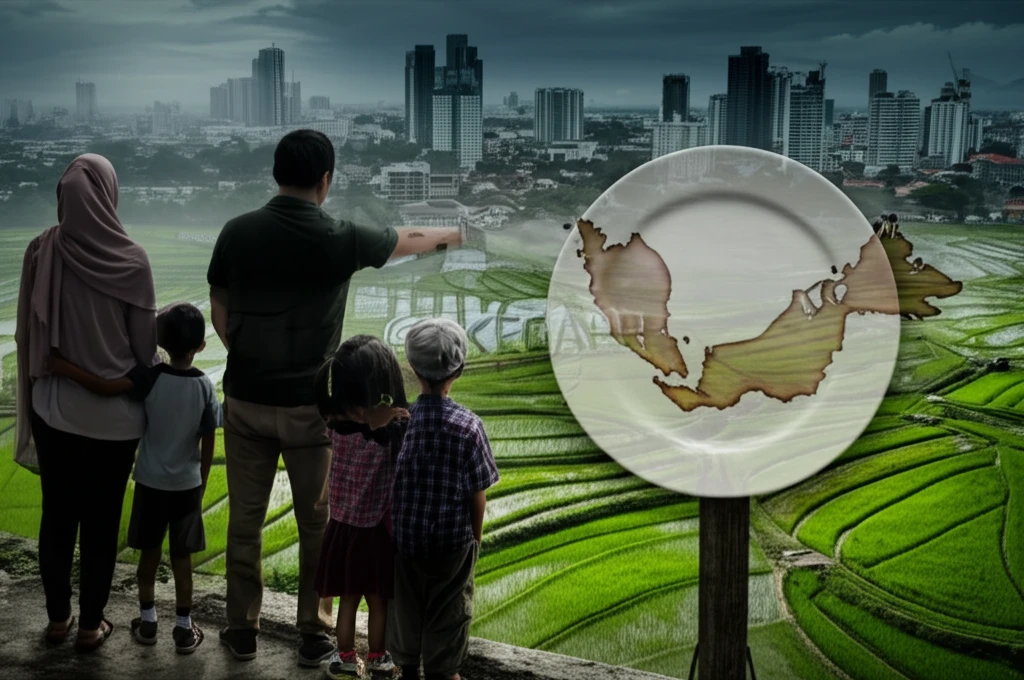
Is Your Plate Secure? Unpacking Food Insecurity in Malaysia and What It Means for You

"A Deep Dive into Local Food Access, Affordability, and the Surprising Gaps in a Nation Known for Abundance"
In a world where grocery store shelves seem endlessly stocked, it's easy to assume that everyone has enough to eat. But what happens when access to sufficient, safe, and nutritious food becomes a daily struggle? This is the reality of food insecurity, a complex issue that goes beyond simple hunger.
Malaysia, a nation celebrated for its diverse cuisine and robust economy, holds a respectable position of 32 out of 105 countries in the Global Food Security Index. This ranking considers factors like affordability, availability, and the overall quality of food. But can a national index truly capture the nuances of food access at the local level?
This article delves into a study conducted in Kedah, a northern state in Peninsular Malaysia, to examine the spatial mapping of food security in the Mukim (districts) of Pendang. By comparing food insecurity between Mukim Ayer Putih, Mukim Guar Kepayang, and Mukim Bukit Raya, this research reveals surprising disparities and challenges the assumption that national food security translates to food security for all.
Malaysia's Food Security at a Crossroads
Malaysia's Food Security Index rose to 61.5 in 2024 from 54.5 in 2023, placing national food security in the 'good performance' category, driven largely by a strong Accessibility Index score. Despite this improvement, approximately 17% of the population still experiences food insecurity according to SDG 2.1.2 indicators. The Food Systems Dashboard also shows Malaysia's food supply at around 400 grams per capita per day, though distribution remains uneven across income groups and regions. These figures suggest that while headline metrics are improving, significant pockets of vulnerability persist beneath the surface.
How Food Security Is Measured in Malaysia
Malaysia's food security is assessed through composite indices such as the Global Food Security Index (GFSI) and the Malaysia Food Security Index, which aggregate indicators across availability, access, utilisation, and stability. However, the GFSI has flagged Malaysia's relatively low score on food security and access policy commitments, revealing gaps between policy existence and effective implementation. Malaysia has responded with the National Food Security Policy Action Plan 2021-2025, encompassing five core strategies, 15 strategies, and 96 initiatives. Yet researchers note that these frameworks struggle to capture the full complexity of challenges including inflation, import dependency, limited arable land, and climate change impacts.
A Long History of Policy Without Resolution
Malaysia has never been short of agriculture and food policies, yet policy abundance has historically proven insufficient to ensure food security. Political influence has shaped the formulation and implementation of these policies, affecting resource allocation and investment in the agro-food sector. This has resulted in persistent inconsistencies across successive policy frameworks. Different countries also define food security differently—some emphasise availability regardless of origin, which is why food-importing nations like Singapore can score higher on food security indices than agricultural countries such as Thailand and Indonesia.
The Four Pillars of Food Security: Are We Missing a Foundation?
The Food and Agriculture Organization (FAO) defines food security as existing “when all people, at all times, have physical and economic access to sufficient, safe and nutritious food to meet their dietary needs and food preferences for an active and healthy life.” This definition rests on four key pillars:
- Availability: Is there enough food produced and accessible within a given area or country?
- Accessibility: Can people physically reach and afford the food that is available?
- Utilization: Are people able to properly use and benefit from the nutrients in the food they consume? This includes adequate nutrition, sanitation, and healthcare.
- Stability: Is the food supply consistent and reliable, or is it subject to shocks like price fluctuations or climate-related disasters?
Emerging Evidence on Determinants and Risks
Recent empirical research has focused on identifying the macroeconomic determinants of food security in Malaysia, including variables such as inflation, import dependency, and agricultural output. These studies underscore the importance of understanding the interplay between economic variables and food access for effective policy formulation. A January 2025 publication from ResearchGate emphasises the urgent need for policy reforms and strategic planning to safeguard Malaysia's food security amid growing global and local challenges. The body of literature consistently highlights that without addressing structural economic factors, incremental policy adjustments may prove inadequate.
Where Policy Ambition Meets Reality
While Malaysia has introduced numerous food security initiatives, critics argue that many programmes suffer from inconsistent implementation and a lack of sustained political commitment. Some analysts caution that focusing narrowly on production targets and self-sufficiency ratios may distract from addressing the root causes of household-level food insecurity, such as income inequality and cost-of-living pressures. There is also debate over whether further subsidising food imports constitutes a long-term strategy or merely delays structural reform. Without deeper systemic changes, Malaysia's impressive policy frameworks risk remaining aspirational rather than transformative.
Malaysia in a Regional and Global Context
Malaysia's food security trajectory does not exist in isolation; regional peers face comparable pressures from climate change, global supply chain volatility, and shifting dietary patterns. Countries like Singapore have pursued aggressive food security strategies through technology and trade diversification, offering potential lessons for Malaysia's approach. However, direct comparisons are complicated by differing definitions of food security and varying levels of agricultural endowment. What is clear is that Malaysia's reliance on food imports exposes it to the same global market fluctuations affecting Southeast Asian neighbours, reinforcing the need for context-specific rather than one-size-fits-all solutions.
Beyond the Plate: A Call to Action for Food Security in Malaysia
The Kedah study serves as a stark reminder that national food security statistics don't always paint the full picture. By using spatial mapping and local-level data, we can identify vulnerable populations and tailor interventions to address their specific needs. Further research is crucial to understand the root causes of food insecurity in these identified villages and to develop sustainable solutions that ensure everyone in Malaysia has access to a secure and nutritious food supply.
Redefining What Food Security Means for Malaysia
Leading researchers argue that Malaysia's food security should be reframed around household financial ability, nutritional status, and resilience rather than solely national production and self-sufficiency metrics. Content analysis of key policy documents—including the National Food Security Policy Action Plan 2021-2025 and the National Agri-Food Policy 2.0 2021-2030—reveals a gap between stated ambitions and actionable mechanisms on the ground. Political dynamics continue to shape resource allocation in ways that may not align with evidence-based food security priorities. The consensus across academic literature is that Malaysia faces a genuine food security problem requiring a fundamental shift in how policies are designed, funded, and evaluated.
Navigating an Uncertain Food Future
Malaysia faces several interconnected challenges in achieving lasting food security, including growing dependence on food imports, declining agricultural productivity, and widening income inequality. A growing population, increasing urbanisation, and changing dietary patterns are reshaping the country's food landscape in ways that existing policies may not adequately address. The nation's vulnerability to global market fluctuations and supply chain disruptions demands a more diversified and resilient food system. Looking ahead, Malaysia will need to balance economic growth imperatives with the urgent need to strengthen domestic food production capacity and reduce import exposure.
Balancing Growth, Stability, and Sustainability
Malaysia's food security policies must navigate the tension between economic stability and environmental sustainability—a balancing act reflected in the country's alignment (and misalignment) with the United Nations' Sustainable Development Goals. The current food security landscape is described as a study in contrasts, with pockets of strong performance alongside persistent structural vulnerabilities. Strategic imperatives include integrating climate resilience into food production systems while ensuring that trade policies do not undermine domestic agriculture. Without coherent coordination across these competing priorities, Malaysia's food system remains exposed to systemic risks that transcend any single policy domain.
Behind the Policies: Lives and Livelihoods
The human cost of food insecurity in Malaysia became especially visible during the COVID-19 pandemic, when government responses under the National Agrofood Policy were tested against real-world disruption. Reliance on food imports and low agricultural productivity left many communities exposed when supply chains faltered. Natural disasters further compounded these vulnerabilities, highlighting the gap between policy frameworks and on-the-ground preparedness. Sustainable food security ultimately depends on ensuring that vulnerable populations—including smallholder farmers, urban poor, and rural communities—have reliable access to affordable, nutritious food.