
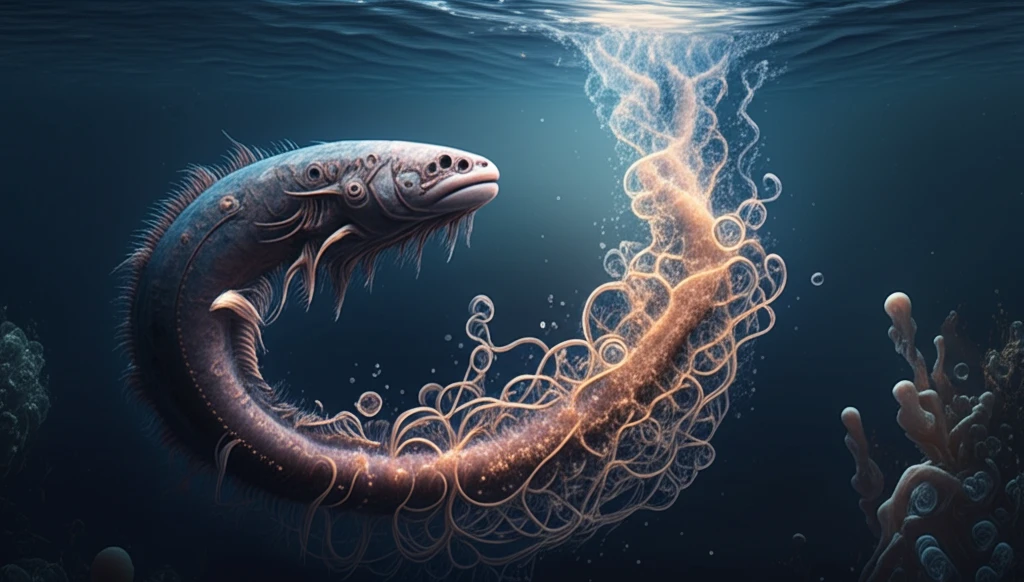
Hagfish Slime: The Unlikely Bio-Material Inspiring Future Tech

"Scientists discover the secrets behind hagfish slime's unique properties, opening doors for innovative materials and bio-inspired designs."
In the depths of the ocean, the hagfish employs a peculiar yet effective defense mechanism: slime. When threatened, these eel-like creatures release a gelatinous substance that quickly expands in seawater, creating a sticky, voluminous barrier against predators. This slime has fascinated scientists for its unique material properties, especially its ability to maintain its structure and function even when significantly diluted.
Recent research has shed light on the concentration-independent mechanics and structure of hagfish slime, revealing how this natural hydrogel maintains its remarkable viscoelastic properties across a wide range of concentrations. This discovery has significant implications for material science, offering insights into designing new engineered materials with robust and adaptable characteristics.
This article delves into the groundbreaking findings about hagfish slime, exploring its composition, mechanical behavior, and potential applications. We'll uncover how this seemingly simple substance could revolutionize industries from personal defense to sustainable materials, offering a fascinating example of bio-inspired innovation.
A Promising but Emerging Biomaterial
Hagfish slime is being investigated as an unusual biomaterial with possible relevance to future material science. Its reported potential is promising, but the available information does not establish mature commercial applications or definitive performance statistics. The field remains exploratory, so claims about its impact should be treated as early-stage rather than settled.
From Biological Material to Synthetic Models
Research commonly examines hagfish slime by separating its structural components and studying their individual functions. This reductionist approach can clarify the roles of threads, mucus, and their interactions, but recreating the complete material remains difficult. A major limitation is that laboratory synthesis must reproduce both the material's components and the rapid way they assemble.
Tracing Slime to the Epidermis
The evolutionary origin of hagfish slime has long remained uncertain. Research describing large intracellular threads in a putatively homologous hagfish epidermal cell supports the possibility that the thread- and mucus-producing cells of slime glands originated in the epidermis. The fossil record leaves a broad timeframe: the youngest hagfish fossil without slime glands dates to the Pennsylvanian period, about 310 million years ago, while the oldest hagfish fossil with slime glands dates to the Cretaceous, about 138 million years ago. Together, these findings mark a major step toward explaining how the defensive slime system evolved, although its origin is not yet fully resolved.
What Makes Hagfish Slime So Special?
Hagfish slime isn't just any ordinary goo. Its defense mechanism is particularly impressive because hagfish can't precisely control the slime's concentration once it's released into the surrounding water. Instead, they eject a concentrated material that rapidly mixes with seawater to form a dilute, sticky, and cohesive gel.
- Thread Cells: These cells contain coiled intermediate filament-based fibers that unravel upon contact with seawater, forming long, strong threads.
- Mucous Vesicles: These vesicles contain glycoproteins that swell and rupture in seawater, creating a gel-like matrix that surrounds and supports the threads.
Measuring How Hagfish Threads Unravel
Recent work has moved beyond describing hagfish slime to measuring the mechanics of its formation. A 2025 study reported the first direct in situ measurements of forces involved in slime formation, including mucus mechanical properties, skein peeling force, thread-mucus adhesion, and thread-thread cohesion. Another 2025 publication established design principles for synthetic skeins and reported the first deployable synthetic skeins inspired by hagfish slime. These studies connect biological observation with the engineering of rapidly deployable soft materials.
The Difficulty of Recreating Hagfish Slime
Hagfish slime has a promising future in biomimetics, but recreating it in the laboratory has been difficult. The material's defensive network contains long fibrous threads approximately 10 centimeters in length, released in condensed coiled skeins approximately 100 micrometers across. Those skeins must unravel within a fraction of a second during a predator attack, making rapid deployment a central engineering challenge. Reductionist studies have clarified aspects of structure, function, and production, but they have not yet made full synthesis straightforward.
Biodegradability and Production Tradeoffs
Compared with synthetic plastics, hagfish slime is described as biodegradable, although its decomposition rate depends on environmental conditions. At the same time, directly harvesting slime from hagfish is not presented as a viable or ethical production strategy. Proposed alternatives include genetic engineering and synthetic biomimicry that avoid harming or exploiting the animals. The comparison therefore involves both environmental potential and the practical challenge of producing a substitute at useful scale.
The Future of Materials is Slimy?
The study of hagfish slime offers a compelling example of how nature can inspire innovative solutions in material science. Its unique properties, particularly its concentration-independent mechanics and self-similar structure, make it a promising candidate for bio-inspired design. Whether it's creating new personal defense mechanisms, improving oil-drilling leakage safeguards, or developing advanced fibrous cell cultures, hagfish slime is helping pave the way for a new generation of materials.
From Natural Defense to Engineered Material
Hagfish slime illustrates how a biological defense system can become a source of engineering ideas. Current research suggests that its value lies not only in its ingredients but also in how threads and mucus assemble rapidly. The technology remains developmental, so its eventual importance will depend on whether researchers can reproduce those behaviors reliably and sustainably.
Toward Synthetic and Sustainable Fibers
Recent outlooks describe possible applications for hagfish-inspired materials in sustainable textiles, biomedical hydrogels, eco-friendly industrial polymers, textiles, and armor. However, the commercial landscape remains unsettled: one market report identifies a gap between biological hagfish exudate and currently available commercial products, which are dominated by synthetic toy slimes and cosmetic snail mucus. Future progress is therefore likely to depend on production methods that can deliver hagfish-like performance without relying on direct animal harvesting. Claims that these materials will replace nylon or Kevlar should be treated as projections rather than established outcomes.
Scaling Without Exploitation
The broader challenge is to translate a complex natural material into a reliable technology without placing pressure on hagfish populations. Synthetic biomimicry and genetic engineering are possible directions, but they introduce their own questions about manufacturing, cost, environmental effects, and performance. Until those issues are resolved, hagfish-inspired materials are best understood as a developing research area rather than a complete replacement for existing materials.
From Defense Mechanism to Human Technology
Hagfish slime research connects a marine animal's predator defense with human efforts to design new materials. A review titled "From reductionism to synthesis: The case of hagfish slime" describes how reductionist approaches have clarified the structure, function, and production of this complex defensive slime. Other discussions point to possible future uses ranging from military-grade fibers to surgical glues, but these applications remain part of the technology's projected potential. The human impact therefore currently lies as much in guiding biomaterials research as in delivering finished products.