
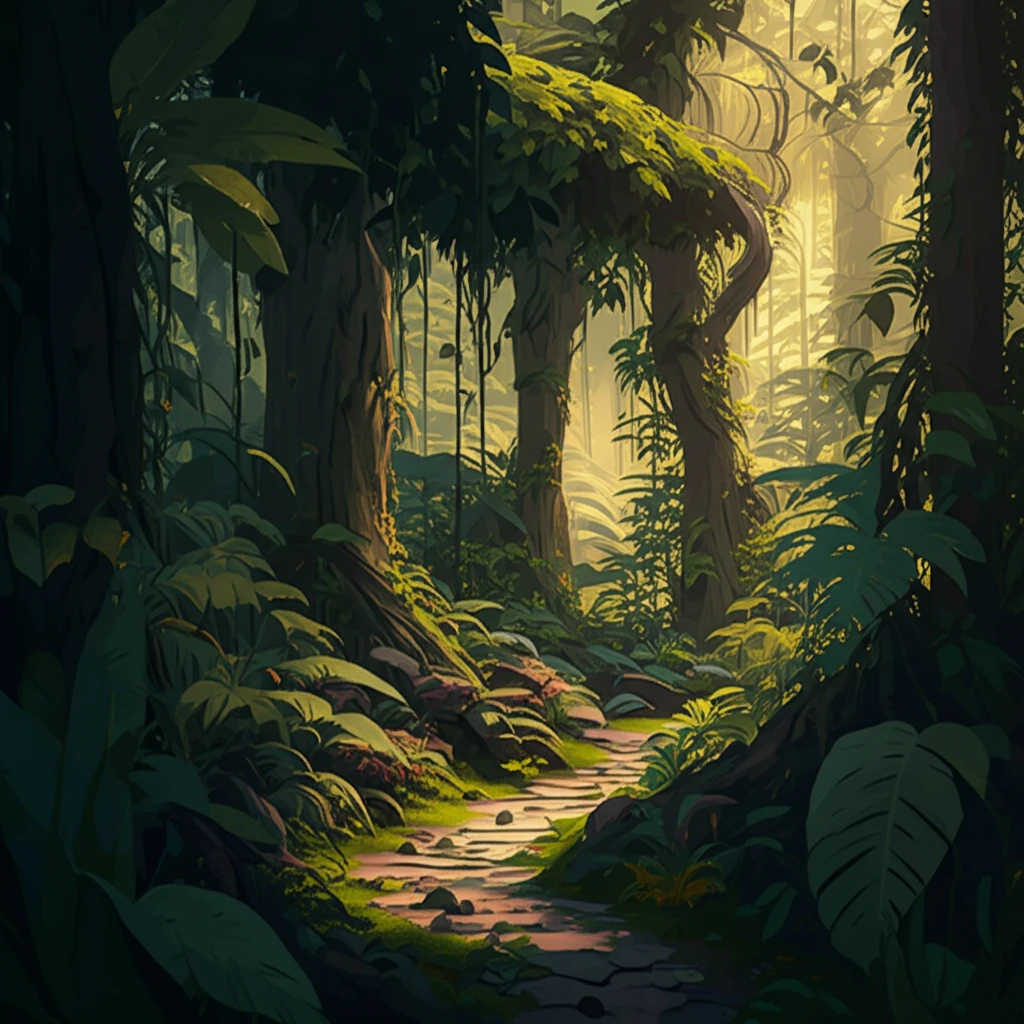
Guardians of the Green: Unveiling the Secrets of Marambaia Island's Forest

"Explore the hidden world of Brazil's Atlantic Forest on Marambaia Island and discover why preserving its biodiversity is crucial."
The Atlantic Forest, one of the world's most threatened tropical biomes, faces relentless pressure from agricultural expansion and deforestation. This continuous exploitation leads to fragmented forests, jeopardizing countless species and disrupting natural ecosystems. Yet, within these fragmented landscapes lie pockets of resilience, areas where conservation efforts strive to safeguard what remains.
Marambaia Island, nestled in Rio de Janeiro, Brazil, is one such haven. Here, on the slopes of the island, a unique section of the Atlantic Forest thrives, harboring a rich collection of tree and shrub species. This island's forest offers a crucial window into the biodiversity of the region and highlights the importance of ongoing conservation initiatives.
Understanding the composition of this forest—identifying its key species, assessing its health, and recognizing its similarities to other forests—is essential for effective conservation planning. This knowledge allows researchers to pinpoint priority areas, track changes over time, and implement targeted strategies to protect this invaluable natural treasure.
A Shrinking Biome Along Brazil's Coast
The Atlantic Forest is a tropical forest that extends along the Atlantic coast of Brazil from Rio Grande do Norte state in the northeast to Rio Grande do Sul state in the south, reaching inland as far as Paraguay and Argentina's Misiones Province. It is characterized by dense vegetation, abundant biodiversity, high temperatures, and intense rainfall throughout the year, and is known locally as Mata Atlântica, Brazil's richest and most threatened forest land. Intense exploitation of the forest in southern Brazil has caused the depletion of stocks of valuable timber, though legal restrictions and socioeconomic changes have subsequently promoted the expansion of secondary forests in the region.
Measuring Soil and Restoration Progress
A common scientific approach evaluates the physical, chemical, and biological attributes of soils to compare agroforestry systems with intact forests. In a study in Paraty, Rio de Janeiro, researchers opened mini-trenches in each area to collect five composite samples at 0–10 cm depth. Such assessments are urgent because less than 20% of the original Atlantic Forest remains, and even cities' urban trees are part of the larger forest ecosystem, with Salvador and São Paulo both committed to protecting and restoring the severely deforested biome.
Foundations of a Megadiverse Forest
The Atlantic Forest region includes several forest variations, from coastal restingas—low forests growing on stabilized coastal dunes—to coastal forests, also known as Atlantic moist forests, which are evergreen tropical forests. The biome has a long-standing history of changes in land use and land cover, monitored scientifically since 1985. Its standing as a megadiverse forest is documented in comprehensive works such as "The Atlantic Forest: History, Biodiversity, Threats and Opportunities of the Megadiverse Forest," published by Springer in 2021 and edited by Marcia C. M. Marques and Carlos E. V. Grelle.
Marambaia's Green Heart: A Deep Dive into Species Diversity
A comprehensive study was conducted on Marambaia Island to catalog the tree and shrub species inhabiting its slopes. By employing a combination of detailed transect surveys and general observation walks, researchers identified a total of 235 species, distributed across 134 genera and 52 families. This diverse collection underscores the ecological richness of the island and its significance as a biodiversity hotspot.
- Dominant Families: Myrtaceae, Fabaceae, and Rubiaceae.
- Rich Genera: Eugenia, Myrcia, and Ocotea.
- Threatened Species: 19 species identified as threatened.
- High Similarity: Strong floristic similarity to Rio Bonito vegetation.
New Findings on a Declining Fauna
Recent research reports four new records of the threatened Brazilian Atlantic Forest endemic Chaetomys subspinosus from three localities, underscoring continued efforts to document the biome's fauna. Scientists also estimate that lowland tapir populations in the Atlantic Forest are at risk of almost complete disappearance, even though the animal—which weighs up to 250 kg—can adapt to most habitats in South America. More broadly, over 80% of Atlantic Rainforest remnants have been impacted by human activity; the biome once covered 15% of Brazil, totaling 1,315,460 km², and only about 20% of the original area now remains, with the fragments varying in size and characteristics.
Resilience Amid Historical Destruction
A look at failures in the Atlantic Forest points to a history of aggressive exploitation rather than inherent fragility. Prior to the arrival of Europeans, the Atlantic Rainforest covered most of the state of São Paulo, but settlers—especially coffee growers—cut down 85% of the forest in a short and frenzied period. Countering pessimism, forestry analyses note that tropical rainforests may regenerate in up to sixty-five years, with animals playing a key role in spreading seeds over the area (nearly 80%), a point echoed in research on how long the Atlantic Rain Forest takes to recover after a disturbance.
Butterflies as Comparative Indicators
Butterflies have emerged as a key tool for comparing the health of Atlantic Forest fragments. Researchers sampling butterflies with entomological nets in 17 forest fragments evaluated whether trophic guild (nectar- vs. fruit-feeding) and habitat affinity (forest-dependent vs. disturbance-adapted) mediate responses to forest loss and fragmentation. Complementary monitoring of fruit-feeding butterfly assemblages in canopy and understorey strata of a seasonal Atlantic Forest found that temporal species turnover is lower in the canopy, illustrating how vertical stratification shapes comparative biodiversity patterns.
Guardians of the Forest: A Call to Action for Conservation
The research on Marambaia Island's Atlantic Forest serves as a powerful reminder of the importance of preserving our planet's diverse ecosystems. The high species richness and the presence of threatened species highlight the ecological significance of this area and the urgent need for conservation efforts. By understanding the floristic composition of the forest and its relationships with other regions, scientists and conservationists can develop targeted strategies to protect this valuable natural resource for future generations.
Reading the Forest Through Its Wildlife
For the first time across the entire Atlantic Rainforest, a group of Brazilian researchers has estimated the population density of the biome's five deer species, allowing them to measure the main factors influencing the number of deer per square kilometer in forest areas. Their findings identify human pressure as the factor most affecting deer density, synthesizing previously fragmented knowledge about the biome's herbivores. Ground-level conflicts reinforce the theme: a plan to create a new mathematics campus with student accommodation in Rio de Janeiro is being challenged by residents because it calls for the removal of 255 trees in a patch of the already severely diminished Atlantic Forest.
A Trail Toward Regeneration
The future of the Atlantic Forest may hinge on demonstrating that the biome can be revived, and history shows the forest can indeed bounce back. Much of the Atlantic Forest that envelops Rio de Janeiro was felled for coffee plantations in the 19th century, says Horacio Ragucci, president of the Brazilian Excursionist Center, as he leads a group along a dirt path originally made by slaves. The trans-Brazil trail, built along such pathways, raises hopes for the future of the Atlantic Forest by reconnecting people with a recovering landscape.
A Mosaic Under Climate Stress
The Atlantic Forest is not a single uniform expanse but a mosaic that includes distinct physiognomies such as sandy restinga and the unique araucária (Brazilian pine) forest in the mountains of the state of Rio Grande do Sul. This diversity of ecosystems faces systemic threats, with researchers projecting that frogs and toads of the Amazon and Atlantic Rainforest will suffer the worst impact of drought combined with rising temperatures. Such biome-wide climate pressures compound the fragmentation and human disturbance that already define the region.
When People and Forest Meet
The Atlantic Forest is considered one of the world's most threatened ecosystems, and its human-disturbed fragments have been shown to negatively affect ant-fruit interactions, a cornerstone of forest regeneration. Despite being only a fraction of the size of the widely lauded Amazon, the biome is home to some of the world's most essential biodiversity and is just as paramount to Brazil's ecosystem. Human impact is now woven into the biome itself: the forest once covered roughly 1.3 million square kilometers (502,000 square miles) along the east coast of Brazil and into Argentina—an area larger than Peru—and mosquitoes there now prefer human blood as a new blood source.