
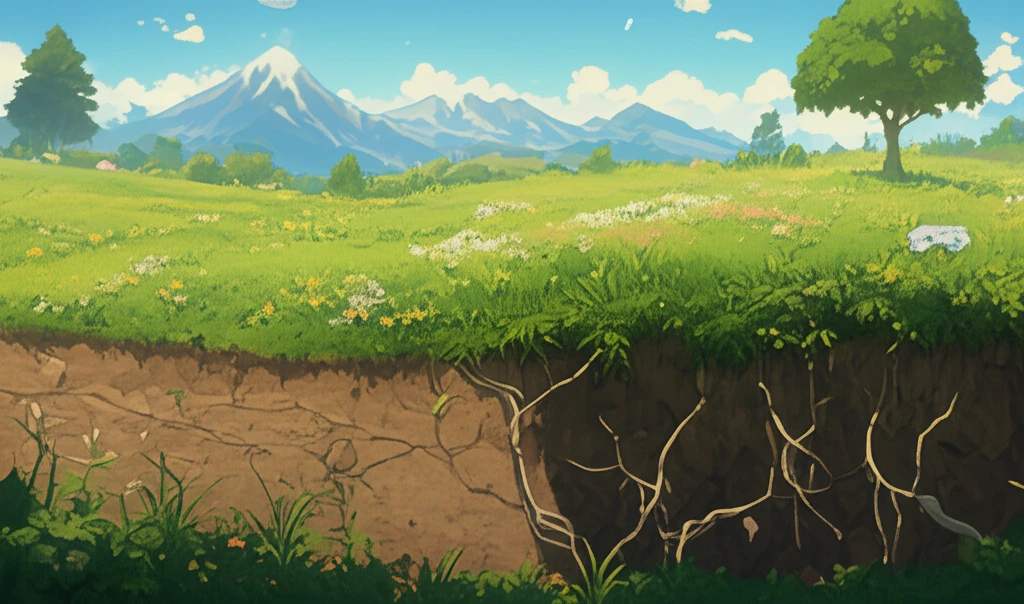
From Barren to Beautiful: The Secrets to Restoring Mountain Grasslands

"Discover how strategic seeding, climate awareness, and soil management can transform degraded mountain landscapes into thriving ecosystems."
Mountain grasslands are biodiversity hotspots, essential for ecological balance and species conservation. In Europe, these grasslands are particularly precious, often harboring rare and endemic species. Unfortunately, human activities such as quarrying, infrastructure development (ski slopes), and natural disasters like landslides have led to the degradation of these vital ecosystems, leaving behind barren or raw soil areas.
Restoring these damaged landscapes is a complex challenge. Unlike typical agricultural lands, raw soil sites in mountainous regions present unique obstacles: poor soil quality, harsh climatic conditions, and limited accessibility. Traditional restoration methods often fall short, highlighting the need for innovative and evidence-based approaches. Key to this is understanding how various factors interact to influence plant establishment and long-term vegetation cover.
This article delves into the science of mountain grassland restoration, drawing on a multi-year study conducted in the Italian Alps. We'll explore the impact of sowing strategies, fertilization, soil composition, and climate on the transformation of raw soil into thriving grassland ecosystems. Whether you're an environmental scientist, conservationist, or simply a nature enthusiast, you'll gain valuable insights into the art and science of ecological restoration.
The Scale of Grassland Loss and Restoration Potential
Mountain grasslands worldwide face severe degradation, with large-scale efforts underway to reverse the damage. In the Loess Canyons of Nebraska, researchers found that targeted fire management increased grassland bird species richness across 65 percent of the treated area—approximately 222,000 acres—while woody plant cover decreased by up to 55 percent across 25 percent of fire-treated zones. In Assam, India, community-led habitat restoration projects aim to reconnect fragmented grassland blocks, establishing corridors that support reintroduced wildlife populations. These examples underscore both the magnitude of grassland loss and the measurable impact of coordinated restoration interventions.
Established Restoration Techniques and the Obstacles They Face
Grassland restoration typically relies on re-establishing native vegetation through seeding, grazing management, and fire regimes, though significant barriers persist. In California, introduced alien annual grasses from southern Europe present a formidable obstacle to restoring native perennial grass populations in foothill and valley grasslands. In China's Nanling Mountain area, researchers have developed a phenological threshold-based approach to assess mountain grassland restoration at regional scales, integrating multiple ecological indicators. Colin Seis in Australia demonstrated that innovative pasture cropping methods can restore degraded grasslands, achieving over 200 plant species including a tenfold increase in native grasses and forbs. However, a key limitation is that introduced species and altered fire cycles can undermine even well-planned restoration efforts over time.
Understanding Grassland Loss Through Time
The historical loss of mountain and lowland grasslands has been staggering. Tennessee alone once held 7.5 million acres of naturally open grassland landscapes when European settlers arrived; today, 90 percent of that habitat has been lost, according to the Southeastern Grasslands Initiative. Large-scale restoration grants have begun to reverse some of this decline, such as the 1,718 acres restored across the Kitty Todd Nature Preserve and surrounding lands in the Lake Erie basin. Marine analogs offer encouraging long-term evidence: the world's largest seagrass restoration project has shown that restored ecosystems can sequester more carbon and nitrogen as they mature, reaching historical sequestration levels within approximately 20 years. These milestones demonstrate that while grassland ecosystems can be restored, the timescales and investment required are substantial.
The Science of Restoration: Key Factors for Success
The study, conducted across six different sites in the Italian Alps, meticulously examined the effects of various factors on plant density and vegetation cover over a period of three to six years. The research team considered a range of altitudes (79 to 2017 meters above sea level) and soil types, each presenting unique challenges. Seeds collected from nearby, healthy grasslands were sown at varying densities, and the impact of fertilization was also carefully assessed.
- Native Seeds are Key: Prioritizing local seed sources ensures better adaptation and long-term success.
- Stony Ground Advantage: During initial growth, rocky soil provide shelter.
- Climate Matters Most: Over the long term, climate conditions such as growing season length are important.
- Fertilize Wisely: Can speed up growth, but also look at improving the soil quality over time.
New Findings on Restoration Strategies Across Ecosystems
Recent research has examined which restoration approaches work best across different mountain forest and grassland zones. Studies in China's various major forest and grassland zones identified and compared multiple restoration methods to determine their relative effectiveness. In India's Western Ghats, researchers have pinpointed sites in the Nilgiris, Palani Hills, and Anamalai ranges where exotic tree invasions are eroding grassland biodiversity, highlighting the need for targeted intervention. In Alberta, Canada, researchers found that using native hay to restore grassland disturbances after pipeline construction yielded promising results, suggesting that locally sourced plant material outperforms commercial seed mixes. A 2026 Leuphana University study also emphasized that local community perceptions—captured through photovoice methodology—play a critical role in shaping grassland restoration outcomes, challenging purely ecological approaches.
When Restoration Efforts Fall Short or Create Trade-offs
While grassland restoration generally yields positive outcomes, the picture is nuanced. A Conservation International study found that restoration in Kenya successfully reduced human-wildlife conflicts and social tensions in resource-scarce communities, countering the argument that restoration always displaces local livelihoods. However, at Lamkani in India, scientists note that overgrazing remains a persistent problem that can undo restoration gains, even though historically managed grazing has been integral to maintaining grassland ecosystems. At Lough Beg in Northern Ireland, wet grassland restoration required individually tailored farm plans for each participating farmer, with specific grazing regimes and scrub control measures—demonstrating that off-the-shelf solutions rarely work. These cases show that restoration succeeds only when it accounts for local socioeconomic and ecological conditions.
Comparing Restoration Effectiveness Across Regions and Methods
A 2025 study published in the Journal of Sustainable Tourism conducted a comparative effectiveness analysis of grassland restoration at household level across four approaches in alpine regions, where ecosystems are highly sensitive to disturbance. The research specifically assessed how different restoration measures perform at fine spatial scales, providing evidence for targeted intervention strategies. Separate research on invasive Lupinus polyphyllus in species-rich mountain grasslands found that where this lupine dominates, the proportion of native grasses drops significantly while legumes increase—a shift that alters ecosystem composition and function. These findings suggest that restoration effectiveness varies considerably depending on the specific degradation pressures, the methods applied, and the spatial scale of intervention, with no single approach proving universally superior.
Restoring Our Mountain Heritage: A Call to Action
The restoration of mountain grasslands is not just an environmental imperative; it's a commitment to preserving our natural heritage. By understanding the intricate relationships between seed sources, sowing strategies, soil conditions, and climate, we can effectively transform degraded landscapes into thriving ecosystems. The lessons learned from the Italian Alps offer a blueprint for successful restoration efforts worldwide, paving the way for a greener, more resilient future.
Expert Perspectives on Restoring Mountain Grassland Ecosystems
Researchers studying the traditional grasslands of Palaearctic mountain massifs describe them as biodiversity hotspots that are now threatened by farming intensification, including excess fertilization and irrigation. In Greece, mountainous grasslands represent a significant portion of the country's grassland area and provide important economic and cultural ecosystem services. Practical restoration efforts, such as those supported by the Vanishing Treasures program, involve herders and farmers identifying former grassland locations and collectively deciding which grass species to sow in cleared patches—a model that integrates traditional ecological knowledge with scientific methods. Expert consensus increasingly emphasizes that experimental extensification—reducing intensive inputs—can effectively restore plant diversity in these threatened cultural landscapes.
Long-Term Thinking for Lasting Grassland Recovery
One of the most critical insights for the future of grassland restoration is that taking the long view matters enormously. Research shows that seeding fast-growing species during initial restoration may impede long-term success because such species lack resilience and can exclude longer-lived native species from establishing. In Armenia, a comprehensive multidecadal trend analysis spanning 1984 to 2018 examined links between satellite-measured vegetation vigor and climate variables in mountain grassland ecosystems, providing a baseline for understanding how these systems respond to environmental change over decades. These findings point toward the need for restoration strategies that prioritize ecological resilience and species longevity over quick visual results, a shift that will require patience and sustained investment from policymakers and land managers alike.
The Limits of Simple Restoration in Complex Ecosystems
Restoring mountain grasslands involves systemic challenges that go beyond simply planting grass. Research on alpine meadow recovery found that grass restoration alone offered limited relief for microbial resource limitations in damaged ecosystems, underscoring the difficulty of relying solely on grass seeds to recover these complex habitats. In China's Inner Mongolia, large-scale grassland restoration programs have implemented five-year grazing bans, after which restored grassland is gradually reintroduced to controlled use—raising ongoing questions about cost, herder participation, and long-term management sustainability. Studies using quantitative analysis of climate variability and human activities on grassland dynamics have become essential for understanding the relative contributions of different drivers of change and for designing effective, evidence-based management and protection measures. These systemic challenges demand integrated approaches that combine ecological science with socioeconomic planning.
How People and Grasslands Depend on Each Other
Grassland restoration is ultimately a human endeavor with tangible impacts on communities. Research using quantitative analysis of climate variability and human activities demonstrates that understanding the relative roles of natural and anthropogenic drivers is essential for designing effective regional grassland management and protection measures. In India, the Western Ghats—a 1,600-kilometer mountain range—offer both cautionary tales and success stories; while historical tree planting has had mixed results, forest restoration in parts of the Western Ghats has succeeded when approached with local ecological knowledge and community engagement. These real-world cases reinforce that grassland restoration cannot be separated from the people who depend on these landscapes for their livelihoods, and that sustainable outcomes require centers of gravity in both science and community participation.