
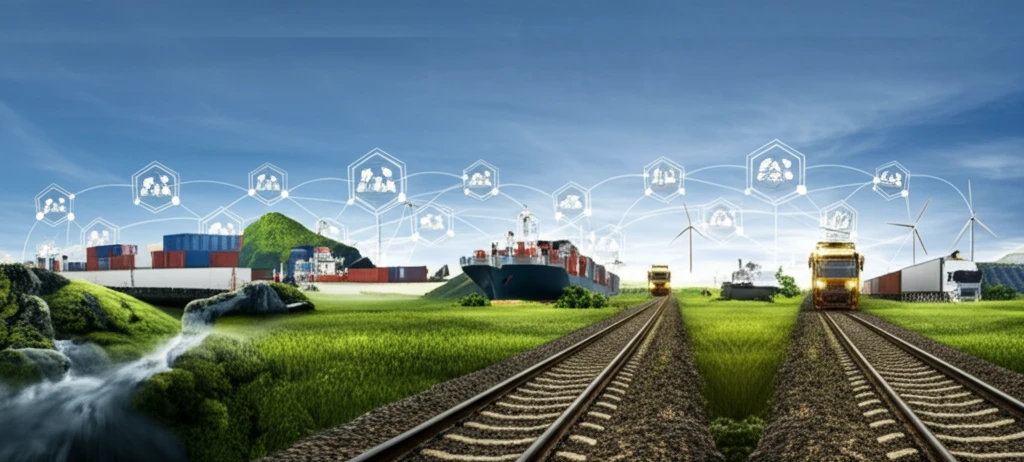
Futuristic, eco-friendly freight transport network with renewable energy-powered vehicles.

Greener Roads Ahead: How Strategic Network Design Can Decarbonize Freight Transport

"Discover how a new strategic network design model called STraM is helping nations like Norway achieve cost-effective decarbonization in their freight transport systems."


In the global push for a cleaner environment, transforming the energy sector is paramount. A significant part of this transformation involves decarbonizing freight transport, a critical step in meeting emission targets set by national governments. This process requires a fundamental shift from fossil fuels to renewable sources, and potentially from high-emission to lower-emission transport methods.

Governments are implementing various strategies to facilitate this shift, focusing on infrastructure investments such as building new roads and railways, establishing charging and filling stations, expanding terminal capacities, and improving existing infrastructure. Fiscal measures, including fuel pricing and road tolls, and regulatory measures like truck size and weight limits, can further drive these changes.

However, deciding on the best policies and infrastructure investments is challenging due to the uncertainties surrounding future developments. National governments face the critical question: Which policies and infrastructure investments will most effectively help achieve their decarbonization goals? To address this, decision support tools are essential.

STraM: Navigating Strategic Network Design for National Freight Decarbonization

Futuristic, eco-friendly freight transport network with renewable energy-powered vehicles.

To address the challenge of decarbonizing freight transport, a strategic network design model known as STraM (Strategic Transport Model) has been developed. STraM explicitly incorporates critical factors such as the development and adoption of new fuel technologies over time, inertia in transport fleets, and uncertainty surrounding future transport costs. This model offers a network design plan that includes infrastructure investments and decisions about fuel technology, all aimed at achieving cost-effective decarbonization of the freight transport system.

The STraM model is designed to be complementary to existing high-resolution national freight transport models. While it may sacrifice some operational detail, it provides a comprehensive framework that integrates key elements for strategic decision-making, like uncertainty over a long time horizon, while retaining a spatial representation of the freight transport network.

The STraM model offers several key advantages:
  • Multiple Strategic Time Periods: STraM accurately represents the evolution of elements such as new technologies, transport fleets, emission budgets, and investments over time.
  • Long-Term Uncertainty: The model explicitly addresses long-term uncertainty in cost and technology development, which is particularly relevant for decarbonizing freight transport where the future of renewable fuel technologies is uncertain.
  • Comprehensive Planning: The model outputs a set of infrastructure investments designed to minimize the total risk-corrected expected system cost and provides an assignment of transport demand to routes across the transportation network, specifying modes and fuels.
Based on the multimodal transport network design modeling framework STAN, STraM incorporates multiple strategic time periods and models long-term uncertainty in cost and technology development, aspects traditionally excluded from national freight transport models but crucial for strategic planning. By explicitly modeling multiple time periods, STraM accurately represents the development of new technologies, inertia in transport fleets, decreasing emission budgets, and investments over time.

Looking Forward: The Future of Sustainable Freight Transport

In conclusion, the STraM model offers a robust framework for achieving cost-effective decarbonization in national freight transport systems. By providing valuable insights into investment strategies, fuel adoption, and the impact of uncertainty, STraM can help governments and industry stakeholders make informed decisions that pave the way for a greener, more sustainable future. As the world continues to prioritize environmental stewardship, models like STraM will play a crucial role in shaping the trajectory of freight transport.

About this Article -

This article was crafted using a human-AI hybrid and collaborative approach. AI assisted our team with initial drafting, research insights, identifying key questions, and image generation. Our human editors guided topic selection, defined the angle, structured the content, ensured factual accuracy and relevance, refined the tone, and conducted thorough editing to deliver helpful, high-quality information.See our About page for more information.

This article is based on research published under:

DOI-LINK: https://doi.org/10.48550/arXiv.2304.14001,

Title: Stram: A Strategic Network Design Model For National Freight Transport Decarbonization

Subject: econ.gn q-fin.ec

Authors: Steffen Jaap Skotvoll Bakker, Jonas Martin, E. Ruben Van Beesten, Ingvild Synnøve Brynildsen, Anette Sandvig, Marit Siqveland, Antonia Golab

Published: 27-04-2023

Everything You Need To Know

1

What is the primary goal of the STraM model?

The primary goal of the STraM model is to achieve cost-effective decarbonization of freight transport systems. It provides a roadmap for infrastructure investments and fuel technology decisions to support a greener future. This includes guiding governments in making informed choices about policies and investments that will most effectively help them achieve their decarbonization goals.

2

How does the STraM model address uncertainty in long-term planning for freight transport decarbonization?

The STraM model explicitly addresses long-term uncertainty in cost and technology development. This is particularly relevant for decarbonizing freight transport, where the future of renewable fuel technologies is uncertain. By incorporating these uncertainties, STraM offers a robust framework for making strategic decisions that consider various possible future scenarios.

3

What are the key advantages of using the STraM model for strategic network design?

The STraM model has several key advantages. It accurately represents the evolution of elements such as new technologies, transport fleets, emission budgets, and investments over multiple strategic time periods. It also explicitly addresses long-term uncertainty in cost and technology development. Finally, it offers comprehensive planning by outputting a set of infrastructure investments designed to minimize the total risk-corrected expected system cost and provides an assignment of transport demand to routes across the transportation network, specifying modes and fuels.

4

How does STraM differ from traditional freight transport models?

STraM differs from traditional models by incorporating multiple strategic time periods and modeling long-term uncertainty in cost and technology development, aspects traditionally excluded from national freight transport models but crucial for strategic planning. It is designed to be complementary to existing high-resolution national freight transport models. While it may sacrifice some operational detail, it provides a comprehensive framework that integrates key elements for strategic decision-making, like uncertainty over a long time horizon, while retaining a spatial representation of the freight transport network. Based on the multimodal transport network design modeling framework STAN, STraM enhances the strategic planning capabilities.

5

What specific factors does STraM consider when planning for freight transport decarbonization?

STraM explicitly incorporates critical factors such as the development and adoption of new fuel technologies over time, inertia in transport fleets, and uncertainty surrounding future transport costs. The model considers the evolution of new technologies, transport fleets, emission budgets, and investments over multiple time periods. It also provides a comprehensive network design plan that includes infrastructure investments and decisions about fuel technology, all aimed at achieving cost-effective decarbonization of the freight transport system.

Newsletter Subscribe

Subscribe to get the latest articles and insights directly in your inbox.