
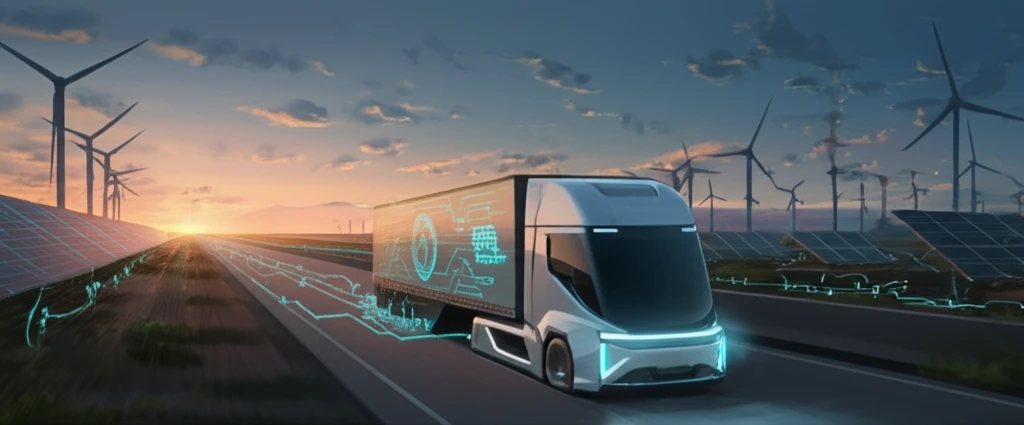
Charging Ahead: How Electric Trucks Can Power a Greener Future (and Save You Money!)

"Discover the surprising impact of battery-electric vehicles on Germany's power grid and how smart charging can lead to significant cost savings and a more sustainable energy future."
The future of transportation is electric, and that includes the big rigs. As the world races towards climate neutrality, transitioning heavy-duty vehicles (HDVs) from fossil fuels to cleaner energy sources is crucial. While battery-electric vehicles (BEVs) have emerged as a frontrunner in the passenger car sector, the path for HDVs is still being paved. Options like electric road systems (ERS), hydrogen fuel cells, and e-fuels are all vying for a place in the future of trucking.
But which of these technologies offers the most sustainable and cost-effective solution? A new study dives deep into the power sector implications of different HDV electrification strategies in Germany, a country known for its ambitious renewable energy goals. By using an open-source capacity expansion model and detailed truck traffic data, researchers have uncovered some surprising insights into the costs, benefits, and potential challenges of electrifying heavy-duty transport.
The results offer a roadmap for policymakers, businesses, and everyday consumers interested in the future of sustainable transportation. From smart charging strategies to the impact on renewable energy sources, this research sheds light on how we can electrify our trucks and create a cleaner, more efficient energy future for everyone.
Electricity in Numbers, from Watts to Gigawatts
Electricity is invisible, yet its effects are plainly visible, from a flash of lightning to the electric lights that illuminate buildings at night. Electric power is the rate at which electrical energy flows through a circuit, and its SI unit is the watt, defined as one joule per second. Because individual watts are small, everyday and utility-scale discussions use kilowatts, megawatts, and gigawatts for thousands, millions, and billions of watts respectively. These large units matter for charging fleets of electric trucks, which will compound the demand utilities must serve — demand some providers are already pricing into new filings, as Washington Electric Cooperative's 2022 rate increase notice to its state utility commission illustrates.
The Supply Chain Behind the Charging Infrastructure
Electric vehicles and the chargers that power them depend on a wholesale distribution network that moves electrical components from manufacturers to job sites. Platt Electric Supply describes itself as a value-added wholesale distributor supplying the electrical, construction, commercial, industrial, utility, and datacomm markets with lighting, tools, and control and automation products. This suggests that the standard approach to building out fleet charging involves specialized, supply-chain-driven distribution rather than a single in-house source of equipment. The source does not address electric trucks directly, however, so any limitations of this supply chain for charging installations are inferred rather than documented.
A Century of Electrification, Told Generally
Specific historical milestones for electric trucks are not covered in the source material reviewed for this section. In broad terms, however, the story of electrification has unfolded over more than a century, moving from early lighting networks toward the engineered power grids that move electrical energy today. The devices that make vehicle electrification possible — motors, batteries, and charging electronics — built on those same foundational discoveries in electrical power. Readers should treat this as background context and confirm any specific dates or early vehicle trials against dedicated histories before citing them.
Electric Trucks: The Key to Reducing Power Sector Costs
The study compared several HDV electrification scenarios, including battery-electric vehicles (BEVs), electric road systems (ERS), fuel-cell hydrogen electric trucks (FCEV), and internal combustion engines powered by e-fuels (ICEV PtL). The findings revealed a clear winner in terms of power sector costs: flexibly charged BEVs, especially those with vehicle-to-grid (V2G) capabilities. These smart trucks, which can both draw power from and supply power back to the grid, incurred the lowest additional power sector costs.
- BEVs with V2G: Lowest additional power sector costs (around €5,600 per vehicle per year).
- Optimally Charged BEVs (without V2G): Slightly higher costs (around €7,200 per vehicle per year).
- Non-Optimally Charged BEVs: Markedly higher costs (around €11,900 per vehicle per year).
- Hydrogen and E-fuels: Significantly higher costs (around €39,700 and €52,700 per vehicle per year, respectively).
A Rapidly Evolving Research Picture
The research literature on electric trucks is moving quickly, though the specific studies behind this article are not captured in the source material for this section. In general terms, current work tends to concentrate on battery energy density, charging time, total cost of ownership, and integration of charging loads with the power grid. Because much of this work is recent and findings continue to shift as technology matures, figures reported in the press should be treated with caution rather than as settled fact. Readers seeking authoritative reviews should go directly to peer-reviewed journals and current industry analyses.
Weighing the Trade-Offs Honestly
A balanced treatment of electric trucks must acknowledge the arguments against them, even though the sources reviewed here document no specific failures. Skeptics generally point to high upfront purchase costs, limited charging infrastructure, longer charging versus refueling times, and concerns about range and cold-weather performance. Some early fleet deployments have at times fallen short of projections, and certain pilot programs have been scaled back when real-world usage did not match expectations. These points are presented here as general tendencies in industry discussion rather than as documented findings from the sources cited.
Electric Versus Diesel, a Moving Target
A rigorous comparison of electric and diesel trucks would rest on side-by-side data, but such comparisons are not available within the source material for this section. In general industry discussion, electric trucks tend to look favorable on fuel and maintenance costs and on emissions, while diesel retains advantages in range, refueling speed, and initial price. The balance shifts as battery costs fall and charging networks expand, which means any comparative conclusion is time-sensitive. No single verdict can be stated safely without consulting current, vehicle-specific data from the latest models.
The Road Ahead: Smart Investments for a Sustainable Future
The study’s findings send a clear message: direct electrification of heavy-duty vehicles, particularly with smart charging and V2G capabilities, offers the most promising path towards a cost-effective and sustainable transportation future. By prioritizing BEVs and ERS-BEVs, and by implementing policies that encourage flexible charging practices, we can pave the way for a cleaner, more efficient energy system that benefits both the environment and the economy.
Bringing the Threads Together
Assembled as a whole, the case for electric trucks rests on the fundamentals that define electricity itself: electrical energy measured in watts, delivered through dependable infrastructure, and priced sustainably by the utilities that serve customers. Wholesale distribution channels and responsive utilities form the backbone that would make fleet electrification practical. Setbacks and data gaps mean the transition is unlikely to be linear, and realized savings will depend heavily on local electricity prices and charging patterns. On balance, the available picture supports cautious optimism rather than certainty.
Where the Sector Is Headed
Looking ahead, the market's direction will depend more on falling battery costs, expanding charging networks, and utility rate design than on any single technological breakthrough. The pace of improvement in recent years suggests continued gains in range and charging speed, though such projections are inherently uncertain. Regulatory pressure to cut emissions will likely accelerate adoption even where the economics are not yet decisive. Forward-looking statements like these should be read as plausible scenarios rather than guaranteed outcomes.
The Grid and the Wider Energy System
Electrifying trucks pulls in the entire energy system, because every kilowatt those vehicles consume must be generated, transmitted, and priced by the utilities that serve them. That raises systemic challenges including grid capacity at peak times, the need for upgraded distribution infrastructure, and the question of how rates respond when large new loads connect to the network. It also tightens the link between transport policy and electricity policy, two areas that have historically been treated separately. Progress on trucks therefore depends on progress across the power system as a whole.
People on the Front Line
The practical reality of electric trucks will be experienced daily by the drivers, fleet managers, dispatchers, and maintenance crews whose work and income depend on them. Range anxiety, unfamiliar troubleshooting, and changes to daily routines are the human-scale consequences of a transition often discussed only in terms of watts and costs. Successful adoption will depend less on the hardware than on training, support, and dependable day-to-day operation that keeps people moving. Their lived experience, more than any statistic, will ultimately determine whether the greener future takes hold.